
What the Average Welder Actually Earns

How Experience Level Changes Your Pay
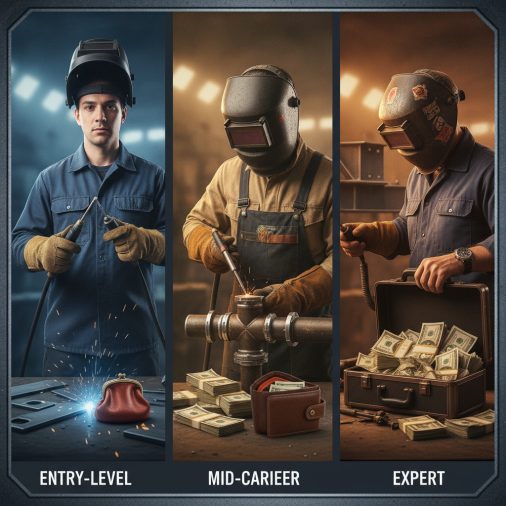
| Experience Level | Typical Annual Salary | Hourly Equivalent |
|---|---|---|
| Entry-Level (0–2 years) | $35,000–$42,000 | $17–$20/hr |
| Mid-Level (3–7 years) | $47,000–$60,000 | $23–$29/hr |
| Senior/Skilled (8+ years) | $62,000–$80,000 | $30–$38/hr |
| Specialized/Certified | $75,000–$110,000+ | $36–$55+/hr |
The Welding Specializations That Pay the Most
Not all welding jobs are equal when it comes to income. Certain trades command significantly higher rates due to skill demands, physical risk, or supply constraints. Underwater Welding consistently ranks as the highest-paid welding specialty. Commercial divers who weld offshore oil rigs or underwater pipelines can earn $100,000–$300,000 per year, though the work is seasonal and physically demanding. Pipeline Welding is another top earner. Certified pipeline welders working on cross-country oil and gas lines typically earn $70,000–$100,000+. Most travel extensively and work long hours during project seasons. TIG Welding (Tungsten Inert Gas) in aerospace, medical device manufacturing, or precision fabrication is also well-compensated, often in the $55,000–$85,000 range. If you’re curious how TIG compares to other methods, understanding TIG and MIG welding differences can help you decide which path to pursue. Structural and Ironworker Welders working on bridges, high-rises, and infrastructure projects earn $55,000–$75,000, often with union benefits that add substantial value. Boilermakers and Pressure Vessel Welders generally earn $60,000–$80,000 due to the strict code requirements and certification demands.How Location Affects Welding Wages
Geography plays a major role in what welders earn. States with active oil and gas industries, heavy manufacturing, or major construction sectors pay considerably more than states with lower industrial activity. Top-paying states for welders: – Alaska — often $65,000–$85,000 median due to pipeline and remote site work – North Dakota — driven by oil field activity – Hawaii — higher cost of living pushes wages up – Washington — strong aerospace and shipbuilding sectors – Texas — volume of pipeline and petrochemical work In contrast, welders in rural Midwest or Southeast markets may see wages closer to the national median or below it, despite similar skill levels. Urban areas generally pay more than rural areas, but higher living costs often offset the difference.Certifications That Increase Welding Income
Credentials directly translate to earning power in welding. AWS (American Welding Society) certifications are the industry standard, and employers pay a measurable premium for certified welders. Certifications that meaningfully increase pay: – AWS Certified Welder (CW) — Foundation credential, often required for structural work – AWS Certified Welding Inspector (CWI) — Moves welders into inspection and oversight roles, typically $70,000–$95,000 – 6G Pipe Certification — All-position pipe welding, highly valued in oil and gas – D1.1 Structural Certification — Required for bridge and building work – ASME Section IX — Pressure vessel code, required in power plants and refineries A welder without certifications working alongside a certified peer may earn $5–$15 per hour less for the same type of work.Union vs. Non-Union Welding Wages
Union membership significantly affects total compensation, though base wages tell only part of the story. Union welders typically earn 20–30% more in total compensation when benefits, pension, and overtime structures are factored in. Unions like the United Association of Plumbers and Pipefitters (UA) and the International Brotherhood of Boilermakers represent large numbers of welders with strong contract wages. Non-union welders often have more flexibility, including contract or freelance arrangements. Skilled non-union welders in high-demand sectors can match or exceed union base wages, but lack the pension and healthcare benefits. In practice, union jobs tend to be more stable and better compensated long-term, while non-union and contract roles offer higher ceilings but less consistency.Self-Employed and Contract Welding Income
Many experienced welders eventually go independent. Freelance welders and contract specialists working directly for fabrication shops, construction companies, or agricultural clients often charge $50–$100+ per hour depending on specialization. Running a mobile welding business introduces overhead — insurance, equipment, travel costs, licensing — but the earning ceiling is higher than most salaried positions. A mobile welder who is comfortable with MIG welding across multiple applications can take on a wide variety of jobs, from farm equipment repairs to custom fabrication, keeping utilization high. Equipment investment matters here — having a reliable, portable multi-process welder like the Lincoln Electric Power MIG 210 MP allows self-employed welders to handle a broader range of materials and client requests without hauling multiple machines. Self-employment income varies widely. Some mobile welders earn $40,000–$60,000 working part-time. Others running full operations with employees reach $150,000+ annually.FAQ
What is the starting salary for a welder with no experience? Most entry-level welders with trade school or community college training start between $35,000 and $42,000 annually. Without any formal training, starting wages can be lower, often in the $15–$17 per hour range working as a welding helper or assistant. Completing even a basic certification significantly improves starting offers. Can welders make six figures? Yes, though it typically requires specialization, certification, or self-employment. Underwater welders, pipeline welders with 6G certification, certified welding inspectors, and experienced contract welders regularly earn $100,000 or more. Location and willingness to travel for project work are major factors in reaching that income level. Is welding a good career financially? Welding offers solid financial stability without requiring a four-year college degree. With the right certifications and specialization, the earning trajectory is competitive with many fields requiring significantly more education. The trade also has consistent demand, and skilled welders are rarely unemployed for long. How does MIG welding skill level affect income compared to TIG? MIG welding is generally considered more accessible to learn, which means the labor pool is larger and wages are more moderate. MIG welding has a shorter learning curve, while TIG welding demands higher precision and takes longer to master. As a result, skilled TIG welders — especially in aerospace or medical manufacturing — typically command higher rates than general MIG welders. What industries pay welders the most? The highest-paying industries for welders include oil and gas extraction, aerospace manufacturing, shipbuilding, power generation, and industrial construction. These sectors require certified, experienced welders who can meet strict quality codes, which drives compensation higher than general manufacturing or repair work. How much do welding inspectors earn compared to production welders? Certified Welding Inspectors (CWIs) typically earn $70,000–$95,000 annually, often exceeding what production welders make. The CWI credential requires passing a rigorous AWS examination and demonstrating welding experience. Many inspectors started as production welders and transitioned into inspection after 5–10 years of hands-on experience. Does working overtime significantly increase welder income? It can. Many welding jobs — particularly in construction, pipeline, and shutdown maintenance — offer substantial overtime. A welder earning $25/hr base who regularly works 50–60 hour weeks during active project seasons can effectively double their standard salary. This is a major reason why annual income figures for welders often exceed what an hourly rate alone suggests.Welding income is genuinely variable, but the ceiling is higher than most people expect. The welders who earn the most aren’t necessarily the fastest — they’re the ones who built verified credentials, stayed open to specialization, and weren’t afraid to move where the work was. If you’re early in your welding career, focusing on certification first and geographic flexibility second is the most reliable path toward the higher end of those numbers.


