
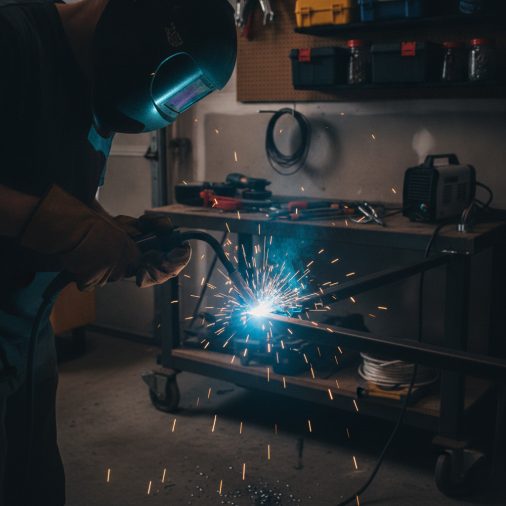
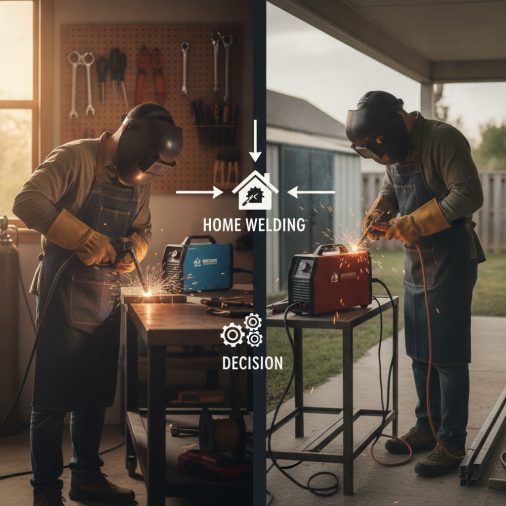
Which Welding Process Makes the Most Sense at Home
Power Requirements and Machine Selection
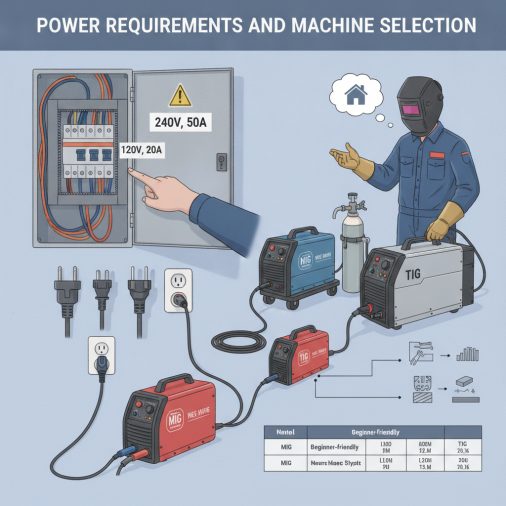
| Machine Type | Input Power | Typical Output | Best For |
|---|---|---|---|
| 120V / Single-Phase | Standard household outlet | Up to ~140A | Sheet metal, light fab, thin plate |
| 240V / Single-Phase | Dedicated circuit | Up to ~220A+ | Thicker plate, heavier structural work |
| Multi-process (120/240V) | Dual voltage | Variable | Versatility across projects |
Setting Up a Safe Home Welding Space
Safety in a home welding environment deserves serious attention. A garage or dedicated shed is ideal. An open basement can work but requires excellent ventilation planning. Fire Safety – Clear combustibles at least 35 feet from your work area, or use welding curtains and fireproof blankets – Keep a fire extinguisher (ABC-rated, minimum 5 lb) within arm’s reach – Check for hidden combustibles — insulation, wood framing, fuel containers nearby Ventilation Welding fumes are genuinely hazardous. Even a short session produces metal oxide fumes, ozone, and particulate matter. Open garage doors aren’t always enough. A box fan exhausting air out of the space, combined with a fresh air intake, creates real airflow. For enclosed spaces, a dedicated fume extractor positioned near the arc provides meaningful protection. Electrical Avoid extension cords for 240V machines. Run a proper circuit with correct gauge wire. For 120V machines, use only heavy-duty extension cords rated for the amperage if absolutely necessary, and keep them as short as possible. For a more complete look at space planning and equipment placement, the home welding setup guide for beginners covers workspace organization in practical terms.Essential Safety Equipment
Cutting corners on PPE is how people get hurt. The minimum gear for home welding: – Auto-darkening welding helmet — Shade 9–13 for MIG/stick, adjustable shade is worth the extra cost – Welding gloves — Heavy leather for stick and flux core, lighter TIG gloves for MIG – Flame-resistant jacket or sleeves — UV radiation from the arc causes sunburn fast, even indirectly – Safety glasses — Worn under the helmet for grinding and slag chipping – Steel-toed boots — Molten spatter falls downward – Ear protection — Grinding and plasma cutting generate significant noise Synthetic clothing melts. Natural fibers like cotton or wool are far safer near an arc.What Materials Can You Weld at Home
Mild steel is the easiest and most forgiving. It’s widely available, affordable, and welds well with MIG, flux core, or stick. Stainless steel is doable at home but requires more attention to heat control, shielding gas selection, and surface contamination. The process for welding stainless steel at home differs enough from mild steel that it’s worth reviewing before your first attempt. Aluminum is achievable with MIG welding but requires a spool gun or push-pull system, pure argon shielding gas, and clean preparation. It’s not the ideal starting point for a brand-new welder. Cast iron requires preheat, slow cooling, and specific electrodes. Possible but demanding. Start with mild steel. Build technique, then expand to other materials.Common Beginner Mistakes Worth Avoiding
Most problems new home welders encounter come from the same handful of errors: Moving too fast or too slow Moving too fast produces a narrow, weak bead. Too slow causes excessive buildup and burn-through on thinner material. A proper bead width is roughly 2–3 times the wire diameter for MIG. Wrong wire or electrode for the material Using the wrong filler causes poor fusion and weak joints. ER70S-6 is the standard all-purpose MIG wire for mild steel. Flux core wire polarity must match the wire manufacturer’s recommendation — most flux core runs DCEN (electrode negative), opposite of solid MIG wire. Skipping joint prep Mill scale, paint, rust, and oil all contaminate the weld. A wire brush and angle grinder get the joint area clean and flat. A few minutes of prep prevents hours of rework. Inadequate shielding gas coverage Wind or drafts can blow shielding gas away from the puddle, causing porosity. Welding outdoors with gas-shielded MIG often means either moving indoors or switching to flux core. If you’re using a gas-shielded setup, understanding how MIG shielding gas works helps you troubleshoot contamination issues quickly. Ignoring the ground clamp A poor ground connection creates arc instability and spatter. Clamp directly to clean metal as close to the weld as practical.Getting Started: The Practical First Steps
1. Choose your process — MIG flux core on 120V covers most beginner home projects without requiring a gas cylinder 2. Set up your space — Ventilation, fire safety, electrical supply sorted before the machine arrives 3. Get your PPE in place — Helmet, gloves, jacket before the first arc 4. Start with scrap mild steel — Practice flat beads before attempting actual joints 5. Learn to read your bead — Width, height, and penetration tell you what to adjust 6. Run test joints before production welds — Always run a test bead on matching scrap when adjusting settings The full beginner guide to starting welding at home walks through equipment selection and first-session setup in much more detail.Realistic Project Ideas for Home Welders
Once you’re comfortable running beads on flat stock, these projects build practical skill: – Metal shelving and storage racks — Simple butt and T-joints, great for learning consistency – Garden furniture and gates — Introduces angle cuts and longer bead runs – Trailer and hitch repairs — Practical, high-stakes welds that teach you to check penetration – Workbench frames — Square layouts teach fitment and distortion control – Automotive rust repair — Thin sheet metal challenges, but rewarding results Avoid structural load-bearing or pressure vessel work until your technique is genuinely solid and tested.FAQ
What is the easiest welding process to learn at home? MIG welding with flux core wire is generally the easiest entry point for home use. The wire feeds automatically, there’s no gas cylinder to manage, and the machine does much of the work. Most people can run acceptable beads within a few practice sessions on flat mild steel. It’s forgiving enough to build confidence while still teaching real technique. Do I need a special electrical outlet for home welding? A 120V machine plugs into any standard 20-amp household outlet, though a dedicated circuit is preferable to avoid tripping breakers. A 240V machine requires a dedicated 240V outlet, typically a 30–50 amp circuit installed by an electrician. Running a 240V machine on an improper circuit is a fire and equipment risk — don’t skip the dedicated circuit. Is home welding dangerous without professional training? It carries real risks — UV radiation, fumes, fire, and electrical hazards — but these are manageable with proper PPE, ventilation, and fire safety measures. Many competent home welders are entirely self-taught using online resources and practice. Taking a short community college or makerspace welding course accelerates the learning curve and builds safe habits from the start. Can I weld aluminum with a basic home MIG welder? Some 120V MIG machines can weld aluminum, but it typically requires a spool gun attachment and 100% argon shielding gas. Aluminum is sticky, prone to burn-through, and feeds poorly through standard MIG guns. It’s achievable but not the best starting project. Building solid technique on mild steel first makes aluminum work significantly less frustrating. How much does it cost to set up a basic home welding station? A basic flux core MIG setup — machine, helmet, gloves, clamps, and angle grinder — can be assembled for $300–$600. A more capable 240V MIG setup with gas cylinder, regulator, and quality PPE typically runs $800–$1,500 depending on machine selection and existing tools. The ongoing cost is consumables: wire, contact tips, and shielding gas if applicable. What thickness of metal can a 120V welder handle? Most 120V MIG machines are rated for up to 1/4-inch mild steel in a single pass and can handle 3/8-inch with multiple passes and proper joint prep. Flux core wire generally pushes slightly deeper penetration than solid MIG wire at the same amperage. For consistent work on 3/8-inch and thicker, a 240V machine produces cleaner, more reliable results. Do I need a welding license to weld at home? For personal use on your own property, no license or certification is required in most jurisdictions. Certifications become relevant if you’re welding structural, pressure vessel, or commercial work, or if you’re welding for hire. Local building codes may apply if welded structures are part of permitted construction, so check local regulations for specific projects.Home welding is a practical, learnable skill that pays off quickly once you have the right setup and safe habits in place. Start with a process and machine matched to your actual projects, invest in proper PPE and ventilation from day one, and practice on scrap before committing to real work. The technique develops faster than most beginners expect — and the ability to repair and build metal work at home is genuinely useful for the long term.


