
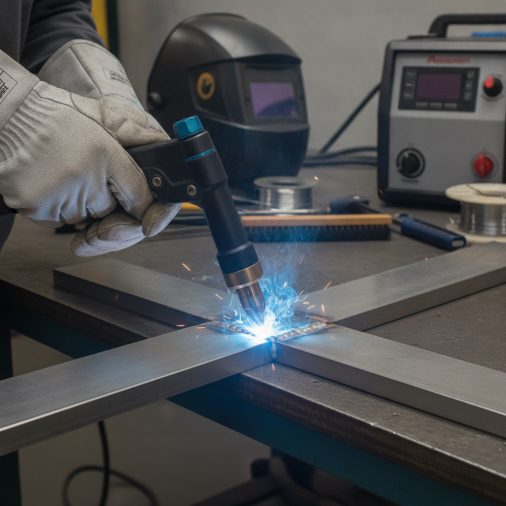
Why Spool Guns Are the Standard for Aluminum MIG Welding
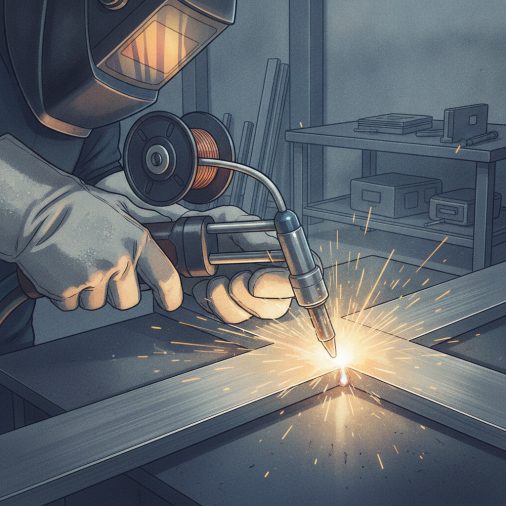
AWS D1.2: The Primary Certification Standard for Aluminum Welding
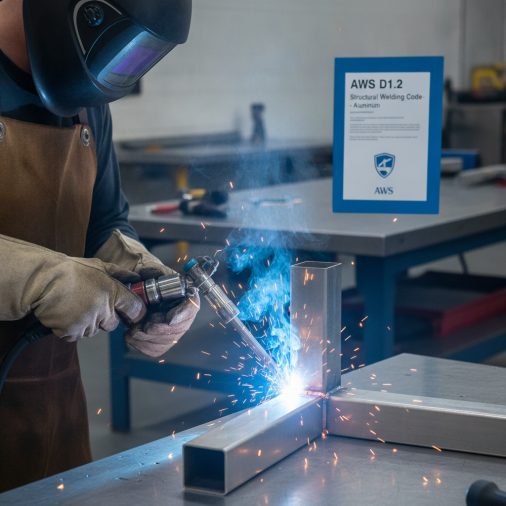
AWS B2.1 and Other Applicable Standards
Beyond D1.2, AWS B2.1 (Specification for Welding Procedure and Performance Qualification) is another framework that covers aluminum GMAW performance qualifications. It’s used across a broader range of industries and is sometimes preferred by manufacturers or contractors who work across multiple material types. Other standards that may apply depending on your field:| Standard | Industry Application |
|---|---|
| AWS D1.2 | Structural aluminum fabrication |
| AWS B2.1 | General manufacturing and multi-material shops |
| AWS D3.6 | Underwater welding (including aluminum where applicable) |
| MIL-STD-2219 | Military aluminum welding |
| AWS D1.6 | Stainless steel (not aluminum, but sometimes confused) |
| ASME Section IX | Pressure vessels and piping, including aluminum alloys |
How Spool Gun Use Affects Your Certification Test
A common question is whether using a spool gun during your certification test locks you into using only a spool gun on the job, or vice versa. The answer is nuanced. Since spool gun and push-pull GMAW are both classified as GMAW in AWS standards, a qualification obtained using a spool gun is generally recognized as valid for GMAW aluminum welding regardless of the wire delivery method. The certification is tied to the process, position, joint type, and material — not the specific gun configuration. That said, employers in specialized industries sometimes specify the exact equipment setup in their welding procedure specification (WPS). If a WPS calls out a particular wire feed configuration, you’d be expected to follow it. Always confirm with your employer or the applicable inspector what the WPS specifies before testing.What the Certification Test Actually Involves
If you’re preparing for an aluminum GMAW certification, here’s what to expect in practical terms. Before the test: – The shop or testing facility will have a Welding Procedure Specification (WPS) already qualified. You follow the WPS — you’re not developing the procedure yourself during a performance test. – You’ll be told the base metal alloy, filler wire (commonly 4043 or 5356), shielding gas (typically 100% argon), material thickness, and position. – Practice on scrap with the same settings before your official test plate. During the test: – Weld the specified test coupon in the required position and joint configuration. – A Certified Welding Inspector (CWI) or equivalent will observe and document your work. – The weld must meet visual acceptance criteria (no porosity, cracks, underfill, or excessive spatter visible). After the test: – The coupon is typically bend tested or radiographed. – Results are documented on a Welder Performance Qualification Record (WPQR). – If you pass, you receive a certificate and a documented qualification range. Understanding aluminum MIG wire speed and voltage settings before your test is essential — running the wrong parameters on a test plate is one of the most preventable reasons people fail.Where to Get Certified
Several organizations and facilities offer aluminum welding certification testing: – AWS Accredited Testing Facilities (ATFs): These are formally accredited sites where you can test for AWS certifications. A list is available on the AWS website. – Community colleges and vocational schools: Many offer both instruction and certification testing on-site, including aluminum GMAW. – Employer-administered qualification: Many fabrication shops administer their own in-house welder performance qualifications following AWS or ASME standards. These are valid for that employer’s projects but may not be transferable. – Union training programs: If you’re affiliated with a welding union such as the International Association of Bridge, Structural, Ornamental and Reinforcing Iron Workers, certification is often administered through apprenticeship or journeyman programs. In practice, the most portable credentials are those tested at an AWS ATF under a widely referenced code like D1.2, since those documents are recognized by multiple employers and inspectors.Shielding Gas Requirements During Certification
This detail trips up some candidates. Aluminum GMAW — whether spool gun or push-pull — requires 100% argon as the shielding gas. Mixed gases that work fine on steel are not appropriate for aluminum and will affect weld quality and test results. Your WPS will specify the gas type and flow rate, and you must follow it exactly during the test. Deviating from the WPS, even with good intentions, is grounds for failing or voiding the test. For a deeper look at why gas selection matters on aluminum, the topic of choosing the right gas for aluminum MIG welding is worth reviewing before your test date.Practical Preparation Tips
Field experience consistently shows that welders who struggle on aluminum certification tests have the same preventable issues: – Travel speed too slow: Aluminum transfers heat quickly and has a narrow window before burn-through or excessive melt-through occurs. Practice maintaining a steady, slightly faster travel speed than you’d use on steel. – Wire speed and voltage mismatch: Aluminum requires a different machine setup than steel. Dialing in your parameters before the test day is non-negotiable. – Contaminated base metal: Aluminum oxidizes rapidly. Clean the base metal with a dedicated stainless steel wire brush and wipe with acetone immediately before welding. – Inconsistent gun angle: Aluminum benefits from a consistent push angle (forehand technique) of roughly 5–15 degrees. Dragging creates porosity and poor fusion. Welders who have practiced specifically with a spool gun on aluminum scrap before the test almost always perform better than those who switch to it cold on test day.FAQ
Does a spool gun certification transfer between employers? Portable certifications like AWS D1.2 performance qualifications are generally transferable as long as the new employer’s WPS covers the same variables (process, position, material, thickness). Employer-specific in-house qualifications typically do not transfer. Always bring your WPQR documentation when changing jobs. Can I get certified for aluminum MIG welding without any formal training? Technically yes — certification is based on performance, not classroom hours. But attempting a test without proper aluminum GMAW practice is rarely successful. Community college courses and AWS-affiliated programs are practical routes for building the required skills before attempting a formal qualification. How long does an AWS D1.2 aluminum welder qualification stay valid? Under AWS D1.2, your qualification remains in effect as long as you have been actively welding in that process within the past 6 months. If you stop welding aluminum GMAW for more than 6 months, re-qualification is typically required. Your employer or a CWI may also require periodic re-testing at their discretion. Is a spool gun certification different from a push-pull gun certification for aluminum? Not under most AWS standards. Both are classified as GMAW. If you test with one and your employer uses the other, the qualification is generally still valid unless the WPS specifies otherwise. Confirm with the applicable CWI or your employer’s welding engineer if you’re unsure. What aluminum alloys are covered by AWS D1.2 certification? AWS D1.2 groups aluminum alloys by base metal groupings. Qualifying on one alloy within a group may qualify you for others in the same group. Common structural alloys like 6061-T6 are frequently used in testing. The specific alloys qualified are listed on your WPQR documentation. Do I need a separate certification for each welding position? Yes. Certifying in a flat position (1G) does not automatically qualify you for vertical or overhead positions under AWS D1.2. Each position must be tested separately, though qualifying at a higher position (like 3G vertical) typically qualifies you for lower positions as well, depending on the code variables. What filler wire is typically used during an aluminum spool gun certification test? The two most common filler wires for aluminum GMAW are ER4043 and ER5356. Which one is used in your test depends on the WPS. ER4043 is smoother and easier to weld but lower strength; ER5356 is stronger and more suitable for structural applications. Your WPS will specify which is required.Aluminum spool gun certification is a real, obtainable credential — most commonly through AWS D1.2 or B2.1 performance qualification testing. The process is practical rather than theoretical: you demonstrate your skill on a test coupon, and the weld quality determines your qualification. Preparation, clean base metal, correct parameters, and consistent technique on aluminum are what separate a passed test from a failed one.


