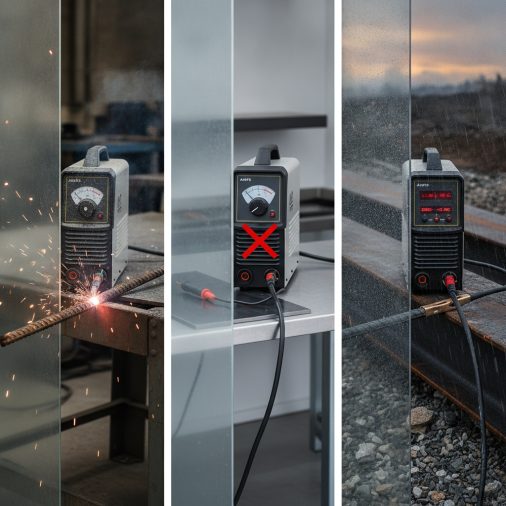
If your AC stick welder produces a smooth arc at some amperage settings but suddenly becomes erratic, stubborn to start, or completely dead at others, you are dealing with what welders commonly call dead spots.
Dead spots on an AC arc welder are specific amperage or tap settings where the arc becomes extremely difficult to start, unstable during welding, or impossible to sustain. They occur most often on transformer-based machines with stepped tap switches, where the gap between one tap and the next leaves certain electrodes without a stable operating range. The fix usually involves switching electrode diameter, changing electrode type, or adjusting the specific tap setting rather than assuming the machine is faulty.
What a Dead Spot Actually Means
Image source: alphazetaent.com
A dead spot is not always a complete absence of output. The term describes any point on the amperage or tap selector where the arc quality drops sharply compared to neighboring settings.
On a tap-style transformer welder, the output jumps in fixed steps — for example, from 90 A straight to 130 A with nothing in between. If a particular electrode needs 110 A to run cleanly, that gap becomes a functional dead spot for that rod size.
On older continuously variable AC transformers using a moving shunt or reactor core, a dead spot can also appear as a mechanical wear point where the core physically sticks or the magnetic path becomes irregular.
Why AC Welders Are More Prone to Dead Spots Than DC Machines
Image source: youtube.com
AC current reverses polarity 50 or 60 times per second depending on your local supply frequency. Each reversal briefly passes through zero, and that zero crossing is where the arc must re-ignite to continue.
At settings where the open-circuit voltage is marginal, the arc can fail to re-ignite on each cycle, causing a sputtering, crackling, or completely extinguished arc. DC machines maintain a continuous current flow in one direction, so they do not face this re-ignition challenge at every cycle.
This is one reason AC welders historically require electrodes formulated with arc-stabilizing flux coatings — such as E6013 or E7014 — to cope with the constant zero crossing. Understanding how electrode choice interacts with machine settings is a key part of diagnosing dead spots.
Types of AC Arc Welders and How Each Creates Dead Spots
These are among the most common AC welders found in home workshops, farm shops, and light fabrication. Output is selected by rotating or sliding a switch that connects different coil taps, producing fixed amperage steps.
Dead spots appear here as gaps between taps. If the tap steps are spaced widely — say 70 A, 100 A, 140 A, 180 A — there is no setting that reliably runs a 3.2 mm (1/8 in) electrode at its ideal mid-range of around 90–110 A. One tap may be slightly low, the next too hot, and neither produces a stable arc with every electrode.
Continuously Variable Shunt-Reactor Welders
These machines use a movable iron core or shunt inside the transformer. Turning the amperage dial physically repositions the core, changing the magnetic leakage and therefore the output current.
Dead spots occur here when the core sticks at a worn or corroded point, when the lead screw mechanism binds, or when there is a flat spot in the magnetic path from physical damage. The dead zone is mechanical rather than a fixed electrical gap, and it may shift position over time as wear continues.
Inverter-Based AC Welders
Modern inverter machines convert input power electronically and can output AC with much finer amperage control than older transformer designs. Dead spots are far less common on inverter machines because the output is digitally controlled and not dependent on physical tap positions.
When an inverter AC welder does exhibit a dead zone, the cause is more likely a failing output stage, a faulty control board, or an incompatible electrode rather than a design limitation.
Common Causes of Dead Spots at Different Settings
Image source: en.wikipedia.org
Understanding the root cause saves time and prevents replacing parts that are not actually defective.
– Tap gap too wide for the electrode in use. The available amperage steps straddle the electrode’s operating range without hitting the practical midpoint.
– Electrode type incompatible with AC. Certain electrodes — including E6010 and many low-hydrogen E7018 rods on basic machines — require higher open-circuit voltage or DC polarity to sustain a stable arc. They may appear to cause a dead spot on AC even when the machine is working correctly.
– Low open-circuit voltage. Budget AC transformers sometimes have open-circuit voltages below 50 V. At low-amperage settings, this may not be enough to re-ignite the arc on each AC cycle.
– Worn or sticking shunt mechanism. On continuously variable machines, physical binding in the core-adjustment mechanism creates zones where the amperage cannot be set accurately.
– Poor input voltage. Running a welder from a generator with unstable output, or from an undersized circuit with significant voltage drop, can push a marginal setting into a dead zone.
– Dirty or corroded tap contacts. Oxidized contacts on the tap switch increase resistance and reduce available output at that step, effectively shifting where a dead spot falls.
For a broader look at why a stick welder may refuse to arc at all, the troubleshooting steps covered in this stick welder not arcing guide are worth reviewing alongside the dead spot diagnosis.
How to Identify Which Setting Is the Problem
Work through this sequence before assuming the machine needs repair.
1. Strike an arc at multiple tap settings using a known-good electrode on clean mild steel. Note which settings produce a smooth arc and which feel erratic or dead.
2. Try a different electrode type at the same setting. If E6013 arcs cleanly where E6010 fails, the dead spot is electrode-related rather than mechanical.
3. Try a different electrode diameter at the same tap. A smaller rod requires less amperage, so it may fall within a usable range on a tap that was too hot for the larger diameter.
4. Check the tap switch contacts by inspecting for pitting, discoloration, or loose connections. Clean corroded contacts carefully with an appropriate contact cleaner or fine emery cloth, following any guidance in your machine’s service manual.
5. Test with a stable power source if you have been running from a generator or extension cord. Voltage drop across a long or undersized cable can worsen marginal settings considerably.
Electrode Choice and Its Effect on Dead Spots
Electrode selection has a larger effect on dead spots than many welders expect. Matching the rod to the machine’s AC characteristics is often the fastest fix.
Electrode
AC Suitability
Notes
E6013
Excellent
Designed for AC; stabilizes arc at lower open-circuit voltages
E7014
Very good
Iron powder coating aids arc stability on AC
E6011
Good
AC-capable alternative to E6010; needs adequate OCV
E6010
Poor on many AC machines
Needs DC and higher OCV; may create apparent dead spots on AC
E7018
Variable
Runs on AC with sufficient OCV; some budget machines struggle
E6012
Good
Performs reasonably on AC; tolerant of variable conditions
For a complete breakdown of rod classifications and what they mean for machine compatibility, the guide to different types of welding rods covers electrode selection in practical detail.
If you work regularly with varied materials and settings, keeping a stick welder settings reference chart nearby helps match amperage ranges to electrode diameters and material thickness before you even strike the first arc.
Practical Workarounds When a Dead Spot Cannot Be Eliminated
Not every older AC transformer can be repaired to eliminate every gap in its tap range. These practical approaches help work around fixed limitations.
Use the next higher tap and reduce travel speed. Moving slightly faster or adjusting arc length compensates partially for a tap that runs a little hot. This works better on thicker materials where there is less burn-through risk.
Choose a smaller electrode diameter. Dropping from 3.2 mm to 2.5 mm (1/8 in to 3/32 in) reduces the required amperage and may land comfortably on a tap that was marginal with the larger rod. Guidance on matching amperage to metal thickness is available in this stick welding amperage and metal thickness reference.
Switch to an electrode designed for AC stability. If you are trying to run an E6010 on an AC machine with limited open-circuit voltage, moving to E6011 or E6013 typically resolves what appears to be a dead spot.
Service the tap switch. On machines with corroded or pitted contacts, cleaning or having an electrician replace the switch contacts can restore proper output levels and shift the dead zone entirely.
When the Dead Spot Indicates a Fault Requiring Repair
Some dead spots signal an actual fault rather than a design limitation or electrode mismatch.
– The dead zone appeared suddenly on a machine that previously worked correctly at that setting.
– The arc is dead or erratic across a wide range of settings rather than one specific tap.
– You smell burning insulation or notice unusual heat from the machine body.
– The tap switch makes a burning or crackling sound.
– Visual inspection reveals burn marks, melted plastic, or discolored contacts.
Do not attempt to repair transformer internals or high-voltage components unless you have appropriate electrical training. Transformer welders store lethal voltages even when unplugged until capacitors discharge. Have the machine inspected by a qualified technician or the manufacturer’s service center.
Safety Considerations
Always wear appropriate eye protection — a proper welding helmet with the correct shade for the amperage range you are using. Leather welding gloves and flame-resistant clothing are necessary whenever the machine is powered and an electrode is fitted.
When troubleshooting dead spots, keep the electrode holder away from grounded metal while the machine is energized. An accidental contact between the electrode and the work or the machine casing can cause a flash or shock.
Ensure the work area is free of flammable materials, and keep adequate ventilation to manage welding fume regardless of the amperage level being tested. Even short test beads produce fume.
Frequently Asked Questions
Why does my AC welder arc well on one setting but not the next?
Tap-switch AC welders produce output in fixed steps. If the gap between two taps is wide, certain electrode sizes and types fall outside a stable operating range on one or both adjacent settings. This is a design characteristic of the machine rather than a fault. Switching to a different electrode diameter or a more AC-compatible rod type often resolves it.
Can using the wrong electrode cause a dead spot on an AC welder?
Yes. Electrodes such as E6010 require DC polarity and relatively high open-circuit voltage. Running them on a standard AC transformer, especially at lower amperage settings, can produce an arc that sputters or fails entirely. The machine may appear to have a dead spot when the electrode itself is simply incompatible with AC output.
Does a dead spot on an AC welder mean the machine is broken?
Not necessarily. Dead spots caused by wide tap gaps or electrode incompatibility are common on older and budget transformer welders and do not indicate a fault. A dead spot that appears suddenly across multiple settings, or that is accompanied by burning smells or unusual heat, warrants inspection by a qualified technician.
Will a longer extension cord make dead spots worse?
Yes. A long or undersized extension cord causes voltage drop, which reduces the open-circuit voltage and usable output at the machine. Settings that were already marginal may become dead zones when power is supplied through a restrictive cable. Use the shortest, heaviest-gauge extension cord practical for your setup.
Can cleaning the tap switch contacts fix a dead spot?
It can help when corroded or pitted contacts are increasing resistance at a specific tap position. Cleaning contacts carefully and ensuring all connections are tight may restore proper output at that setting. However, if the dead spot exists because the tap steps are simply too far apart in amperage, cleaning contacts will not close that gap.
Do inverter AC welders have dead spots?
Inverter-based AC welders typically do not have dead spots from tap gaps because their output is electronically controlled with fine resolution. When an inverter machine does exhibit a dead zone, the cause is usually a component fault, a failing control board, or an electrode that is incompatible with the machine’s AC waveform characteristics.
Getting the Most From an AC Welder With Limited Settings
Dead spots on an AC arc welder are usually a combination of machine design, electrode choice, and power supply quality rather than a sign the machine is beyond use. Start by identifying whether the dead zone is consistent across all electrodes or specific to one rod type or diameter.
Switching to an AC-compatible electrode such as E6013 or E6011 resolves a significant portion of apparent dead spots on tap-style machines. Keeping tap contacts clean, using an adequate power source, and matching electrode diameter to the available amperage steps eliminates most of the rest.
When a dead spot appears suddenly or spreads across a wide range of settings, treat it as a prompt for professional inspection rather than a settings problem to work around.