
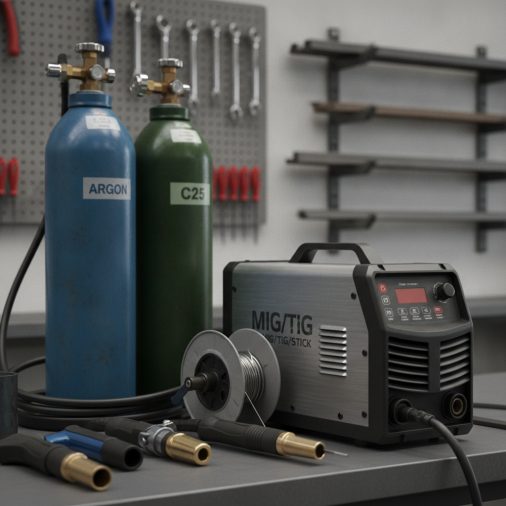
You just picked up a multiprocess welder that handles MIG, flux-core, stick, and TIG, and now you’re staring at a wall of gas cylinders wondering which one to buy. The right choice depends on which processes you use most and which metals you plan to weld.
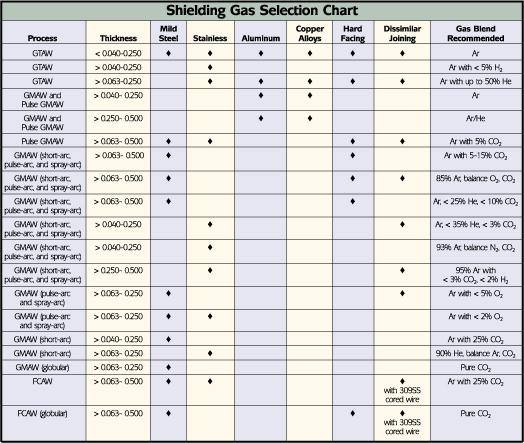
For most multiprocess welders, a 75% argon / 25% CO₂ mix (commonly called C25 or 75/25) is the most practical all-around shielding gas. It works well for MIG welding mild steel across a wide range of thicknesses, produces a stable arc, limits spatter, and is widely available. For TIG welding or aluminum MIG work, pure argon is required. Stainless steel MIG typically calls for a tri-mix or 98% argon / 2% CO₂ blend. No single gas covers every process perfectly, so your material and process combination drives the decision.
Why Shielding Gas Choice Matters on a Multiprocess Machine
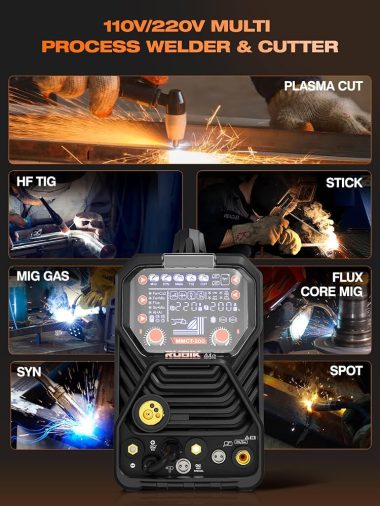
A multiprocess welder is designed to switch between welding processes without replacing the machine. That flexibility is useful, but it also means you may need more than one cylinder in your shop depending on the work you do.
Shielding gas protects the molten weld pool from atmospheric oxygen, nitrogen, and moisture. Without adequate protection, you get porosity, contamination, and weakened welds. Different gases and gas blends create different arc characteristics, penetration profiles, spatter levels, and bead appearances.
Choosing the wrong gas for a given process or material can produce weld defects even if every other variable is set correctly. Understanding which gas suits each process lets you get the most out of a multiprocess machine.
The Most Common Shielding Gases and What They Do
Argon
Pure argon is an inert gas that produces a smooth, stable arc with minimal spatter. It is the standard choice for TIG welding on steel, stainless steel, and aluminum. It is also required for MIG welding aluminum because it provides the cleaning action needed to break through aluminum’s oxide layer.
Argon alone is not ideal for MIG welding mild steel. It produces a narrow, finger-shaped penetration profile and an erratic arc on steel without some addition of an active gas like CO₂ or oxygen.
Carbon Dioxide (CO₂)
Pure CO₂ is an active gas that provides deep penetration and is significantly less expensive than argon blends. It works for MIG welding mild steel but produces a rougher arc, more spatter, and a less controlled puddle compared to argon blends.
Some budget-conscious fabricators use 100% CO₂ for structural mild steel work where appearance is secondary to penetration and cost. It is not suitable for TIG welding or aluminum MIG welding.
Argon / CO₂ Blends
Blending argon with CO₂ combines a stable arc with adequate penetration and reduced spatter. The most common blend is 75% argon / 25% CO₂, though 80/20 and 90/10 blends are also available. Higher argon percentages generally produce cleaner welds with less spatter, while higher CO₂ percentages improve penetration depth.
The 75/25 blend is the most practical starting point for anyone using a multiprocess welder primarily on mild steel. It is available at most welding supply shops and works across a broad range of wire diameters and machine settings. For a deeper look at how this gas performs on mild steel specifically, the article on choosing the best gas for MIG welding mild steel covers the tradeoffs in useful detail.
Pure Argon for Aluminum MIG
When you switch your multiprocess welder to MIG aluminum, the gas must change to 100% argon. Argon/CO₂ blends cause excessive oxidation on aluminum and produce a contaminated, porous weld. A spool gun and pure argon are both necessary for clean aluminum MIG results.
Tri-Mix for Stainless Steel MIG
MIG welding stainless steel typically calls for a tri-mix blend, commonly around 90% helium, 7.5% argon, and 2.5% CO₂, though the exact composition varies by supplier. Some welders use a simpler 98% argon / 2% CO₂ blend for short-circuit transfer on thin stainless, which can work well and is easier to source. Stainless steel MIG gas choices are covered in detail in the guide on what gas to use when MIG welding stainless steel.
Matching Gas to Process on a Multiprocess Welder
The table below summarizes which shielding gases suit the most common multiprocess welder configurations. These are general starting points, not substitutes for your machine manufacturer’s guidance or a written welding procedure.
| Process | Base Metal | Recommended Gas | Notes |
|---|---|---|---|
| MIG (GMAW) | Mild steel | 75% Ar / 25% CO₂ (C25) | Best general-purpose blend |
| MIG (GMAW) | Mild steel | 100% CO₂ | Deeper penetration, more spatter |
| MIG (GMAW) | Aluminum | 100% Argon | Required; blends cause defects |
| MIG (GMAW) | Stainless steel | Tri-mix or 98% Ar / 2% CO₂ | Thin gauge: 98/2 often suitable |
| TIG (GTAW) | Steel, stainless, aluminum | 100% Argon | Standard for all TIG work |
| Flux-Core (FCAW-G) | Mild or low-alloy steel | 75% Ar / 25% CO₂ or 100% CO₂ | Depends on wire classification; check wire data sheet |
| Flux-Core (FCAW-S) | Mild steel | No gas required | Self-shielded wire only |
| Stick (SMAW) | Most metals | No gas required | Electrode coating provides shielding |
Flux-Core Welding and Shielding Gas
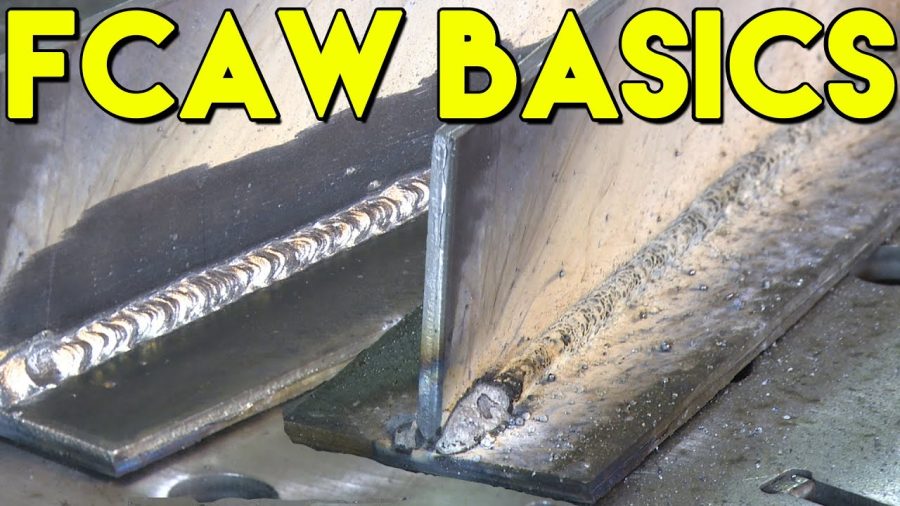
This is a common point of confusion on multiprocess machines. Flux-core wire comes in two types: self-shielded (FCAW-S) and gas-shielded (FCAW-G).
Self-shielded flux-core wire generates its own shielding from the flux core and requires no external gas. Gas-shielded flux-core wire requires an external shielding gas, typically 75/25 or 100% CO₂ depending on the wire classification. Always check the wire manufacturer’s data sheet to confirm the correct gas pairing. Using the wrong gas with a gas-shielded wire, or running no gas with a wire that requires it, produces porosity and poor fusion. For more detail on running flux-core without a gas cylinder, the overview of gasless MIG welding and flux-core setup explains the differences clearly.
Practical Gas Strategy for a Multiprocess Shop
If most of your work involves mild steel MIG or gas-shielded flux-core, one cylinder of 75/25 covers both processes efficiently. Adding a second cylinder of pure argon handles TIG welding on all common metals and aluminum MIG work when needed.
Two cylinders — 75/25 and pure argon — cover the majority of what a multiprocess welder is likely to do in a general fabrication or maintenance shop. Stainless work may require a third cylinder of tri-mix or 98/2, but that addition is worth considering only when stainless welding is a regular part of the workload.
Buying a large cylinder of your primary gas is more economical per cubic foot than refilling small cylinders repeatedly. Renting a cylinder from a local welding supply house is often the most practical arrangement for shops that weld regularly. If you’re new to tracking how much gas your setup consumes, the guide on calculating MIG welding gas consumption can help you estimate your usage before committing to a cylinder size.
Flow Rate Settings
Gas flow rate affects shielding quality and running cost. Too low a flow rate leaves the weld pool exposed. Too high a flow rate wastes gas and can create turbulence that pulls atmospheric contamination into the shielding envelope.
For most MIG and TIG applications indoors with no significant air movement, a flow rate in the range of 15–25 CFH (cubic feet per hour) is a common starting point. Outdoor welding, larger nozzles, or higher amperages may require higher flow rates. Always refer to your wire or filler metal manufacturer’s guidance and adjust based on actual weld results rather than targeting a fixed number.
Cylinder Safety
Shielding gas cylinders are stored under high pressure and must be treated carefully. Always secure cylinders upright using a chain, strap, or dedicated cylinder cart to prevent tipping. Store cylinders away from heat sources, sparks, and direct flame. Keep the protective cap on the valve when a regulator is not attached.
Never attempt to repair a cylinder or valve yourself. Do not drag or roll cylinders on their edges. Follow your supplier’s handling and storage instructions at all times.
Frequently Asked Questions
Can I use one shielding gas for all processes on a multiprocess welder?
No single gas covers every process and material combination correctly. Pure argon works for TIG on all common metals and for aluminum MIG, but it performs poorly for MIG welding mild steel. A 75/25 argon/CO₂ blend works well for mild steel MIG and gas-shielded flux-core but is not suitable for aluminum or TIG. Stick and self-shielded flux-core require no gas at all.
Is 100% CO₂ a good choice for a multiprocess welder?
Pure CO₂ is a cost-effective option for MIG welding mild steel when weld appearance and spatter are less critical. It offers deeper penetration than argon blends but produces a rougher arc and more cleanup work. It is not suitable for TIG welding, aluminum MIG, or stainless steel MIG, so it has limited versatility across a multiprocess machine’s full capability.
What gas do I need if I mainly TIG weld with a multiprocess welder?
Pure argon is the standard shielding gas for TIG welding mild steel, stainless steel, and aluminum. It produces a clean, stable arc and is suitable across all common TIG applications. Helium or argon/helium blends are used in some industrial TIG applications for increased heat input, but pure argon covers the vast majority of general TIG work.
Does shielding gas affect weld strength?
Shielding gas directly affects weld quality, which influences mechanical properties. Using the wrong gas can introduce porosity, oxidation, or poor fusion, all of which reduce weld integrity. A properly shielded weld made with the correct gas, wire, and settings will generally meet the mechanical requirements of the base metal. However, weld appearance alone does not confirm structural adequacy, especially for load-bearing or regulated applications.
Can I use argon/CO₂ mix for stainless steel MIG welding?
Standard 75/25 is generally not recommended for stainless steel MIG because the higher CO₂ content can cause carbide precipitation and corrosion issues at the weld zone. A low-CO₂ blend such as 98% argon / 2% CO₂ is more appropriate for short-circuit transfer on thin stainless, while tri-mix blends are common for heavier stainless applications. Always verify with the filler metal data sheet and applicable welding procedure.
Do I need a different regulator for each shielding gas?
Argon and argon/CO₂ blend regulators are generally interchangeable because both use the same CGA 580 connection in most markets. Pure CO₂ cylinders typically use a CGA 320 connection and require a different regulator or adapter. Confirm the correct connection type with your gas supplier before purchasing a regulator for a new cylinder type.
Choosing a Gas Setup That Works Long-Term
For most multiprocess welders, starting with a cylinder of 75% argon / 25% CO₂ and adding pure argon when TIG or aluminum MIG work becomes part of the routine is a practical and cost-effective approach. Match the gas to the process and material first, then dial in flow rate and machine settings for the specific job. For regulated, structural, or safety-critical work, always follow a qualified welding procedure and have the work inspected by a competent professional rather than relying on gas selection alone to guarantee a sound weld.


