
Choosing the wrong welding cable can cause overheating, voltage drop, and even fire hazards. This article explains how to read a welding cable amperage chart, what factors affect your cable size selection, and how to match the right gauge to your specific welding setup. Whether you’re running a MIG welder in a shop or setting up a portable stick welder on a job site, getting the cable size right protects your equipment and keeps your welds consistent.
—
Quick Answer
Welding cable size is determined by amperage and cable length. For most applications, a 2 AWG cable handles up to 200 amps at 50 feet, while a 1/0 AWG handles up to 300 amps at the same distance. Longer cables require larger gauges to prevent voltage drop and overheating.
—
Welding Cable Amperage Chart
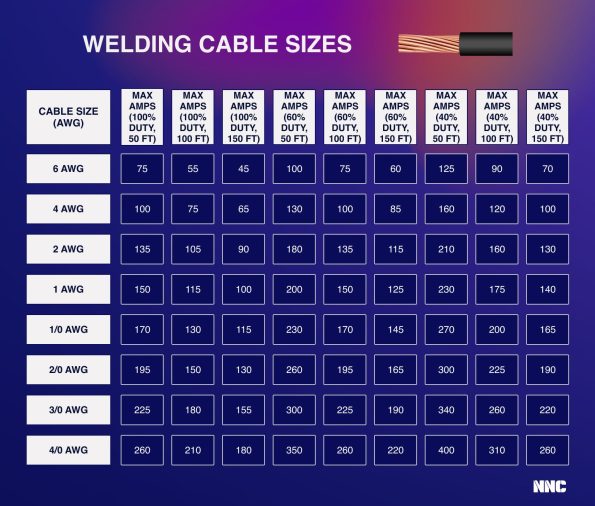
This chart covers the most common cable sizes and their recommended amperage ratings based on cable length. These values assume a combined length of both the electrode and ground cables (total circuit length).
| AWG Size | Up to 50 ft | Up to 100 ft | Up to 150 ft | Up to 200 ft |
|---|---|---|---|---|
| 4 AWG | 150 A | 100 A | 85 A | 70 A |
| 2 AWG | 200 A | 150 A | 130 A | 110 A |
| 1 AWG | 250 A | 200 A | 160 A | 140 A |
| 1/0 AWG | 300 A | 250 A | 200 A | 175 A |
| 2/0 AWG | 350 A | 300 A | 250 A | 225 A |
| 3/0 AWG | 400 A | 350 A | 300 A | 275 A |
| 4/0 AWG | 500 A | 400 A | 350 A | 325 A |
These are general guidelines. A related point is welding settings stick welding every, especially when Always verify with your welder’s manufacturer specifications and matters.
—
Why Cable Length Changes Everything
Most people focus only on amperage when picking a cable. But cable length is just as critical. The longer the cable, the more electrical resistance it creates. That resistance causes voltage to drop before it reaches the welding arc.
A voltage drop of even 2–3 volts can noticeably affect arc stability. In practice, a cable that works fine at 50 feet may cause sputtering, inconsistent penetration, or overheating at 150 feet. Always measure the total circuit length — that means both the electrode cable and the ground cable combined.
—
How Duty Cycle Affects Your Cable Choice
Duty cycle refers to how long a welder runs within a 10-minute period. A welder with a 60% duty cycle runs for 6 minutes and rests for 4 minutes. Higher duty cycles generate more sustained heat in the cable.
Field experience shows that cables running near their maximum rated amperage at high duty cycles (above 60%) can degrade faster and run dangerously hot. If you’re doing production welding or running long beads, size up one gauge from the chart recommendation. This is a simple precaution that extends cable life significantly.
—
Understanding AWG: Bigger Number Means Smaller Cable
AWG stands for American Wire Gauge. The numbering system is counterintuitive — a higher number means a thinner wire. A 4 AWG cable is thinner than a 1/0 AWG cable.
Once you move past 1 AWG, the system switches to “aught” sizes:
– 1/0 AWG (called “one-aught”)
– 2/0 AWG (called “two-aught”)
– 3/0 AWG (called “three-aught”)
– 4/0 AWG (called “four-aught”)
Each step up in size increases the copper cross-section and the cable’s ability to carry current safely. For heavy industrial welding above 400 amps, 4/0 AWG is the standard starting point.
—
Common Mistakes When Selecting Welding Cable
A common issue technicians encounter is using a cable that’s rated for the welder’s output but not for the actual working distance. The welder might be rated at 250 amps, but if the cable run is 175 feet, a 1 AWG cable won’t perform safely.
Other frequent mistakes include:
– Using undersized ground cables — The ground cable carries the same current as the electrode cable. Both must be properly sized.
– Ignoring ambient temperature — Hot environments reduce a cable’s effective ampacity. In summer heat or enclosed spaces, derate the cable by 10–15%.
– Daisy-chaining extension cables — Connecting multiple shorter cables together increases resistance at each connection point. Use a single continuous cable whenever possible.
– Choosing price over quality — Cheap cables often use aluminum-core conductors instead of pure copper. Aluminum carries less current for the same gauge size and corrodes faster at connection points.
—
Welding Cable vs. Standard Electrical Cable
Welding cable is not the same as standard electrical wire, and the two should not be substituted for each other. Welding cable uses fine-stranded copper conductors, which makes it extremely flexible. This flexibility is essential because the cable moves constantly during welding.
Standard electrical wire uses fewer, thicker strands. It’s designed to stay in place inside walls or conduit. Using standard wire for welding leads to cracking, stiffness, and premature failure of the insulation. Welding cable insulation is also rated for higher temperatures and greater abrasion resistance.
—
Practical Tips for Setting Up Your Welding Leads
Getting your cable setup right from the start saves time and prevents problems mid-job.
– Measure before you buy — Walk the actual cable path, not just the straight-line distance. Cables route around obstacles, which adds length.
– Use quality connectors — Poor-quality lugs and connectors create resistance at the termination point, generating heat even when the cable itself is properly sized.
– Inspect cables regularly — Look for cracked insulation, exposed copper, or discolored spots near connectors. These are signs of overheating or damage.
– Store cables loosely coiled — Tight coiling over time stresses the insulation and can cause internal conductor damage.
– Label your cables — On busy job sites, knowing which cable is which saves setup time and prevents accidental mismatches.
—
FAQ
What size welding cable do I need for a 200-amp welder?
For a 200-amp welder with cable runs up to 50 feet, a 2 AWG cable is sufficient. For runs up to 100 feet, step up to a 1 AWG or 1/0 AWG to maintain proper voltage and prevent overheating.
Can I use the same cable for both the electrode and ground?
Yes. Both the electrode (stinger) cable and the ground cable carry the same current and should be the same gauge. Using a smaller ground cable is a common mistake that causes heat buildup on the ground side.
What happens if my welding cable is too small?
An undersized cable will overheat, causing insulation to soften or melt. It also creates voltage drop at the arc, leading to poor arc stability, inconsistent penetration, and weak welds.
Is copper welding cable better than aluminum?
Yes, for most welding applications. Copper has lower resistance, handles heat better, and is more durable at connection points. Aluminum cable is lighter and cheaper but requires larger gauge sizes to match copper’s performance.
How do I calculate total cable length for the chart?
Add the length of the electrode cable and the ground cable together. If your electrode lead is 75 feet and your ground lead is 25 feet, your total circuit length is 100 feet. Use that number when reading the amperage chart.
Can I use welding cable for other high-current applications?
Welding cable is sometimes used for battery cables, audio systems, and other high-current DC applications because of its flexibility and current capacity. However, always check local codes and application-specific requirements before doing so.
What is the most common welding cable size for general shop use?
For most general-purpose shop welding with machines rated between 150 and 300 amps, 2 AWG to 1/0 AWG covers the majority of setups. Many professional welders keep a 1/0 AWG setup as their standard because it handles a wide range of machines and distances.
—
Final Thoughts
Selecting the right welding cable comes down to three things: amperage, cable length, and duty cycle. The amperage chart gives you a solid starting point, but real-world conditions — heat, long runs, high-duty-cycle work — often mean you should size up one gauge for a safety margin.
Always measure total circuit length, use pure copper cable, and inspect your leads regularly. A properly sized cable runs cooler, lasts longer, and delivers a more stable arc. Getting this right is one of the simplest ways to improve both safety and weld quality on any job.


