
What “Gasless” MIG Welding Actually Means
Equipment You Need Before You Start
Polarity: The Step Most People Get Wrong
This is the single most important setup step, and it’s frequently skipped. Standard solid wire MIG welding runs on DCEP (Direct Current Electrode Positive), also called reverse polarity. Self-shielded flux core wire requires DCEN (Direct Current Electrode Negative), also called straight polarity. Running flux core wire on the wrong polarity produces rough arcs, excessive spatter, and poor fusion — and many beginners blame the wire or the welder without realizing polarity is the problem. How to change polarity on most MIG welders: 1. Turn the machine completely off and unplug it 2. Open the wire feed compartment 3. Locate the polarity cables (usually labeled + and −) 4. Swap the connections: move the torch lead to the negative terminal and the ground clamp to the positive terminal 5. Close the compartment and plug the machine back in Some machines have a polarity switch or diagram inside the door panel. Check your manual if the terminals aren’t clearly labeled.Step-by-Step: How to MIG Weld Without Gas
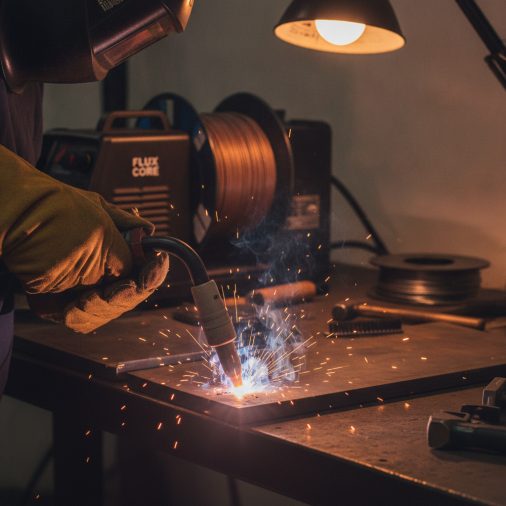
Once your polarity is set and your flux core wire is loaded, the process is straightforward. 1. Load the flux core wire — Feed the wire through the liner, past the drive rolls, and through the gun. Set the drive roll tension just firm enough to feed without slipping. Flux core wire is tubular and softer than solid wire, so don’t overtighten. 2. Set voltage and wire speed — Start with your welder’s recommended settings chart for the wire diameter and metal thickness you’re using. For 0.030″ wire on 1/8″ mild steel, a typical starting point is around 17–19 volts with moderate wire speed. 3. Prepare the base metal — Clean the joint area with a wire brush or grinder. Flux core is more tolerant of mill scale and light rust than solid wire MIG, but paint, heavy grease, and thick corrosion will still cause problems. 4. Set your stick-out — Maintain a contact-tip-to-work distance (CTWD) of about 3/4″ to 1″. This is longer than solid wire MIG, which typically runs 1/4″ to 3/8″. The longer stick-out is intentional — it preheats the flux and helps stabilize the arc. 5. Use a drag (forehand) technique — With self-shielded flux core, drag the gun away from the weld puddle rather than pushing into it. A slight drag angle of 5–15 degrees works well for flat and horizontal welds. 6. Weld and watch the puddle — Keep a consistent travel speed. The puddle should be fluid but not runny. Slow travel means too much heat and potential burn-through; too fast means insufficient fusion. 7. Remove the slag — After each pass, chip and wire-brush the slag off before inspecting or adding another layer. Slag inclusions in multi-pass welds are a real problem if you skip this step.Flux Core Wire Sizes and Typical Applications
| Wire Diameter | Typical Metal Thickness | Common Use |
|---|---|---|
| 0.030" | 18 gauge – 3/16" | Light fabrication, auto repair, sheet metal |
| 0.035" | 1/8" – 1/4" | General fabrication, structural repairs |
| 0.045" | 3/16" – 1/2" | Heavy fabrication, farm equipment, structural |
When Gasless Welding Works Well (And When It Doesn’t)
Flux core welding without gas has genuine strengths, but it’s not the right choice for every situation. Where gasless flux core works well: – Outdoor welding in windy conditions (wind blows shielding gas away, but flux core handles it) – Field repairs on farm equipment, fences, and structural steel – Welding on slightly rusty or painted surfaces where prep is limited – Thicker mild steel where deep penetration is an advantage – Portability situations where carrying a gas cylinder isn’t practical Where gasless flux core falls short: – Thin sheet metal — burn-through risk is higher due to the hotter, more penetrating arc – Clean cosmetic welds — flux core leaves more spatter and slag compared to gas-shielded MIG – Aluminum — self-shielded flux core wire for aluminum doesn’t exist in a practical form; welding aluminum without gas is not a viable option – Stainless steel — standard self-shielded flux core wire is not suitable for stainless If your project involves thin sheet metal, welding thin metal without burning through requires careful technique adjustments regardless of whether you’re using gas or flux core wire.Common Problems and How to Fix Them
Excessive spatter Usually caused by wrong polarity, voltage too high, or stick-out too short. Check polarity first — it’s the most common cause. Then reduce voltage slightly or increase stick-out to the 3/4″–1″ range. Porosity (holes or pitting in the weld) Often caused by contaminated base metal, damaged flux wire (moisture-absorbed), or improper stick-out. Inspect the wire spool for rust or moisture damage. Store flux core wire sealed when not in use. Rough, stuttering arc Check drive roll tension — too tight crushes the tubular wire and causes feeding issues. Also verify polarity is set to DCEN. Slag inclusions Always chip and brush slag completely between passes. If doing multi-pass welds, this step is non-negotiable. Burn-through on thin material Reduce voltage, increase travel speed, or use a smaller wire diameter. Flux core’s aggressive penetration makes it less forgiving on thin gauge steel than gas-shielded MIG. If you’re trying to understand whether gas is required for MIG welding more broadly, the answer depends entirely on the wire type you’re running.FAQ
Can any MIG welder run flux core wire without gas? Most MIG welders manufactured in the last 20 years can run self-shielded flux core wire, provided you can change the polarity to DCEN. Check your welder’s manual to confirm it supports flux core operation. Some very small entry-level machines are flux-core-only by design, while others are dual-purpose. Is gasless flux core welding as strong as gas-shielded MIG? On mild steel in flat and horizontal positions, properly executed flux core welds can match or exceed the strength of gas-shielded MIG welds. The weld chemistry in quality self-shielded wire is engineered for good mechanical properties. The bigger variable is technique — a sloppy flux core weld isn’t stronger just because it penetrates deeper. Do I need to remove slag after every flux core pass? Yes, always. Slag must be fully chipped and wire-brushed off between passes. Welding over un-removed slag traps it inside the joint, creating inclusions that weaken the weld. This is a non-negotiable step in multi-pass welding with flux core wire. Can I use flux core wire on stainless steel or aluminum without gas? Not effectively. Standard self-shielded flux core wire is designed for mild steel and some low-alloy steels. There is no practical self-shielded flux core wire for aluminum. Stainless steel flux core wire exists, but it typically requires a gas shield to work correctly. For those materials, shielding gas is generally required. Why is my flux core weld so much spattier than my gas MIG welds? Flux core welding inherently produces more spatter than gas-shielded solid wire MIG — that’s a characteristic of the process, not a defect. Proper polarity (DCEN), correct voltage, and appropriate stick-out will minimize it, but some spatter is normal. Anti-spatter spray applied to surrounding metal before welding makes cleanup easier. What’s the best wire for beginners doing gasless MIG? For most beginners welding mild steel, a self-shielded flux core wire like Lincoln Electric Innershield NR-211-MP in 0.030″ or 0.035″ is a reliable starting point. It’s forgiving, widely available, and designed to work across a range of positions and thicknesses. Can flux core wire be used outdoors in windy conditions? Yes — this is actually one of the primary advantages of self-shielded flux core over gas-shielded MIG. Wind disperses external shielding gas and causes weld contamination, but self-shielded flux core generates its own protection internally, making it far more suitable for outdoor and field welding.Gasless MIG welding with flux core wire is a capable, practical process — not a compromise. Set the polarity correctly, maintain proper stick-out, and remove slag after every pass. Master those three habits and you’ll get consistent, structurally sound welds without ever touching a gas cylinder.


