The PrimeWeld MIG 285 sits in a competitive spot — powerful enough for serious fabrication work, yet still accessible to welders who don’t want to spend professional shop money. If you’re deciding whether it fits your needs, the details matter.
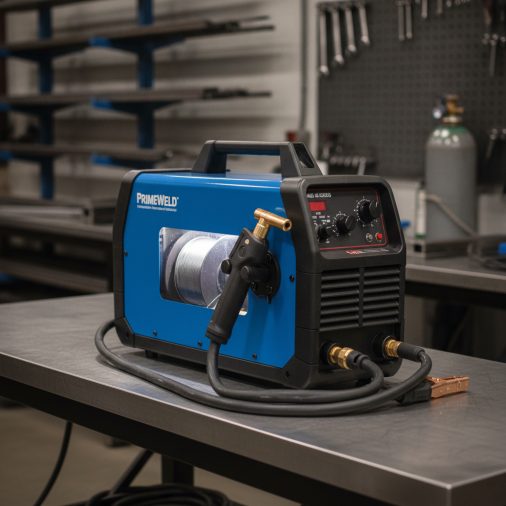
The PrimeWeld MIG 285 is a 285-amp multi-process MIG welder capable of MIG, flux-core, stick, and lift-TIG welding. It runs on 220V power, handles material thicknesses from thin sheet metal up to 3/8 inch in a single pass, and includes a spool gun port for aluminum welding. It’s designed for hobbyists, serious home shop users, and light professional work.
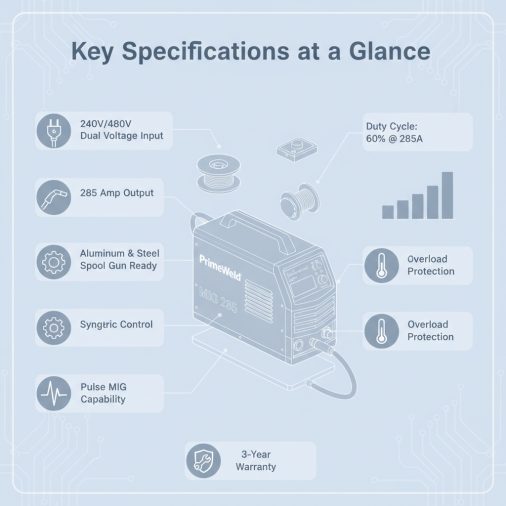
Key Specifications at a Glance
Specification
Details
Welding Processes
MIG, Flux-Core, Stick (MMA), Lift-TIG
Input Voltage
220V / Single Phase
Amperage Range
30A – 285A
Duty Cycle
60% at 285A
Wire Feed Speed
50–700 IPM
Compatible Wire Diameter
0.024" – 0.045"
Spool Gun Port
Yes (compatible with optional spool gun)
Shielding Gas
C25 (75% Argon / 25% CO₂) recommended for mild steel
Material Thickness Range
24 gauge – 3/8" (single pass)
Weight
Approximately 52 lbs
Warranty
3-year warranty
What the MIG 285 Is Actually Built For
This machine targets the gap between entry-level hobbyist welders and full industrial equipment. At 285 amps, it delivers enough output for structural mild steel work, trailer fabrication, roll cage repairs, and general shop fabrication without requiring three-phase power.
In practice, the 60% duty cycle at maximum output means you can run it hard for real work without constant cool-down interruptions. Most users won’t be welding at 285A continuously anyway — at typical working amperages for 1/4″ steel, duty cycle becomes a non-issue.
The inclusion of stick (MMA) and lift-TIG capability makes it more versatile than a dedicated MIG machine. If you occasionally need to weld in a tight corner or work outdoors where shielding gas coverage is difficult, the stick process gives you that flexibility from the same machine.
MIG Welding Performance on Mild Steel
The PrimeWeld MIG 285 performs well on mild steel, which is where most users will spend the majority of their time. The wire feed system is stable and consistent, which directly impacts bead quality and spatter levels.
For material up to 1/4″, the machine runs cleanly with C25 shielding gas and ER70S-6 wire. Stepping up to 3/8″ is achievable in a single pass at higher amperage settings, though preheating the base metal helps ensure full fusion on the thicker end of that range.
If you’re learning to read and improve your bead appearance, understanding what a good MIG weld actually looks like will help you dial in the MIG 285’s settings faster and recognize when your wire speed or voltage is off.
Aluminum Welding With the Spool Gun Port
The MIG 285 includes a dedicated spool gun port, which is the right way to handle aluminum MIG welding. Aluminum wire is soft and tends to bird-nest inside a standard push-feed liner over long cable runs — a spool gun eliminates that problem by keeping the wire feed mechanism right at the gun.
PrimeWeld offers a compatible spool gun sold separately. For shielding gas, aluminum MIG welding requires 100% argon — not C25. If you want a deeper look at gas selection for aluminum work, the differences between shielding gases for MIG welding aluminum are worth reviewing before your first aluminum job.
Flux-Core and Stick Capability
Flux-core mode is useful when working outdoors or in conditions where shielding gas coverage is unreliable. The MIG 285 handles both gasless flux-core (FCAW-S) and gas-shielded flux-core (FCAW-G) depending on the wire you load.
For stick welding, the machine runs 6013, 7018, and 6011 electrodes effectively across a practical working range. This is a genuine capability, not a token feature — the arc stability in stick mode is solid for occasional structural repairs or outdoor work.
If you’ve never needed gas for a particular job and want to understand when each process makes sense, the question of whether you need gas for MIG welding has practical implications for how you’ll use the MIG 285 day-to-day.
Build Quality and Controls
The MIG 285 uses a digital display panel with separate controls for voltage and wire feed speed. This makes fine-tuning more reliable than older analog dial systems — you can replicate settings exactly the next time you run the same material and thickness.
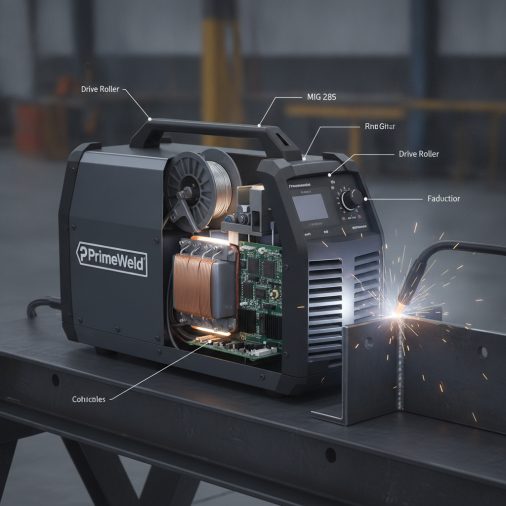
The torch included in the package is a 250A-rated EURO-style connector, which matters for long-term ownership because replacement parts and upgraded torches are widely available and affordable. The drive roll system is accessible and straightforward to change for different wire diameters.
The machine’s fan-on-demand cooling system runs the internal fan only when needed, which reduces dust and debris ingestion inside the chassis. Field experience with multi-process machines shows that thermal management directly affects long-term reliability, so this is a meaningful design choice rather than a marketing detail.
Sheet Metal and Thin Stock Performance
Thin material is where many higher-amperage machines struggle — too much power and too little refinement at the low end creates burn-through problems. The MIG 285 steps down to 30A at the low end, which gives it genuine usability on thinner gauge materials.
For automotive body panels, thin tubing, or exhaust work, running short circuit transfer at lower settings with 0.023″ or 0.024″ wire produces manageable heat input. Pulse or synergic control is not a feature on the MIG 285, so technique and settings discipline matter more on thin stock than on a machine with built-in pulse capability.
If thin material is your primary focus, reviewing proper technique for MIG welding sheet metal will help you get the most from the machine’s lower range settings.
Common Setup Mistakes to Avoid
A few recurring issues come up when welders first run the MIG 285:
– Incorrect polarity for flux-core: When running gasless flux-core wire, switch to electrode negative (DCEN). Leaving it on electrode positive (DCEP, which is correct for solid MIG wire) causes poor fusion and excessive spatter.
– Shielding gas flow rate: Aim for 20–25 CFH for most mild steel work. Too low and you get porosity; too high and you create turbulence that pulls in atmospheric contamination.
– Wire tension: Overly tight drive roll tension crushes soft wire, especially aluminum. Back off tension until the wire feeds smoothly without slipping.
– Contact tip wear: At higher amperages, contact tips wear faster. A worn or oversized tip causes arc instability and erratic feeding.
– Ground connection: A poor ground causes arc wander and inconsistent penetration. Always clamp directly to clean, bare metal as close to the weld zone as practical.
How It Compares to Nearby Competitors
Feature
PrimeWeld MIG 285
Lincoln Electric Power MIG 256
Hobart Handler 210 MVP
Max Output
285A
256A
210A
Input Voltage
220V only
208/230V
115V / 230V
Multi-Process
Yes (MIG, FCAW, Stick, TIG)
MIG / FCAW only
MIG / FCAW only
Spool Gun Port
Yes
Yes
Yes
Duty Cycle at Max
60%
40% at 200A
30% at 150A
Price Range
Mid-range
Higher
Mid-range
Warranty
3 years
1 year
5 years
The Lincoln Electric Power MIG 256 has brand legacy and dealer support, but the PrimeWeld MIG 285 offers higher sustained output, longer warranty coverage, and multi-process capability at a lower price point. The Hobart Handler 210 MVP offers dual-voltage convenience but tops out at 210A with a lower duty cycle.
FAQ
What materials can the PrimeWeld MIG 285 weld?
The MIG 285 handles mild steel, stainless steel, aluminum (with a compatible spool gun and appropriate wire), and cast iron in MIG mode. Stick mode expands options for harder-to-reach situations. For stainless, use ER308L wire with a tri-mix shielding gas (He/Ar/CO₂). For a full breakdown of material capabilities with a MIG machine, what you can weld with a MIG welder covers the topic in practical detail.
Does the PrimeWeld MIG 285 require a dedicated circuit?
Yes. At 220V input, the MIG 285 draws significant amperage at full output. Most users run it on a dedicated 50-amp, 240V circuit. Running it through a shared or undersized circuit will cause voltage drop, tripped breakers, and potentially inconsistent arc performance.
Can the PrimeWeld MIG 285 weld stainless steel?
Yes, with the right wire and gas. Use ER308L or ER309L stainless wire with a tri-mix shielding gas (typically 90% helium, 7.5% argon, 2.5% CO₂). Standard C25 gas will work in a pinch for non-critical welds but produces a rougher bead profile and more oxidation on stainless. More detail on how to MIG weld stainless steel properly is worth reading before your first stainless job.
What wire size should I use with the PrimeWeld MIG 285 for general steel work?
For most general steel work between 14 gauge and 3/16″, 0.030″ ER70S-6 wire with C25 gas is the standard choice. For material 1/4″ and thicker, stepping up to 0.035″ wire improves deposition rate and penetration. For sheet metal under 18 gauge, 0.024″ wire gives you better control at lower heat settings.
Is the PrimeWeld MIG 285 a good choice for vertical welding?
The machine handles vertical welding well, but technique and settings adjustments matter significantly. Reduce wire speed and voltage by about 10–15% compared to flat position settings to control the molten puddle against gravity. Running uphill (forehand) generally gives better penetration on vertical joints with a MIG setup. If vertical welding is new territory for you, proper technique for vertical MIG welding walks through the key adjustments.
What is the duty cycle of the PrimeWeld MIG 285?
At maximum output (285A), the duty cycle is 60%, meaning it can weld continuously for 6 minutes out of every 10-minute period before requiring a cool-down interval. At lower working amperages — which is typical for most jobs — the effective duty cycle increases substantially, making thermal shutdowns rare in real shop use.
Does the PrimeWeld MIG 285 include a gas regulator and hose?
Yes, PrimeWeld includes a dual-gauge gas regulator, gas hose, and a 10-foot MIG gun in the standard package. The included regulator works with standard argon/CO₂ tanks. You’ll need to source your own shielding gas cylinder separately.
The PrimeWeld MIG 285 hits a practical sweet spot for welders who need genuine multi-process capability and real output capacity without professional shop pricing. The 3-year warranty, stable arc performance, and spool gun support make it a durable choice for a home shop or light professional use. If your work involves mostly mild steel fabrication with occasional stainless or aluminum, this machine covers the range well — provided you’re running it on proper 220V power and taking the time to dial in settings for each material and thickness.