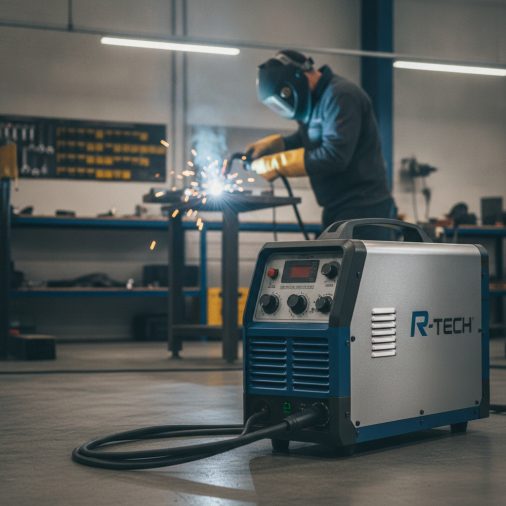
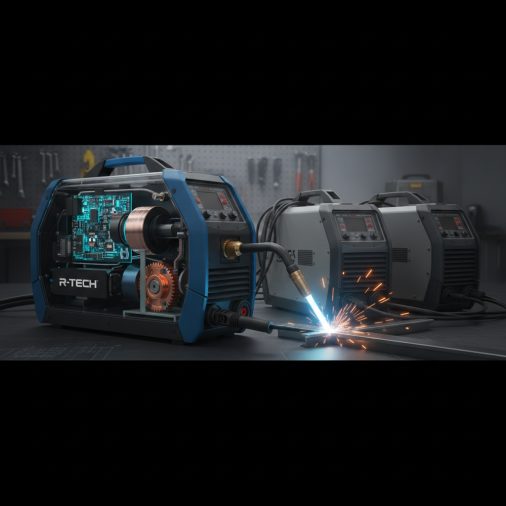
R-Tech welders have built a solid reputation in the UK fabrication and hobbyist market, particularly among welders who want reliable, professional-grade performance without paying industrial machine prices. If you’ve been comparing machines and keep seeing the R-Tech name, here’s what you actually need to know.
R-Tech MIG welders are a range of UK-designed, inverter-based MIG welding machines built for hobbyists, fabricators, and light-to-medium industrial users. They’re known for stable arc performance, robust build quality, and strong UK-based customer support. Models typically range from compact 150A hobby units to 250A+ industrial inverter machines capable of running on single or three-phase power.
What Makes R-Tech Different From Other MIG Welder Brands
R-Tech is a UK company that designs and sells its own branded welding equipment, aimed primarily at the domestic and light professional market. Unlike many budget brands that simply rebadge Chinese OEM hardware, R-Tech puts more emphasis on quality control, component selection, and post-sale support.
Their machines are inverter-based, which means lighter weight, better energy efficiency, and more precise arc control compared to older transformer-based MIG welders. Inverter technology also tends to respond better to voltage fluctuations, which matters in workshop environments running multiple tools.
In practice, R-Tech machines are often compared favorably to similarly priced machines from Hobart and Lincoln Electric, though direct spec-for-spec comparisons depend heavily on the model and intended use case.
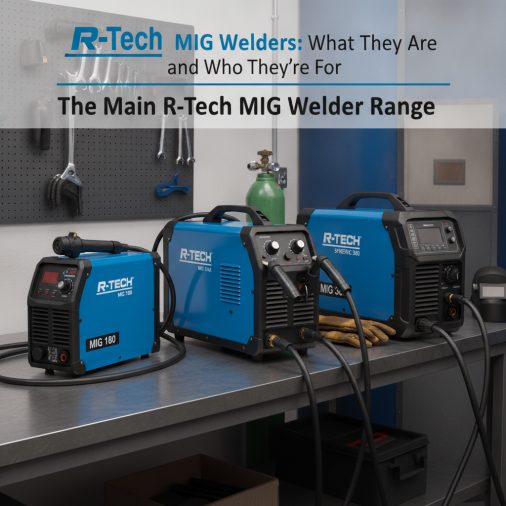
The Main R-Tech MIG Welder Range
R-Tech offers several distinct lines aimed at different user levels. Here’s a practical breakdown:
Model Series
Amperage Range
Power Supply
Best For
MIG150
Up to 150A
230V single phase
Home use, thin steel, hobby projects
MIG180
Up to 180A
230V single phase
Light fabrication, auto body, DIY
MIG200
Up to 200A
230V single phase
General workshop, medium steel
MIG250
Up to 250A
230V single phase
Heavy fabrication, structural work
MIG250 3-Phase
Up to 250A
3-phase
Production environments
Most users starting out in a home garage or small workshop will find the MIG180 or MIG200 covers the vast majority of jobs. The MIG250 is better suited to anyone regularly welding material above 6mm or running long production cycles where duty cycle becomes critical.
Key Features Worth Knowing Before You Buy
R-Tech MIG welders typically come with a set of features that set them apart from bottom-tier machines:
– Synergic control on higher-end models, which automatically adjusts voltage based on wire speed — useful for beginners and time-pressed professionals
– Thermal overload protection with clear indicator lighting
– Euro-style torch connectors, making torch replacement straightforward and compatible with widely available consumables
– Flux-core (gasless) capability on most models, which is helpful if you’re working outdoors or in draughty conditions where shielding gas coverage is compromised
– Variable wire speed and voltage control with clear panel markings
One feature users frequently highlight is the quality of the torch supplied with the machine. Budget welders often include low-grade torches that cause feed problems early on. R-Tech’s included torches are generally considered solid for the price point.
Understanding what size MIG welding wire to use for your specific material thickness will help you get the most out of whichever R-Tech model you choose.
Duty Cycle: What R-Tech Specs Actually Mean in Practice
Duty cycle is one of the most misunderstood specs on any welder. It tells you what percentage of a 10-minute period the machine can weld before needing to cool down.
R-Tech typically rates their machines at a specific amperage. For example, a 60% duty cycle at 150A means 6 minutes of welding, 4 minutes of rest within any 10-minute window. At lower amperages, duty cycle improves significantly — often to 100% at reduced power settings.
For hobby and light fabrication work, most users never hit the duty cycle limit because natural workflow includes repositioning, inspection, and material prep. It becomes relevant in production welding where arcs are held for extended periods.
Shielding Gas Setup for R-Tech Machines
R-Tech MIG welders are designed to run with standard CO₂ or Argon/CO₂ mixed gas cylinders. For mild steel, a 75% Argon / 25% CO₂ mix (often called C25) is the most common choice — it gives a cleaner bead, less spatter, and better arc stability than pure CO₂.
If you’re welding stainless steel, you’ll want a tri-mix or 98% Argon / 2% CO₂ blend. For aluminum, pure Argon is the standard. Getting your shielding gas selection right for MIG welding directly affects bead quality and spatter levels, regardless of machine quality.
Flow rate for most light to medium work typically sits between 10–15 litres per minute. Adjust upward slightly in drafty conditions, but avoid excessive flow, which can cause turbulence and draw in atmospheric contamination.
Common Issues and Practical Fixes
Even quality machines like R-Tech MIG welders occasionally run into issues. Most are user-side rather than equipment failure.
Erratic wire feed or bird-nesting
This is usually caused by incorrect drive roll tension, a worn or kinked liner, or the wrong wire diameter loaded for the drive roll groove. Check liner condition annually if you’re a regular user, and match your groove to your wire gauge precisely.
Porosity in the weld bead
Almost always a shielding gas issue. Check connections at the regulator, the gas hose, and the solenoid valve. Even a small leak will allow oxygen contamination. Surface contamination — oil, rust, mill scale — causes the same symptom.
High or ropey weld profile
This typically points to wire speed being too high relative to voltage, or travel speed being too slow. A raised, ropey bead usually means the heat input isn’t penetrating properly. Understanding why MIG welds appear too high can help you identify whether the cause is settings, technique, or material prep.
Tip burning back frequently
Stick-out is too short, or wire speed is set too low. Maintain roughly 10–15mm of electrode stick-out and ensure wire speed matches your voltage setting.
R-Tech vs. Comparable UK Market Machines
R-Tech competes primarily against machines from SIP, Clarke, and Draper at the lower price points, and against Lincoln Electric and ESAB at the higher range. Here’s how they generally stack up:
Brand
Build Quality
Support
Arc Stability
Synergic Options
Price Point
R-Tech
Strong
Excellent (UK-based)
Very good
Yes (mid-high range)
Mid-range
SIP
Average
Limited
Moderate
Limited
Budget
Clarke
Average
Moderate
Moderate
Limited
Budget-mid
Lincoln Electric
Excellent
Good
Excellent
Yes
Mid-high
ESAB
Excellent
Good
Excellent
Yes
High
R-Tech sits in an appealing position for UK buyers who want better-than-budget quality without paying Lincoln Electric or ESAB prices. Their after-sales support — including UK phone support and parts availability — is consistently cited as a differentiator.
Technique Tips for Getting Better Results
Machine quality only accounts for part of your weld quality. Technique and settings make up the rest.
A few practical points that apply specifically when using R-Tech MIG welders:
– On synergic models, use the synergic function as a starting point, then fine-tune voltage manually based on your actual material and position
– For vertical welding, drop your wire speed and voltage slightly compared to your flat position settings — welding vertical with a MIG welder requires a slightly different approach to puddle control
– Use a push angle of 10–15 degrees for better shielding gas coverage on clean material; a slight pull can help penetration on thicker sections
– Clean your base metal. R-Tech machines won’t compensate for heavy surface contamination — wire brush or grind back to bare metal on rusty or coated stock
The Lincoln Electric Magnum Pro 100L replacement torch is worth considering if you ever need to replace the included torch, as it’s widely compatible with Euro-connector machines and offers good durability at a practical price point.
FAQ
Are R-Tech MIG welders suitable for beginners?
Yes, particularly the MIG150 and MIG180 models. The synergic control feature on compatible models simplifies setup considerably by linking voltage and wire speed automatically. Beginners can start with a synergic preset and adjust from there, which reduces the learning curve compared to fully manual machines.
What’s the difference between R-Tech’s standard and industrial MIG ranges?
The primary differences are duty cycle rating, power supply requirements, and construction. Industrial models typically offer higher duty cycles at maximum amperage, heavier-duty wire feed mechanisms, and support for three-phase power. For regular workshop fabrication on mild steel up to 10mm, the single-phase 200A or 250A units are typically sufficient.
Can R-Tech MIG welders run gasless flux-core wire?
Most R-Tech MIG welders support flux-core wire operation. This requires switching the drive roll polarity to DCEN (electrode negative), as MIG welding polarity differs between solid wire and flux-core processes. Check your specific model’s manual to confirm polarity switching procedure.
How does R-Tech customer support compare to other brands?
R-Tech is consistently praised for their UK-based telephone and email support. Parts are generally available directly from R-Tech, and their team can walk through technical issues with users. This is a genuine advantage over brands where support is handled through distributors or overseas call centers.
What’s the maximum steel thickness an R-Tech MIG welder can handle?
The MIG150 can handle mild steel up to approximately 6mm in a single pass. The MIG200 can manage up to around 8–10mm with proper joint preparation, and the MIG250 extends that to 12mm or more. For thicker material, multiple passes are recommended regardless of machine power.
Do R-Tech welders work with a spool gun for aluminum?
Some R-Tech models support spool gun attachments for aluminum welding. Check your specific model’s specifications for spool gun compatibility before purchasing. Aluminum requires a properly connected spool gun to avoid bird-nesting in the standard liner, which doesn’t handle soft aluminum wire well.
Are R-Tech welders good value compared to similar machines?
For UK buyers specifically, yes. The combination of build quality, UK support, warranty terms, and genuine synergic functionality at mid-range pricing makes R-Tech competitive. Buyers outside the UK may find brands with stronger local support networks a better fit, simply because R-Tech’s primary advantage is their domestic service infrastructure.
R-Tech MIG welders occupy a genuinely useful space in the market — more capable than budget DIY machines, more accessible than heavy industrial equipment, and backed by support that actually answers the phone. For UK fabricators, hobbyists working on cars, frames, or structural projects, and small workshops that need a reliable daily machine, they’re worth serious consideration. Match the model to your actual amperage needs, get your shielding gas setup right, and the machine will largely get out of your way and let you weld.