

If you’ve ever watched a welder run a smooth, continuous bead along a metal joint with what looks like effortless speed, there’s a good chance you were watching MIG welding in action. It’s one of the most widely used welding processes in the world today — found in auto manufacturing, construction, shipbuilding, and home workshops alike. But where did it come from, and who actually developed it? Understanding the origins of MIG welding gives you a clearer picture of why the process works the way it does and how it evolved into the tool millions of welders rely on today.
MIG welding was invented by researchers at Battelle Memorial Institute in Columbus, Ohio, in 1948. The process was developed primarily by P.O. Nobel and refined through collaboration with engineers at Air Reduction Company. It was first patented and commercially introduced in the United States around 1948–1950.
The Origins: What Led to MIG Welding
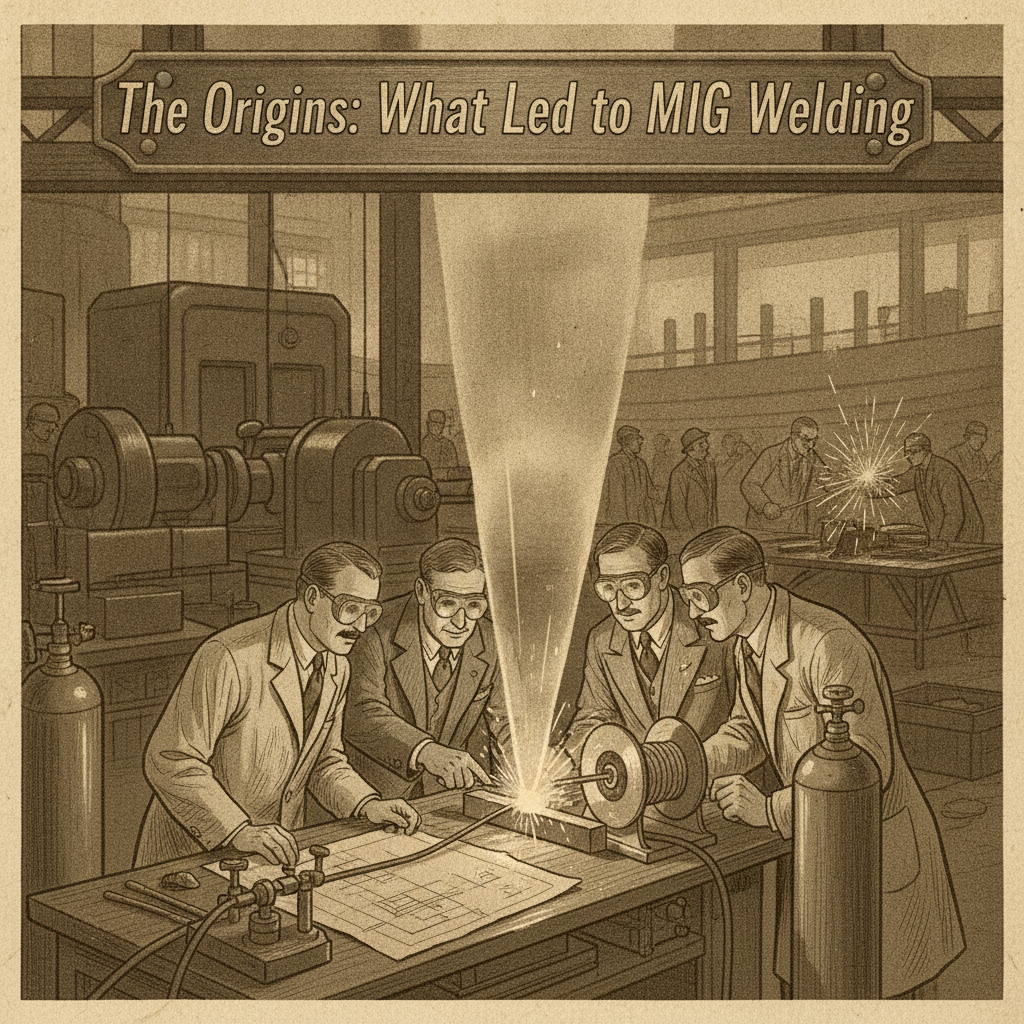
Before MIG welding existed, welders relied heavily on stick welding (SMAW) and TIG welding (GTAW). TIG welding, developed in the late 1930s and early 1940s, was a major breakthrough — it used an inert gas shield to protect the weld pool from atmospheric contamination, producing clean, high-quality welds.
The problem with TIG welding was speed. It required a separate filler rod fed by hand, making it slow and demanding a high level of skill. For industries like aerospace and automotive manufacturing that needed to weld aluminum and non-ferrous metals quickly and consistently, TIG simply couldn’t keep up with production demands.
That gap is exactly what MIG welding was designed to fill.
The Inventors Behind the Process
Battelle Memorial Institute and the 1948 Breakthrough
The formal development of MIG welding is credited to researchers at Battelle Memorial Institute in Columbus, Ohio. The key figure in this work was P.O. Nobel, who led the research effort. Working alongside engineers from the Air Reduction Company (later known as Airco), the team developed a process that fed a consumable wire electrode continuously through a welding gun, shielded by an inert gas — initially helium, and later argon.
The process was patented in 1948 and introduced commercially shortly after. The patent described what we now recognize as Gas Metal Arc Welding (GMAW), commonly called MIG welding — short for Metal Inert Gas welding.
The Role of Air Reduction Company
Air Reduction Company played a significant commercial role in bringing the technology to market. Their engineers contributed to refining the equipment design, particularly the wire feed mechanism and the welding gun, making the process practical for industrial use rather than just a laboratory concept.
Without their manufacturing and engineering input, the Battelle research might have remained theoretical for much longer.
How the Process Evolved After 1948
The original MIG process used inert gases — helium and argon — which worked well for aluminum and non-ferrous metals but was expensive for welding steel. Steel was, and still is, the most commonly welded material in industry.
The Shift to CO₂ and Mixed Gases
In 1953, a Soviet engineer named Lyubavskii and his colleague Novoshilov discovered that using carbon dioxide (CO₂) as a shielding gas made the process far more economical for welding steel. CO₂ is not truly inert — it’s an active gas — which is why the broader process is now called GMAW (Gas Metal Arc Welding) rather than strictly MIG welding.
This development opened the door to widespread industrial adoption. CO₂ shielding was cheap, widely available, and produced acceptable weld quality on mild steel. Today, most MIG welding on steel uses a mixed gas — typically 75% argon / 25% CO₂ — which balances cost with weld quality and reduced spatter.
Short-Circuit Transfer and Spray Transfer Refinements
Through the 1950s and 1960s, engineers refined the different metal transfer modes within GMAW:
– Short-circuit transfer — lower voltage, suitable for thin materials and out-of-position welding
– Globular transfer — higher voltage, less controlled, more spatter
– Spray transfer — high voltage and argon-rich gas, producing a fine, smooth arc ideal for thicker metals
Each mode expanded the range of applications MIG welding could handle, cementing its place as a versatile industrial process.
MIG Welding vs. TIG Welding: The Key Differences
Since MIG welding grew directly out of the limitations of TIG welding, it’s worth understanding how they compare.
| Feature | MIG Welding (GMAW) | TIG Welding (GTAW) |
|---|---|---|
| Electrode type | Consumable wire | Non-consumable tungsten |
| Filler metal | Fed automatically | Fed manually by hand |
| Shielding gas | Argon, CO₂, or mixed | Argon or helium |
| Speed | Fast | Slow |
| Skill level required | Lower | Higher |
| Weld quality | Good | Excellent |
| Best for | Steel, aluminum, production | Thin metals, precision work |
| Typical use | Automotive, fabrication | Aerospace, pipe, artistic work |
MIG welding trades some of TIG’s precision for significantly higher speed and ease of use — a trade-off that made it ideal for high-volume manufacturing.
Why the Name “MIG” Stuck (Even Though It’s Not Always Accurate)
The term MIG — Metal Inert Gas — was accurate when the process was first developed using helium and argon. Once CO₂ became common, the gas was no longer truly inert, making the name technically incorrect for many applications.
The American Welding Society (AWS) standardized the process under the name GMAW (Gas Metal Arc Welding) to be more accurate. In Europe, you’ll also hear the term MAG welding (Metal Active Gas) used specifically when CO₂ or mixed gases are involved.
In practice, most welders, suppliers, and manufacturers still call it MIG welding regardless of which gas is used. The name is too embedded in everyday language to disappear.
The Impact of MIG Welding on Modern Manufacturing
It’s hard to overstate how much MIG welding changed industrial production. Before its widespread adoption, welding was a slow, highly skilled trade. MIG welding made it possible to train workers faster, weld more consistently, and dramatically increase throughput.
Key industries transformed by MIG welding include:
– Automotive manufacturing — robotic MIG welding is standard on modern assembly lines
– Shipbuilding — long continuous welds on steel plate became far more efficient
– Structural steel fabrication — beams, frames, and supports welded at speed
– HVAC and pipe fabrication — ductwork and light structural components
– Home and hobby welding — affordable MIG machines made welding accessible to non-professionals
The development of wire feed automation and eventually robotic welding systems built directly on the MIG process, making it the backbone of modern automated manufacturing.
FAQ
Who is credited with inventing MIG welding?
MIG welding is primarily credited to researchers at Battelle Memorial Institute, with P.O. Nobel leading the development effort. The work was done in collaboration with engineers at Air Reduction Company. The process was patented in 1948 and commercially introduced shortly after, initially targeting aluminum and non-ferrous metal welding in aerospace applications.
What year was MIG welding invented?
MIG welding was developed and patented in 1948. Commercial equipment became available in the United States around 1948 to 1950. The process expanded significantly after 1953, when CO₂ shielding gas was introduced for welding steel, making it affordable and practical for large-scale industrial use.
What was MIG welding originally designed for?
The original MIG process was designed primarily for welding aluminum and non-ferrous metals in the aerospace industry. TIG welding could handle these materials but was too slow for production environments. MIG’s continuous wire feed and inert gas shielding offered a faster alternative without sacrificing the clean, oxide-free welds that aluminum requires.
What is the difference between MIG and GMAW?
They refer to the same process. GMAW (Gas Metal Arc Welding) is the official AWS term and is technically more accurate because it covers both inert and active shielding gases. MIG (Metal Inert Gas) is the older, informal name that stuck in everyday use. When CO₂ or mixed gases are used on steel, some standards call it MAG welding (Metal Active Gas).
Did the Soviet Union contribute to MIG welding development?
Yes. In 1953, Soviet engineers Lyubavskii and Novoshilov demonstrated that CO₂ could be used as a shielding gas instead of expensive inert gases. This made MIG welding economically viable for welding steel, which is far more common than aluminum in most industries. Their contribution was critical to the global adoption of the process.
How did MIG welding change the automotive industry?
MIG welding allowed automakers to weld steel body panels, frames, and components far faster than stick or TIG welding. It also enabled automation — robotic MIG welding arms became standard on assembly lines from the 1970s onward. Today, a modern vehicle contains hundreds of MIG welds, many made by robotic systems that operate continuously with minimal human intervention.
Is MIG welding still the most common welding process today?
MIG welding remains one of the most widely used processes globally, particularly in manufacturing, fabrication, and repair work. Flux-core arc welding (FCAW) and resistance spot welding compete in specific applications, but GMAW’s combination of speed, versatility, and relatively low skill threshold keeps it dominant in both industrial and hobbyist settings.
Final Thoughts
MIG welding’s invention in 1948 was a direct response to a real production problem — the need to weld aluminum and non-ferrous metals faster than TIG welding allowed. What started as a specialized aerospace process became the world’s most widely used welding method once CO₂ shielding made it practical for steel. The next time you watch a welder lay down a clean, fast bead, you’re seeing the result of work that began at Battelle Memorial Institute over 75 years ago — refined, automated, and scaled into an industry that builds almost everything around us.


