
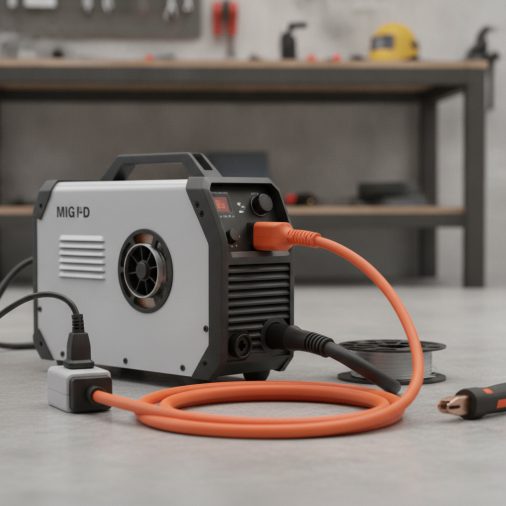
Plugging a MIG welder into an extension cord seems like a simple solution when your outlet is too far away. But get it wrong, and you risk damaging your machine, tripping breakers constantly, or creating a genuine fire hazard. This article explains exactly when an extension cord is safe to use, what specifications actually matter, and how to avoid the mistakes that cause most problems in the field.
Yes, you can use an extension cord with a MIG welder — but only if it meets specific requirements. The cord must be heavy-gauge (typically 6 AWG or 8 AWG for 240V machines), rated for the welder’s amperage draw, and kept as short as possible. A cheap or undersized cord will cause voltage drop, overheating, and poor weld quality.
Why Extension Cords and Welders Are a Tricky Combination
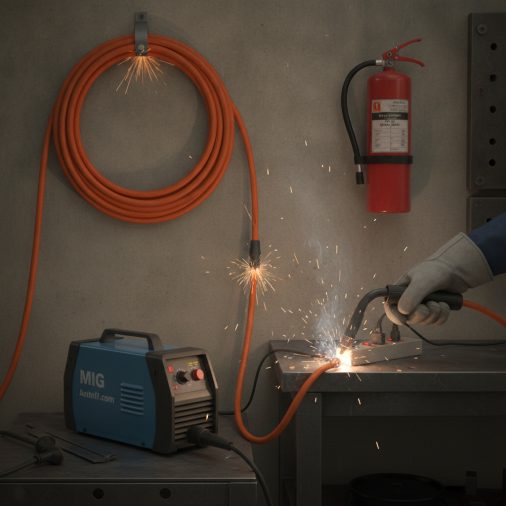
MIG welders are high-demand electrical loads. Even a mid-range 140-amp hobby welder can draw 20–30 amps from the wall during operation. A professional 250-amp machine can pull 50 amps or more at full output.
Extension cords have resistance. The longer and thinner the cord, the more resistance it adds to the circuit. That resistance causes voltage to drop before it even reaches the welder.
Voltage drop is the core problem. When a MIG welder receives less voltage than it needs, the machine compensates by drawing more current — which generates heat in the cord, stresses the welder’s internal components, and produces inconsistent arc performance. In practice, a welder running on an undersized extension cord often shows erratic wire feed, weak arc starts, and poor penetration.
The Specifications That Actually Matter
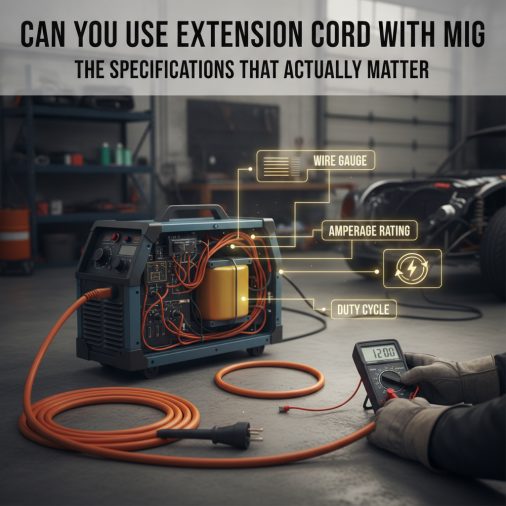
When selecting an extension cord for a MIG welder, three specifications determine whether it will work safely:
Wire Gauge (AWG)
Wire gauge is the most critical factor. Lower AWG numbers mean thicker wire and less resistance.
| Welder Type | Input Voltage | Recommended Minimum AWG |
|---|---|---|
| Light-duty hobby welder (90–140A output) | 120V | 12 AWG |
| Mid-range welder (140–200A output) | 240V | 10 AWG |
| Heavy-duty welder (200–250A output) | 240V | 8 AWG |
| Industrial welder (250A+ output) | 240V | 6 AWG |
These are minimum recommendations. Going one gauge heavier than required is always the safer choice.
Cord Length
Resistance increases with length. A 25-foot cord causes far less voltage drop than a 100-foot cord of the same gauge. As a general rule:
– Under 25 feet: 10 AWG is typically adequate for most 240V hobby welders
– 25–50 feet: Step up to 8 AWG minimum
– 50–100 feet: 6 AWG is the practical minimum for any serious welding work
– Over 100 feet: Avoid if possible; if necessary, use 4 AWG and expect some performance compromise
Amperage Rating
Every extension cord has a printed amperage rating. That rating must exceed the welder’s maximum input amperage draw — not the output amperage. Check your welder’s data plate or manual for the input amperage specification. A 200-amp output MIG welder running on 240V typically draws around 30–40 amps from the wall.
120V vs. 240V Welders: Different Rules Apply
The voltage of your welder changes what kind of extension cord you need.
120V MIG welders (typically smaller flux-core or entry-level MIG machines) draw higher current for the same power output compared to 240V machines. A 120V welder running at 20 amps needs a 12 AWG cord at minimum, and even then, keep the run short.
240V MIG welders draw less current for equivalent power, which gives you slightly more flexibility on cord length — but the voltage is higher, so the safety stakes are also higher. Never use a standard household extension cord (typically 16 AWG or 14 AWG) with a 240V welder under any circumstances.
The plug type also matters. A 240V welder uses a NEMA 6-50 or NEMA 14-50 plug in most cases. Your extension cord must match that plug configuration exactly. Using adapters to force a mismatched connection is dangerous and should be avoided.
What Happens When You Use the Wrong Cord
This is where field experience is instructive. A common issue technicians encounter is a welder that “works fine” on a cheap extension cord at low settings but starts tripping breakers or producing spatter-heavy welds at higher amperage settings.
Here’s what actually happens inside an undersized cord:
– Voltage drop reduces the effective voltage reaching the welder, causing the machine to struggle
– Resistance heating builds up in the cord itself — the cord gets warm or hot to the touch, which is a warning sign
– Breaker trips occur because the welder draws excess current trying to compensate for low voltage
– Welder damage can result over time, particularly to the transformer, wire feed motor, or control board
– Fire risk increases if the cord’s insulation degrades from repeated overheating
A cord that feels warm during welding is already undersized. A cord that feels hot is a fire hazard and should be replaced immediately.
Choosing the Right Extension Cord: Practical Checklist
Before buying or using an extension cord with your MIG welder, run through this checklist:
– [ ] Check the welder’s data plate for input voltage and maximum input amperage
– [ ] Select a cord gauge rated for at least that amperage at your intended length
– [ ] Confirm the cord’s plug and receptacle match your welder’s plug type
– [ ] Choose the shortest cord that gets the job done
– [ ] Verify the cord is rated for outdoor or heavy-duty use (look for “SJTW” or “SOOW” jacket ratings)
– [ ] Avoid extension cords sold in coiled form — always unroll completely before use to prevent heat buildup
– [ ] Check that the cord is in good condition with no cracked insulation, damaged plugs, or repair tape
SOOW-rated cords (rubber-jacketed, oil-resistant, outdoor-rated) are the preferred choice for welding environments. They handle heat better than standard vinyl-jacketed cords and hold up to shop floor abuse.
When You Should Not Use an Extension Cord
Some situations call for a different solution entirely rather than a longer cord.
Avoid extension cords entirely when:
– Your welder is rated above 250 amps output and you’re running at high duty cycles
– The required cord length exceeds 100 feet
– You’re welding in wet or damp conditions without a cord explicitly rated for those environments
– Your breaker panel can’t support a dedicated circuit for the welder’s location
In these cases, the right answer is having an electrician run a dedicated circuit to where you need it. A 50-amp, 240V dedicated circuit with proper wire gauge run through conduit is a permanent, safe solution that protects both the welder and the building’s electrical system.
FAQ
Can I use a 12 AWG extension cord with a 240V MIG welder?
Generally, no. A 12 AWG cord is too thin for most 240V MIG welders, especially at any meaningful length. At 240V, you’re typically drawing 30–50 amps from the wall, and 12 AWG is only rated for 20 amps. Using it risks overheating the cord, tripping breakers, and causing voltage drop severe enough to damage the welder over time.
Why does my MIG welder trip the breaker when I use an extension cord?
This almost always points to an undersized cord causing voltage drop. When the welder receives less voltage than required, it pulls more current to compensate, which pushes the circuit past the breaker’s threshold. The fix is switching to a heavier-gauge, shorter cord — or running a dedicated circuit directly to the welder’s location.
Does cord length really affect weld quality that much?
Yes, noticeably so. A 100-foot run of 10 AWG cord can cause enough voltage drop to make a 200-amp welder behave like a 160-amp welder. You’ll see inconsistent arc starts, more spatter, reduced penetration, and difficulty maintaining a stable puddle. Most experienced welders notice the difference immediately when comparing a long cord run to a direct outlet connection.
What does SOOW mean on an extension cord, and why does it matter for welding?
SOOW stands for Service, Oil-resistant insulation, Oil-resistant jacket, Weather-resistant. For welding applications, the oil and heat resistance of the jacket matters because welding environments often involve metal shavings, grinding sparks, and floor-level abuse. SOOW cords handle these conditions significantly better than standard vinyl-jacketed cords and are the recommended type for any serious shop use.
Can I use a generator extension cord for my MIG welder?
Heavy-duty generator extension cords are often a good match because they’re typically built with 10 AWG or 8 AWG wire and rated for high amperage. Check the cord’s amperage rating and gauge against your welder’s input requirements. If the specs align, a generator cord can work well — just confirm the plug type matches your welder’s inlet.
Is it safe to use an extension cord with a flux-core MIG welder?
Flux-core welders that run on 120V follow the same rules as any other 120V welder. Use a minimum 12 AWG cord, keep the run under 25 feet where possible, and never use a standard household 16 AWG cord. The smaller size of most flux-core machines doesn’t eliminate the risk — it just means the minimum acceptable cord gauge is slightly more forgiving than with larger 240V machines.
What gauge extension cord do I need for a Lincoln Electric 210MP or similar multi-process welder?
For a 240V machine like the Lincoln 210MP, which draws approximately 30 amps at full output, use a minimum 10 AWG cord for runs up to 25 feet. For 25–50 feet, step up to 8 AWG. Always unroll the cord fully before welding, and use a SOOW or SJTW-rated cord rather than a standard household extension cord.
Final Thoughts
Using an extension cord with a MIG welder is workable — but only when the cord is genuinely up to the task. The gauge, length, and amperage rating all have to align with your welder’s actual input requirements, not just its output amperage. When in doubt, go heavier on the gauge and shorter on the length. If you find yourself needing more than 50–75 feet of cord regularly, the better long-term investment is a dedicated circuit run to where you actually weld.


