
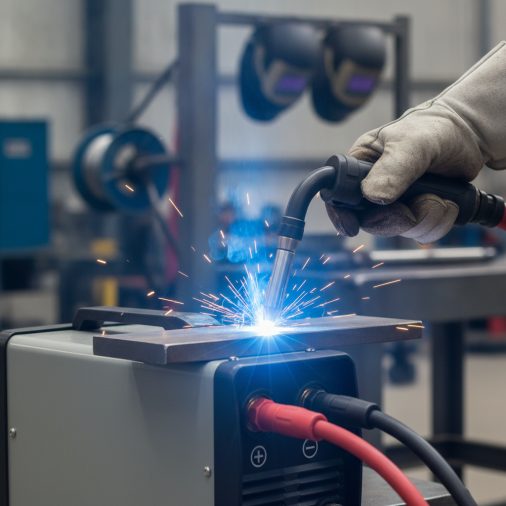
MIG welding polarity is one of those topics that confuses beginners and occasionally trips up intermediate welders switching between processes or wire types. Getting polarity wrong doesn’t just affect weld quality — it can cause erratic arcs, excessive spatter, and poor fusion. This article explains exactly what polarity MIG welding uses, why it matters, when exceptions apply, and how to verify your machine is set up correctly before striking an arc.
Standard MIG welding uses DCEP — Direct Current Electrode Positive, meaning the welding wire (electrode) connects to the positive terminal and the workpiece connects to the negative terminal. This polarity delivers deeper penetration, a stable arc, and better overall weld quality for most solid wire applications.
What Polarity Actually Means in Welding
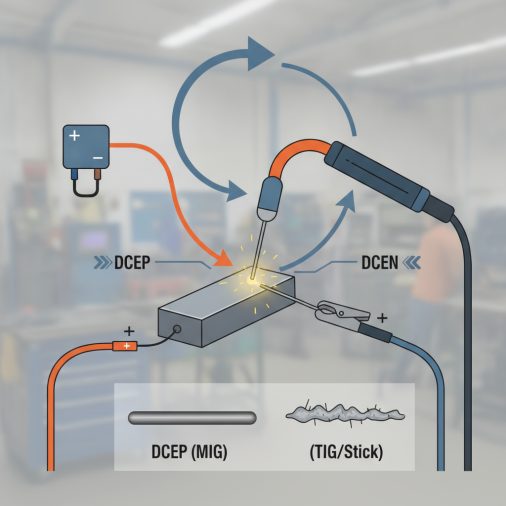
Polarity describes the direction electrical current flows through a welding circuit. In DC welding, current travels in one fixed direction — either from the machine to the electrode, or from the electrode back to the machine.
There are two DC polarity options:
– DCEP (Direct Current Electrode Positive) — also called reverse polarity. The electrode (wire) is positive; the workpiece is negative. Current flows from the workpiece to the electrode.
– DCEN (Direct Current Electrode Negative) — also called straight polarity. The electrode is negative; the workpiece is positive. Current flows from the electrode to the workpiece.
The direction of current flow changes how heat is distributed across the weld, which directly affects penetration depth, bead profile, and arc stability.
Why MIG Welding Defaults to DCEP (Electrode Positive)
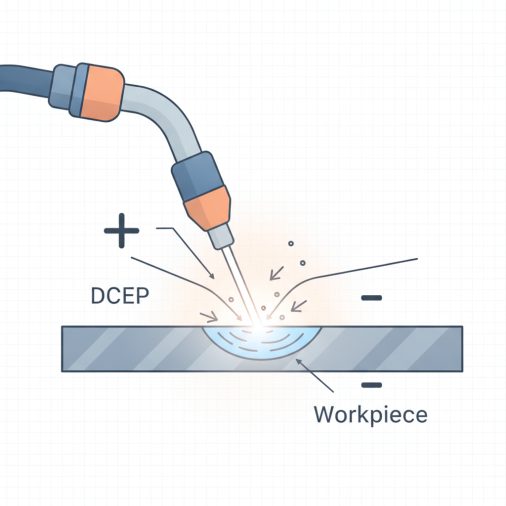
With DCEP, roughly two-thirds of the arc heat concentrates at the electrode (the wire). This sounds counterintuitive — you’d expect heat at the base metal to be more useful — but the physics work in your favor.
The higher heat at the wire tip helps melt the electrode consistently and transfer droplets smoothly into the weld pool. The remaining heat at the base metal is still sufficient for good fusion and penetration on most common material thicknesses.
DCEP with solid wire and shielding gas produces:
– A stable, controllable arc
– Smooth metal transfer (spray, globular, or short-circuit depending on settings)
– Good penetration into the base metal
– Minimal spatter compared to DCEN on the same wire
Field experience consistently shows that solid wire MIG on DCEP is forgiving and predictable — which is a big reason it became the industry standard for gas-shielded MIG welding.
The Exception: Flux-Core Wire and DCEN
Here’s where many welders get caught off guard. Flux-cored wire (FCAW) often requires DCEN, not DCEP — the opposite of solid wire MIG.
Self-shielded flux-core wire (the type that doesn’t need external shielding gas) is specifically designed to run on DCEN. The flux chemistry in the wire core generates its own shielding and works correctly only when the electrode is negative.
Running self-shielded flux-core wire on DCEP typically results in:
– Excessive spatter
– Porosity in the weld
– Poor arc stability
– Weak, inconsistent fusion
Gas-shielded flux-core wire (FCAW-G), however, generally runs on DCEP — similar to solid wire MIG. Always check the wire manufacturer’s data sheet before assuming polarity.
| Wire Type | Typical Polarity | Shielding |
|---|---|---|
| Solid MIG wire (ER70S-6, etc.) | DCEP | External gas required |
| Self-shielded flux-core (E71T-11, etc.) | DCEN | No gas needed |
| Gas-shielded flux-core (E71T-1C, etc.) | DCEP | External gas required |
| Aluminum MIG wire | DCEP | External gas required |
| Silicon bronze MIG wire | DCEP | External gas required |
How to Check and Change Polarity on Your MIG Welder
Most MIG welders have a polarity changeover point inside the machine — typically behind the wire feed panel or inside the front access door. It’s usually a set of terminals with cables that can be swapped.
To verify and change polarity:
1. Turn the machine completely off and unplug it from power.
2. Open the wire feed compartment or access panel (location varies by brand — check your manual).
3. Locate the two cable terminals labeled + (positive) and − (negative).
4. The torch lead (going to the gun) should connect to + for DCEP, or − for DCEN.
5. The work clamp lead connects to the opposite terminal.
6. Swap the cables if needed, then close the panel securely.
7. Reconnect power before welding.
Some newer inverter-based MIG machines include a polarity switch on the front panel, making this much faster. Machines like the Lincoln Electric Power MIG series and Miller Millermatic lineup often label this clearly.
If you’re unsure which terminal your torch lead connects to, trace the cable physically from the gun back to the machine’s internal terminals.
What Happens If You Weld with the Wrong Polarity
Wrong polarity is one of the most common setup mistakes in MIG welding, and the symptoms are hard to miss once you know what to look for.
Signs you’re running the wrong polarity:
– Excessive spatter — far more than normal for your wire and gas combination
– Erratic, unstable arc — the arc pops, stutters, or won’t settle
– Poor penetration — the bead sits on top of the metal rather than fusing into it
– Porosity — small holes or voids visible in the finished weld bead
– Inconsistent wire feeding — the arc seems to push back against the wire
In practice, a welder running solid wire on DCEN will often describe the arc as “fighting them.” The wire tends to stub into the puddle rather than transferring smoothly. Spatter increases dramatically, and the bead profile looks irregular and raised.
Catching this early saves material, time, and frustration. If a new spool of wire or a different machine suddenly produces these symptoms, polarity is the first thing to check.
Does Polarity Affect Penetration Depth?
Yes — polarity has a direct and measurable effect on penetration.
DCEP concentrates more heat at the base metal side of the arc compared to DCEN, which results in deeper penetration into the workpiece. This is why DCEP is preferred for structural welds, thicker materials, and applications where fusion quality is critical.
DCEN, when used intentionally (such as with self-shielded flux-core), produces a shallower, wider bead profile. This can actually be useful in specific situations — for example, welding thin sheet metal where burn-through is a risk, or in surfacing and hard-facing applications where you want to deposit material without melting deeply into the substrate.
The key takeaway: penetration depth is a function of both polarity and heat input (amperage, voltage, travel speed). Polarity sets the baseline; your settings fine-tune the result.
Polarity and AC: Does It Apply to MIG?
Standard MIG welding does not use AC (alternating current). MIG is a DC process. AC welding is primarily associated with TIG welding aluminum and stick welding with specific electrodes.
Some specialty applications use AC MIG for high-speed production welding on thin materials, but this is industrial-level equipment not typically encountered in fabrication shops or home workshops. For all practical purposes, MIG welding is a DC process, and polarity selection means choosing between DCEP and DCEN.
FAQ
Why does my MIG welder have polarity cables inside instead of a switch?
Older transformer-based MIG machines use physical cable swaps to change polarity because the design doesn’t accommodate a simple switch at those current levels. Inverter-based machines can manage polarity electronically, which is why newer models often include a front-panel switch. Both methods achieve the same result — they just reflect different internal designs.
Can wrong polarity damage my MIG welder?
Running the wrong polarity won’t typically damage the machine itself, but it can damage your gun consumables faster. The incorrect heat distribution accelerates wear on the contact tip and can cause irregular burnback into the tip. Over time, this increases consumable costs and may cause feeding problems. Fix polarity before assuming you have a gun or liner issue.
Is DCEP the same as reverse polarity?
Yes. DCEP and reverse polarity are the same thing — just different naming conventions. Older welding literature often uses “straight polarity” (DCEN) and “reverse polarity” (DCEP). Modern standards prefer DCEN and DCEP because the terms are self-explanatory. Both describe the same electrical configuration.
What polarity should I use for MIG welding aluminum?
Aluminum MIG welding (GMAW) uses DCEP, the same as steel solid wire. The difference with aluminum is the wire alloy (typically ER4043 or ER5356), the shielding gas (100% argon), and the gun setup (spool gun or push-pull system to handle the softer wire). Polarity itself remains DCEP.
Can I MIG weld without shielding gas by changing polarity?
Switching to DCEN and running self-shielded flux-core wire allows you to weld without external shielding gas. However, this is technically FCAW (flux-cored arc welding), not traditional MIG (GMAW). Many MIG machines support both processes. The wire type drives the polarity requirement — not the other way around.
What polarity does a Lincoln Electric or Miller MIG welder ship set to from the factory?
Most MIG welders ship configured for DCEP (electrode positive) because solid wire with shielding gas is the most common setup. If you’re switching to self-shielded flux-core wire, you’ll need to manually change the polarity to DCEN. The machine manual will show the exact location of the polarity terminals or switch for your specific model.
Does polarity matter for MIG welding stainless steel?
Yes. Stainless steel MIG welding uses DCEP, the same as carbon steel solid wire. The wire type changes (typically ER308L, ER309L, or ER316L depending on the base metal), and the shielding gas is usually a tri-mix or 98% argon / 2% CO₂ blend. Polarity stays DCEP throughout.
Final Thoughts
MIG welding with solid wire runs on DCEP — electrode positive — and that’s the correct setup for the vast majority of MIG applications. The one situation that genuinely requires DCEN is self-shielded flux-core wire, and confusing the two is one of the most common causes of poor weld quality that gets misdiagnosed as a technique or settings problem. Before adjusting voltage, wire speed, or gas flow, always confirm your polarity matches your wire type. It takes thirty seconds to check and can save an entire project.


