
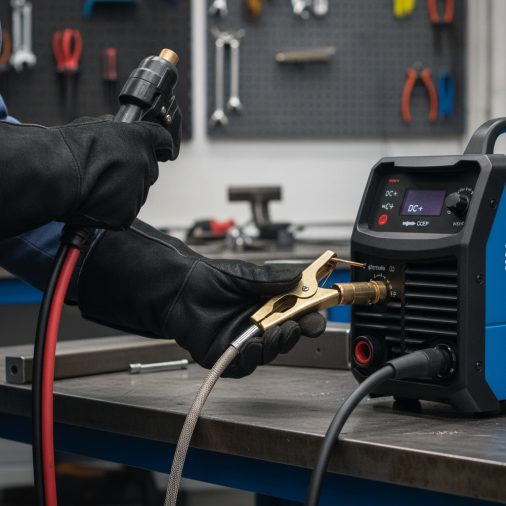
Getting MIG welding polarity wrong is one of the most common reasons for poor welds — and one of the easiest problems to fix once you understand what’s happening. This article explains what polarity means in MIG welding, how each polarity setting affects your weld, when to use each one, and how to troubleshoot polarity-related problems. Whether you’re setting up a new machine or diagnosing a weld that looks wrong, this guide covers everything you need.
MIG welding typically uses DCEP (Direct Current Electrode Positive), also called reverse polarity, where the electrode (wire) connects to the positive terminal. This produces deeper penetration, a stable arc, and cleaner welds. DCEN (electrode negative) is used for flux-core welding without gas. AC polarity is rarely used in MIG applications.
What Polarity Actually Means in MIG Welding
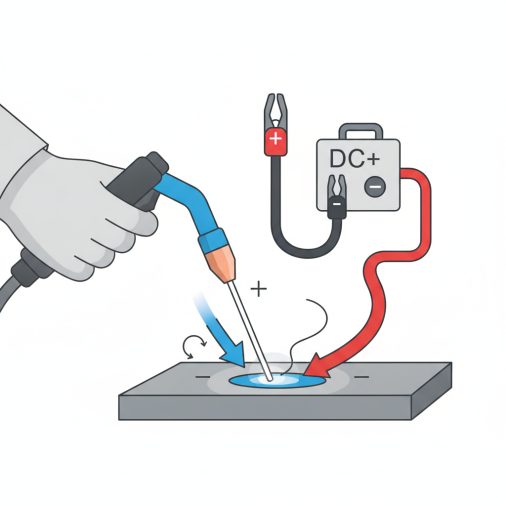
Polarity refers to the direction that electrical current flows through the welding circuit. In a DC (direct current) welding setup, current flows in one direction only — either from the machine to the wire, or from the wire back to the machine.
There are two DC polarity options:
– DCEP — Direct Current Electrode Positive (also called reverse polarity): The welding wire connects to the positive terminal. Current flows from the workpiece through the arc to the wire.
– DCEN — Direct Current Electrode Negative (also called straight polarity): The welding wire connects to the negative terminal. Current flows from the wire through the arc to the workpiece.
The direction of current flow changes how heat is distributed, how the arc behaves, and how well the wire fuses with the base metal.
Why Polarity Has Such a Big Effect on Your Weld
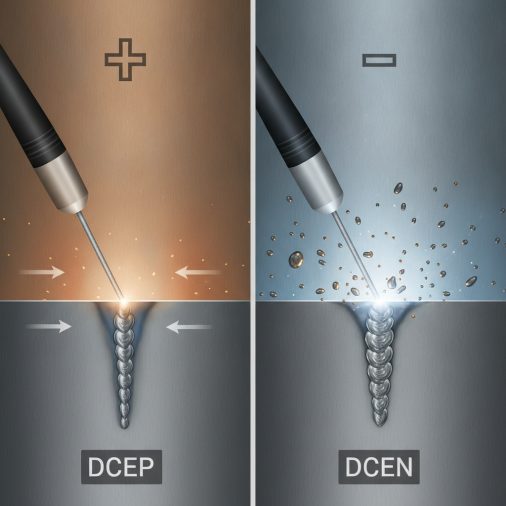
In any welding arc, roughly two-thirds of the heat concentrates at the positive side of the circuit. This is the core reason polarity matters so much.
With DCEP, the positive terminal is at the wire (electrode). That means more heat goes into the arc and the weld pool, producing:
– Deeper penetration into the base metal
– A stable, smooth arc
– Good cleaning action on the metal surface (important for aluminum)
– Slightly slower wire burn-off rate
With DCEN, the positive terminal is at the workpiece. Heat shifts toward the base metal surface rather than the arc itself, which produces:
– Shallower penetration
– Higher wire deposition rates (the wire melts faster)
– A less stable arc with standard solid wire
– Reduced heat input to the weld pool
In practice, DCEN with solid wire and shielding gas tends to produce a rough, spattery arc that’s difficult to control. This is why DCEP is the standard for solid wire MIG welding.
The Standard Polarity for Each MIG Process
| Process | Wire Type | Shielding Gas | Correct Polarity |
|---|---|---|---|
| Standard MIG (GMAW) | Solid wire (ER70S-6, etc.) | Required (75/25, 100% CO₂, etc.) | DCEP |
| Flux-Core (FCAW-S) | Self-shielded flux-core | None | DCEN |
| Gas-Shielded Flux-Core (FCAW-G) | Gas-shielded flux-core | Required | DCEP |
| Aluminum MIG | ER4043 / ER5356 aluminum wire | 100% Argon | DCEP |
| Stainless MIG | ER308L, ER316L, etc. | Tri-mix or 98/2 Argon/CO₂ | DCEP |
The most important distinction here is between self-shielded flux-core wire and solid wire. Self-shielded flux-core (like Lincoln NR-211 or Hobart Fabshield 21B) is specifically designed to run on DCEN. Running it on DCEP will produce a poor arc, excessive spatter, and weak fusion.
Gas-shielded flux-core wire (like Lincoln Outershield or Hobart FabCO) runs on DCEP, just like solid wire.
Always check the wire manufacturer’s data sheet — the correct polarity is listed there.
How to Change Polarity on a MIG Welder
Most MIG welders have a polarity changeover inside the machine, near the wire feed compartment. The process is straightforward:
1. Turn off and unplug the welder before touching any internal connections.
2. Open the wire feed door or side panel to access the internal terminals.
3. Locate the two leads — one connected to the wire feed stud and one to the work clamp circuit.
4. Swap the connections to change polarity. The labels inside the machine typically read “+” and “−” or “DCEP” and “DCEN.”
5. Reconnect the leads securely and close the panel.
6. Verify the polarity matches your wire type before welding.
Some higher-end machines have an external polarity switch or selector dial, which makes this process much faster. Entry-level flux-core/MIG combo machines (like many Lincoln Electric Handy MIG or Hobart Handler models) require the internal lead swap described above.
What Happens When You Use the Wrong Polarity
This is where a lot of welders get frustrated without knowing why. Running the wrong polarity doesn’t always produce an obvious error — sometimes the welder just feels “off” and the results are poor.
Symptoms of incorrect polarity:
– Excessive spatter that won’t go away even after adjusting voltage and wire speed
– Unstable, erratic arc that pops and sputters
– Poor fusion — the bead sits on top of the metal rather than penetrating it
– Porosity in the weld bead
– Wire stubbing into the workpiece (wire feeds but doesn’t melt smoothly)
– Weld bead looks convex, ropy, or inconsistent
Field experience shows that incorrect polarity is frequently the first thing to check when a welder has been working fine and then suddenly starts producing bad welds — especially after a wire change or process switch.
If you’ve recently switched from solid wire to flux-core (or vice versa) and the arc quality dropped sharply, polarity is almost certainly the issue.
Polarity and Shielding Gas: They Work Together
Polarity and shielding gas selection are closely linked. Using the right polarity with the wrong gas — or vice versa — still produces suboptimal results.
For solid wire MIG on steel, the standard combination is:
– DCEP + 75% Argon / 25% CO₂ (C25) for general fabrication
– DCEP + 100% CO₂ for deeper penetration and lower cost (more spatter)
For aluminum MIG, pure argon is required regardless of polarity. Running CO₂ or mixed gas on aluminum causes porosity and arc instability.
For self-shielded flux-core, no shielding gas is used at all. The flux inside the wire generates its own shielding when burned. Polarity (DCEN) is what makes this chemistry work correctly.
Getting both polarity and gas right together is what produces clean, consistent welds.
Common Polarity Mistakes and How to Avoid Them
Mistake 1: Switching to flux-core wire without changing polarity
This is the single most common polarity error. Many welders buy self-shielded flux-core wire to weld outdoors (where wind disrupts shielding gas) and forget to swap to DCEN. The result is a spattery, porous mess.
Mistake 2: Assuming all flux-core wire uses the same polarity
Self-shielded and gas-shielded flux-core wires use opposite polarity. Mixing them up produces the same symptoms as Mistake 1.
Mistake 3: Not checking the wire data sheet
Wire manufacturers specify polarity requirements clearly. Skipping this step — especially with specialty wires — leads to avoidable problems.
Mistake 4: Loose polarity connections inside the machine
After swapping leads, a loose connection can cause intermittent arc problems that look like voltage or wire speed issues. Always tighten the terminal connections firmly.
FAQ
What polarity is used for MIG welding?
Standard MIG welding with solid wire uses DCEP (Direct Current Electrode Positive), also called reverse polarity. The wire connects to the positive terminal. This produces a stable arc, good penetration, and clean welds. Self-shielded flux-core wire is the main exception — it requires DCEN (electrode negative). Always confirm polarity requirements with the wire manufacturer’s specifications before welding.
What happens if you MIG weld with the wrong polarity?
You’ll typically see excessive spatter, an unstable or erratic arc, poor fusion, and a bead that sits on top of the metal rather than penetrating it. Porosity is also common. These symptoms can look like voltage or wire speed problems, which is why polarity is often overlooked. Checking polarity first saves a lot of troubleshooting time.
Does polarity affect weld penetration?
Yes, significantly. DCEP concentrates more heat in the arc and weld pool, producing deeper penetration into the base metal. DCEN shifts heat toward the wire, which increases deposition rate but reduces penetration depth. For structural welds where fusion matters, DCEP is the correct choice with solid wire.
Can you MIG weld aluminum with DCEP?
Yes — aluminum MIG welding uses DCEP with 100% argon shielding gas. The DCEP polarity also provides a cathodic cleaning action that breaks up the aluminum oxide layer on the surface, which is critical for getting clean fusion. Using any CO₂ or mixed gas on aluminum will cause porosity and arc problems regardless of polarity.
Why does my flux-core wire produce so much spatter?
If you’re using self-shielded flux-core wire, the most likely cause is incorrect polarity. Self-shielded flux-core requires DCEN. If the machine is set to DCEP, the arc will be rough, spattery, and inconsistent. After confirming polarity, also check that voltage and wire speed are within the wire manufacturer’s recommended range for your material thickness.
Is AC polarity ever used in MIG welding?
Rarely, and only in specialized applications. Some older or budget welders output AC rather than DC, which produces an inconsistent arc for MIG welding. Most modern MIG welders output DC. AC is more commonly associated with TIG welding aluminum or stick welding with certain electrodes. For standard MIG work, DC is always preferred.
How do I know which polarity my welder is currently set to?
Open the wire feed compartment and look at which terminal the wire feed lead is connected to. If it connects to the “+” terminal, you’re on DCEP. If it connects to “−”, you’re on DCEN. Some machines have a polarity indicator label or a selector switch on the front panel. When in doubt, trace the leads visually — it takes less than a minute.
Final Thoughts
Polarity is one of those settings that’s easy to overlook because it doesn’t have a dial on the front of the machine — but it has a bigger impact on weld quality than most people expect. The rule is simple: solid wire and gas-shielded flux-core use DCEP; self-shielded flux-core uses DCEN. Any time a weld looks wrong and you’ve already adjusted voltage and wire speed without improvement, check polarity before anything else. Getting this right costs nothing and fixes problems that hours of other adjustments won’t solve.


