Choosing MIG wire isn’t always straightforward. With so many brands on the market, it’s easy to wonder whether a lesser-known name will hold up or whether you’re better off sticking with the big players. Radnor sits in an interesting middle ground—widely available through industrial distributors yet not always talked about in welding forums.
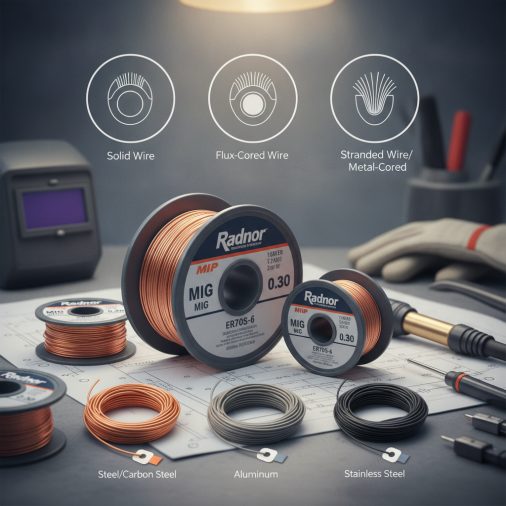
Radnor MIG welding wire is a private-label brand sold primarily through Airgas and its affiliated distributors. It covers the most common wire classifications including ER70S-6 solid wire and E71T-11 flux-core wire, and it generally performs comparably to mid-tier national brands at a competitive price point. It’s a practical choice for fabrication shops, maintenance welders, and serious hobbyists who buy through industrial supply channels.
What Radnor Wire Actually Is
Radnor is a house brand, which means it isn’t manufactured under its own name in a proprietary facility. Instead, it’s produced to spec by established wire manufacturers and sold under the Radnor label exclusively through Airgas distributors.
This is more common than most welders realize. Many “brand name” wires follow the same AWS classification standards, use comparable copper coatings and alloy compositions, and come off similar production lines. What matters most is whether the wire meets its stated AWS classification consistently.
Radnor products are held to those same AWS standards, which means a spool of Radnor ER70S-6 must meet the same chemical and mechanical requirements as Lincoln Electric or Hobart ER70S-6. The classification does most of the quality control work.
Available Wire Types and Classifications
Radnor offers wire across the most commonly used MIG and flux-core categories:
Wire Type
AWS Classification
Typical Application
Solid MIG Wire
ER70S-6
Mild steel, general fabrication
Flux-Core Wire
E71T-11
All-position, gasless welding
Stainless Wire
ER308L, ER309L
Stainless steel fabrication
Aluminum Wire
ER4043, ER5356
Aluminum welding
Low-Alloy Wire
ER80S-D2
Higher-strength mild steel
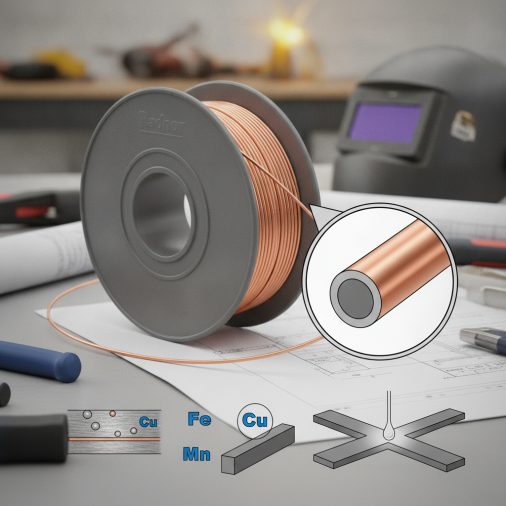
The ER70S-6 solid wire is by far the most commonly purchased Radnor product. It’s designed for welding mild steel with CO₂ or 75/25 Ar/CO₂ shielding gas and includes higher levels of silicon and manganese deoxidizers, which help produce cleaner welds on base metal that has light rust, mill scale, or surface contamination.
Understanding what MIG welding wire is made of helps clarify why deoxidizer levels in ER70S-6 wire matter so much for real-world weld quality.
Wire Diameter Options and What They Mean for Your Welder
Radnor solid wire typically comes in 0.023 in., 0.030 in., 0.035 in., and 0.045 in. diameters. Each suits different applications:
– 0.023 in. — Best for thin sheet metal, automotive panels, and light gauge work
– 0.030 in. — Versatile for 18 gauge to 3/16 in. steel; common for general shop use
– 0.035 in. — The most popular size for structural and general fabrication work
– 0.045 in. — Heavier production welding and thicker plate
If you’re unsure which to reach for, 0.030 in. or 0.035 in. covers most situations. Choosing the wrong diameter is one of the more common wire-related mistakes welders make. A wire that’s too heavy for thin material will cause burn-through; one that’s too light for thicker sections produces poor fusion and requires multiple passes where one would do.
For a detailed breakdown, this guide on what size MIG welding wire to use covers the practical decision-making process well.
How Radnor Wire Performs in Practice
Performance on a solid wire largely comes down to three factors: arc stability, spatter level, and feedability through the liner and contact tip. Field experience with Radnor ER70S-6 puts it in the dependable middle tier.
Arc stability is generally consistent. Users running 75/25 shielding gas report a smooth, predictable arc with no unusual wandering or instability at standard voltage and wire speed settings.
Spatter is modest and comparable to other ER70S-6 products. Running CO₂ (C100) produces more spatter than 75/25, which is true of any ER70S-6 wire—not a Radnor-specific issue.
Feedability is where some variation shows up. Occasionally, welders report that Radnor wire has slightly rougher surface finishing compared to premium options like Lincoln Electric SuperArc L-56, which can result in marginally increased liner wear over high-volume use. For light to moderate shop use, this isn’t likely to be noticeable. In high-production environments running thousands of pounds per year, the difference becomes more relevant.
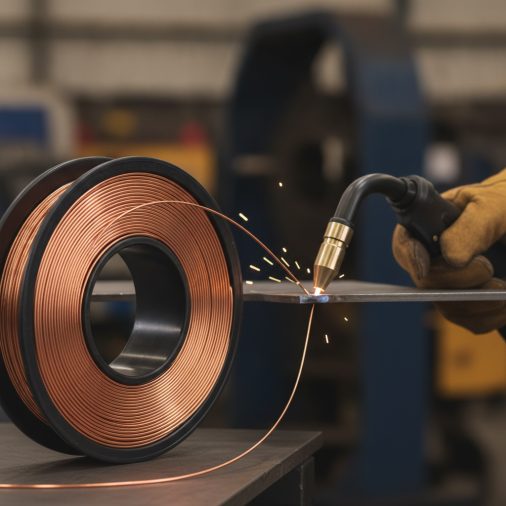
The copper coating on ER70S-6 wire affects both feedability and conductivity. Thin, even copper coating produces better electrical contact at the tip and smoother feeding. Radnor’s coating is functional, though not as refined as some premium brands marketed specifically for robotic or high-cycle applications.
Radnor vs. Other Common Wire Brands
When comparing Radnor to other ER70S-6 options, the differences are rarely about capability and more about consistency and value.
Brand
Tier
Best For
Notes
Radnor ER70S-6
Mid-tier
Shop and fabrication use
Airgas exclusive; reliable AWS compliance
Lincoln Electric SuperArc L-56
Premium
High-production, robotic welding
Consistent copper coating; premium pricing
Hobart HB-28
Mid-tier
General shop use
Widely available; solid performance
ESAB Spoolarc 86
Premium
Structural and high-volume work
Excellent feedability and arc character
Washington Alloy ER70S-6
Budget-mid
Price-sensitive purchasing
Broad distribution; variable coating quality
For most welders doing structural fab, maintenance work, or shop repairs, Radnor performs close enough to premium options that the cost difference is hard to justify—especially when purchasing through an existing Airgas account where pricing may already be competitive.
Shielding Gas Pairing
Like all ER70S-6 wire, Radnor solid wire requires shielding gas. It doesn’t work as a self-shielded wire.
– 75% Argon / 25% CO₂ (C25) — The most popular choice. Produces lower spatter, better bead appearance, and good mechanical properties.
– 100% CO₂ (C100) — Lower cost, deeper penetration, but more spatter and a rougher bead profile.
– 90/10 or 85/15 Ar/CO₂ — Less common; used when slightly better arc control is needed without moving to a tri-mix.
For most applications, 75/25 is the practical default. If you’re switching between steel and stainless regularly, it’s worth reading up on whether normal MIG wire works on stainless steel before assuming you can use the same spool.
Common Issues and How to Fix Them
Even quality wire causes problems when setup or storage conditions aren’t right.
Wire birds-nesting at the drive rolls
Usually caused by a mismatched drive roll groove, excessive tension, or a blocked liner. Check that the drive roll groove matches the wire diameter and that the contact tip isn’t partially plugged.
Porosity in the weld
Most often a shielding gas issue—check flow rate (typically 15–25 CFH), hose connections, and that the nozzle isn’t clogged with spatter. Can also indicate contaminated base metal.
Inconsistent arc or sputtering
Worn contact tip is the most common culprit. Radnor wire, like any ER70S-6, will wear contact tips over time. Replace tips regularly, especially in high-amperage applications.
Rust or contamination on the wire
Radnor wire stored in humid environments can develop surface oxidation. Oxidized wire feeds poorly and causes porosity. Store wire in sealed bags or a dry cabinet and use a wire conditioner pad on the liner entrance.
For situations where the wire feed system itself is the problem, troubleshooting a wire feed motor that’s not working covers the mechanical side in detail.
Where Radnor Wire Makes the Most Sense
Radnor is a practical choice in specific situations:
– Existing Airgas customers — If you already purchase gas or consumables through Airgas, Radnor wire often arrives on the same order, simplifying procurement.
– Light to medium production shops — The wire performs consistently enough for everyday fabrication without the premium cost of top-tier brands.
– Maintenance and repair welding — ER70S-6’s deoxidizers make it forgiving on real-world steel that isn’t perfectly clean.
– Flux-core applications without gas — The Radnor E71T-11 is a reasonable option for outdoor or field welding where running a gas cylinder isn’t practical.
It’s less suited for robotic welding cells or high-cycle automation where wire consistency and copper coating uniformity directly affect system uptime and contact tip life.
FAQ
Is Radnor MIG wire made in the USA?
Radnor is a private-label brand owned by Airgas, which is a major industrial gas and welding supply company. The wire may be manufactured domestically or offshore depending on the product line and current supply agreements. Airgas doesn’t consistently disclose the manufacturing origin for Radnor consumables, so if country of origin is a purchasing requirement, it’s worth confirming directly with your Airgas rep before ordering.
Can I use Radnor ER70S-6 wire on a Lincoln or Miller welder?
Yes. AWS-classified wire is interchangeable across MIG welders regardless of the machine brand. Radnor ER70S-6 will feed and perform the same way in a Lincoln Electric Weld-Pak 140 or a Miller Millermatic 211 as any other ER70S-6 wire. The wire classification defines the performance, not the machine brand.
What’s the difference between Radnor ER70S-6 and ER70S-3?
ER70S-6 contains higher levels of silicon and manganese deoxidizers compared to ER70S-3. In practice, this makes ER70S-6 more tolerant of base metal contamination—light rust, mill scale, or minor surface oxidation. ER70S-3 is better suited for clean, prepared base metal. For most general shop and field work, ER70S-6 is the safer and more forgiving default choice.
Does Radnor flux-core wire need shielding gas?
The Radnor E71T-11 flux-core wire is self-shielded, meaning it doesn’t require external shielding gas. This makes it well-suited for outdoor work or situations where wind or portability makes running a gas cylinder impractical. However, self-shielded flux-core typically produces more spatter and rougher bead appearance than gas-shielded wire. Understanding when MIG welding requires shielding gas helps clarify when each option makes sense.
How does Radnor wire compare in terms of spatter to Lincoln SuperArc L-56?
In side-by-side testing, Lincoln SuperArc L-56 generally produces noticeably less spatter, particularly in spray transfer or at higher amperages. This is partly due to tighter manufacturing tolerances and a more refined copper coating. For most light to medium welding, the spatter difference is manageable with Radnor wire. For high-volume production where cleanup time adds up, the premium wires tend to pay for themselves.
Can I use Radnor ER70S-6 wire to weld thinner sheet metal?
Yes, but wire diameter matters more than brand here. Use 0.023 in. or 0.030 in. wire for thin gauge material to reduce heat input and minimize burn-through risk. If you’re regularly welding thin panels, MIG welding sheet metal techniques covers the setup and technique side of keeping heat under control.
Is Radnor stainless MIG wire suitable for food-grade applications?
Radnor ER308L and ER309L stainless wire meets standard AWS classifications for stainless welding, but food-grade suitability depends on weld quality, surface finish, post-weld treatment, and compliance with applicable standards (such as FDA or USDA requirements). The wire classification alone doesn’t certify a weld for food contact applications. Always verify regulatory requirements with the relevant authority for your specific application.
The Practical Bottom Line
Radnor MIG weld wire is a dependable, mid-tier option for welders who buy through Airgas and need reliable AWS-classified wire without paying premium brand pricing. It’s not going to outperform Lincoln or ESAB in high-production robotic applications, but for fabrication shops, maintenance work, and serious hobbyist use, the performance gap is small enough that most welders won’t notice it in day-to-day use.
The key is matching the right classification and diameter to your application—that decision matters far more than the brand on the label. Store it properly, keep your liner and tips in good shape, and Radnor wire will do the job consistently.