If you’ve been shopping for welders or browsing metalworking forums, you’ve probably come across the term “IMIG welding” and wondered if it’s something different from standard MIG welding — or just a marketing label.
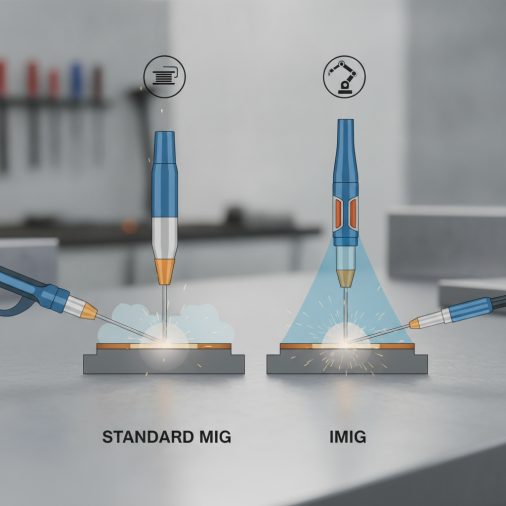
IMIG welding refers to Inverter MIG welding. It’s a form of MIG (Metal Inert Gas) welding that uses an inverter-based power source instead of a traditional transformer. The inverter technology makes the machine significantly lighter, more energy-efficient, and more responsive to arc adjustments. In practice, IMIG welders deliver the same fundamental welding process as conventional MIG machines, but with greater portability and often finer voltage control.
What Makes IMIG Different from Standard MIG
Traditional MIG welders use a heavy transformer to convert AC power into the DC current needed for welding. These machines are reliable but bulky — a shop-grade transformer MIG welder can weigh 60 to 100+ pounds.
Inverter MIG welders replace that transformer with a high-frequency inverter circuit. The inverter switches current at extremely high frequencies (typically 20,000–100,000 Hz), which allows the internal components to be much smaller while still delivering stable output. The result is a machine that might weigh 10–20 pounds but performs comparably to a transformer unit in many situations.
The “I” in IMIG simply identifies this inverter-based architecture. You’ll see this designation most often on compact welders marketed for home shops, auto body work, or mobile fabrication.
How the IMIG Process Actually Works
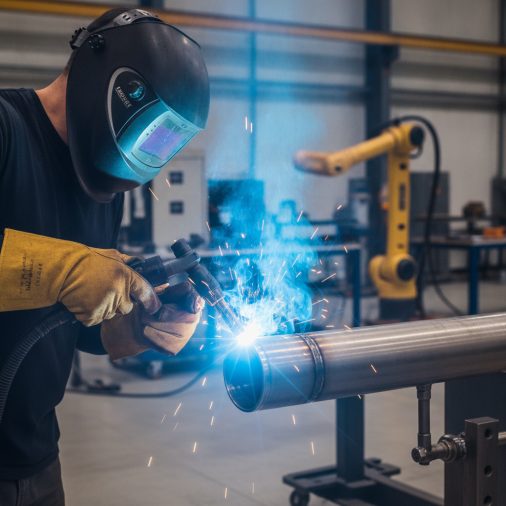
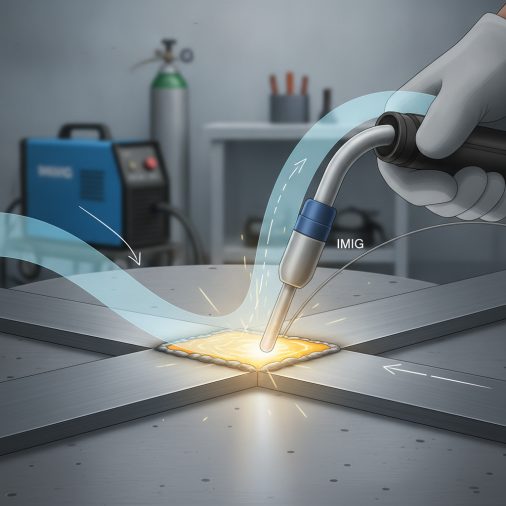
The core welding process is identical to standard MIG welding. A continuous solid wire electrode feeds through the gun at a controlled rate, an arc forms between the wire tip and the base metal, and shielding gas (typically C25 — 75% argon, 25% CO₂ — for mild steel) protects the molten puddle from atmospheric contamination.
What changes with inverter technology is how power is regulated. Inverter circuits respond to changes in arc conditions much faster than transformer circuits. This means:
– Better arc stability at lower amperages
– Smoother short-circuit transfer during thin metal welding
– Faster adjustment when voltage dips or surges occur
– Consistent output even on generator or extension cord power
For welders working on sheet metal, thin tubing, or automotive panels, this responsiveness makes a noticeable difference in bead quality and reducing spatter during MIG welding.
IMIG vs. Conventional MIG: Key Differences
Feature
Inverter MIG (IMIG)
Transformer MIG
Weight
10–25 lbs typical
50–100+ lbs
Energy efficiency
High (85–90%+)
Moderate (50–70%)
Arc response speed
Very fast
Slower
Performance on thin metal
Excellent
Good
Cost (entry level)
Generally lower
Varies
Durability (heavy shop use)
Moderate–Good
Very high
Generator compatibility
Usually good
Can be problematic
Transformer-based machines still have a place in heavy industrial environments where continuous duty cycles and extreme abuse resistance matter most. But for the majority of hobbyists, automotive fabricators, and small-shop welders, an IMIG unit offers practical advantages with very few downsides.
What Materials Can You Weld with an IMIG Welder?
IMIG welders handle the same metals as any MIG setup. Material capability depends on wire selection, shielding gas, and machine amperage range — not the inverter technology itself.
Common applications include:
– Mild steel — the most common, using ER70S-6 wire and C25 gas
– Stainless steel — possible with ER308L wire and a tri-mix or 98/2 argon/CO₂ gas blend
– Aluminum — requires a spool gun or push-pull setup and 100% argon shielding gas
– Flux-cored wire — many IMIG machines support gasless FCAW (flux-cored arc welding) as well
Knowing what size MIG welding wire to use for your material thickness is just as important with an IMIG unit as with any other MIG welder. Wire diameter recommendations don’t change based on whether the power source uses an inverter.
Typical Settings and Duty Cycle Considerations
Most compact IMIG welders sold for home and light professional use fall in the 130–200 amp range. Here’s a general reference for mild steel:
Metal Thickness
Wire Diameter
Voltage (approx.)
Wire Speed
18–22 gauge
0.023"
14–16V
Low–Medium
1/8"
0.030"
17–19V
Medium
3/16"
0.035"
18–21V
Medium–High
1/4"
0.035"–0.045"
20–23V
High
Duty cycle matters more than most beginners expect. A typical compact IMIG welder at 150 amps might carry a 30–40% duty cycle — meaning 3–4 minutes of welding per 10-minute cycle before needing to cool. Exceeding duty cycle consistently shortens inverter component life faster than it would on a transformer machine.
In practice, this isn’t an issue for most repair and fabrication work. Long, continuous runs in production environments are where industrial transformer welders still hold an advantage.
Polarity Setup for IMIG Welding
Like all MIG welding, IMIG runs on DCEP (Direct Current Electrode Positive) when using solid wire with shielding gas. This means the welding gun is connected to the positive terminal and the work clamp to the negative. Understanding MIG welding polarity ensures proper fusion and arc characteristics regardless of the power source type.
If you’re running flux-cored wire (FCAW) without gas, most self-shielded wires require DCEN (electrode negative). Always check the wire manufacturer’s spec sheet before switching.
Common IMIG Welding Problems and Fixes
Erratic arc or wire stuttering
Usually caused by a worn or undersized contact tip, kinked liner, or mismatched wire diameter. Replace the contact tip and inspect the liner for bends or debris.
Porosity in the weld
Almost always a shielding gas issue — check for leaks, confirm flow rate (typically 15–25 CFH), and verify you’re using the correct gas for your wire type. Running solid wire without shielding gas produces heavily contaminated, porous welds.
Burnback (wire fusing to contact tip)
Voltage too high for the wire speed setting, or gun held too close to the workpiece. Increase wire speed slightly or reduce voltage.
Thermal shutdown
Duty cycle exceeded. Let the machine cool with the fan running. Don’t power off immediately — the fan continues cooling internal components.
Inconsistent penetration on thicker material
IMIG machines near their maximum amperage can struggle on thicker steel. Consider preheating material above 3/16″ thickness or stepping up to a higher-capacity machine.
Choosing an IMIG Welder: What Actually Matters
The inverter label alone doesn’t tell you much about build quality. Focus on:
– Amperage range — match it to your typical material thickness
– Duty cycle at working amperage — not just peak duty cycle
– Wire feed system quality — metal drive rolls outperform plastic on longevity
– Gas solenoid reliability — budget machines sometimes have inconsistent gas flow
– Parts availability — contact tips, liners, and nozzles should be easy to source
The Lincoln Electric Easy MIG 180 and the Hobart Handler 190 are both inverter-based machines commonly recommended for serious hobbyists and light fabricators. Both offer solid duty cycles and reliable wire feed systems without crossing into heavy industrial pricing.
Safety Practices Specific to IMIG Welders
Inverter machines don’t fundamentally change welding safety requirements. UV radiation, fumes, spatter, and electrical hazards are identical to any MIG setup. However, a few practical notes apply:
– Never open the case to repair inverter circuits yourself — capacitors retain dangerous charge even after unplugging
– Keep the machine’s cooling vents clear; compact inverter units rely on active airflow
– Avoid using very long extension cords without adequate wire gauge; voltage drop affects inverter performance more noticeably than transformer machines
MIG welding safety risks apply equally whether you’re using an inverter or transformer power source. Proper ventilation, eye protection, and grounding practices remain non-negotiable.
FAQ
Is IMIG welding good for beginners?
Yes. Inverter MIG welders are generally well-suited to beginners because they’re lightweight, easier to set up, and often more forgiving on thin metal. The faster arc response can actually help reduce common beginner mistakes like burning through sheet metal. MIG welding as a starting process is already considered beginner-accessible, and IMIG machines make that entry even more practical.
Can an IMIG welder run on a generator?
Most modern IMIG welders handle generator power better than transformer machines, but generator compatibility varies by model. Check the manufacturer specs for minimum generator wattage and confirm the generator produces clean sine wave output. Inverter generators (like Honda EU series) pair best with IMIG machines.
What shielding gas should I use with an IMIG welder on steel?
For mild steel, C25 (75% argon, 25% CO₂) is the standard choice. It provides good penetration, a stable arc, and minimal spatter. Pure CO₂ is cheaper and gives deeper penetration but produces more spatter. For a detailed breakdown, choosing the best gas for MIG welding mild steel covers the comparison thoroughly.
Does IMIG welding produce weaker welds than conventional MIG?
No. Weld strength depends on technique, base metal preparation, filler wire selection, and proper fusion — not on whether the power source uses an inverter or transformer. Properly executed IMIG welds meet the same structural standards as transformer MIG welds.
Can I weld aluminum with an IMIG welder?
Many IMIG machines support aluminum welding, but you’ll typically need a spool gun attachment to prevent the soft aluminum wire from birdnesting in the standard liner. You’ll also need 100% argon shielding gas. Check whether your specific machine has a spool gun port before purchasing one.
How do I know when my IMIG welder’s duty cycle is being exceeded?
Most machines have a thermal overload indicator light that activates when the duty cycle is reached. The machine will cut output but the cooling fan continues running. Wait until the indicator clears before resuming — typically 5–10 minutes depending on ambient temperature.
Is flux-cored wire compatible with IMIG welders?
Yes, most IMIG welders support both solid wire with gas and flux-cored wire (gasless). You’ll need to swap polarity to DCEN for self-shielded flux-cored wire and change to knurled drive rolls to grip the softer tubular wire properly. Always confirm your specific machine supports dual-process operation.
IMIG welding is simply MIG welding with a smarter, more efficient power source. The inverter technology brings real practical benefits — weight, responsiveness, and energy efficiency — without changing the fundamental process or the skills required to do it well. For most home shop welders and small fabricators, the advantages are genuine and the limitations are rarely encountered in normal use.