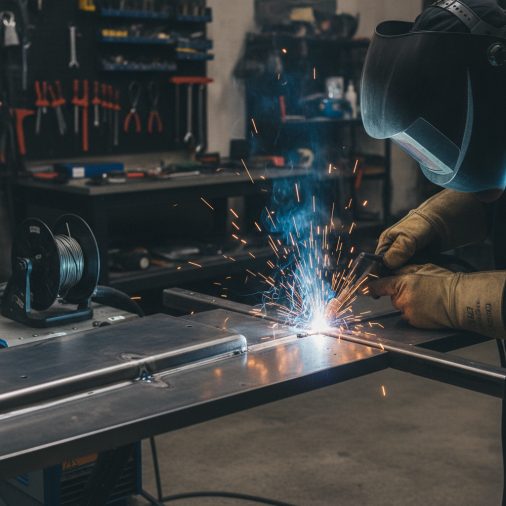
Automotive sheet metal is thin, unforgiving, and quick to warp or blow through. If you’re planning to repair a floor pan, patch a quarter panel, or tackle rust repair on a daily driver, understanding how flux core welding behaves on body panels can save you a lot of grief before you strike an arc.
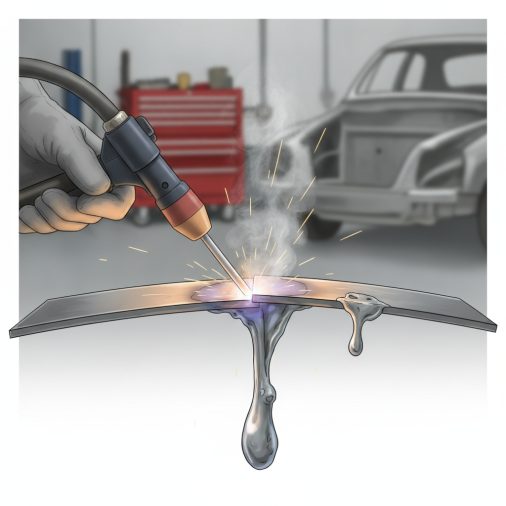
Flux core welding can work on automotive panels, but it requires careful setup and technique. The process runs hotter than MIG with shielding gas, which increases burn-through risk on thin 18–22 gauge sheet metal. Short tack sequences, reduced wire speed, and proper polarity settings are essential. For most panel work, self-shielded flux core wire in .030″ diameter is the most practical starting point.
Why Flux Core Welding Is Tricky on Thin Sheet Metal
Standard automotive body panels typically range from 18 gauge (0.048″) to 22 gauge (0.030″). That’s not much metal to work with. Flux core welding, even at reduced settings, delivers more heat than a shielded MIG setup running the same wire diameter.
The flux core process creates its own shielding through a chemical reaction inside the wire itself. That’s convenient — no gas cylinder needed — but it also produces a more aggressive arc with higher spatter and more heat concentration at the weld pool.
The result? Blown holes and warped panels are common for beginners. Neither is unfixable, but both slow down a repair job significantly.
Wire Selection and Polarity: Two Things You Must Get Right
Before touching metal, wire choice and polarity setup matter more on body panels than almost any other variable.
Wire diameter: Use .030″ flux core wire for automotive panels. Some experienced welders drop to .024″ on extremely thin metal, but .030″ is the practical sweet spot for control and availability.
Wire type: Self-shielded flux core wire, classified under AWS E71T-GS or E71T-11, is the standard choice for this application. These wires are designed for single-pass work on thin material without external shielding gas.
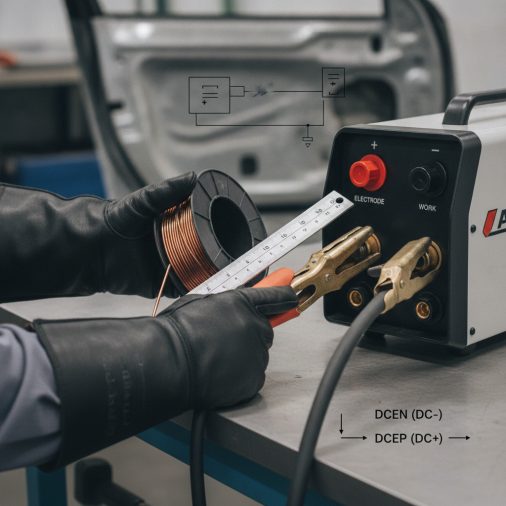
Polarity: Self-shielded flux core wire runs on DCEN — Direct Current Electrode Negative, also called straight polarity. This is the opposite of standard MIG welding. Running the wrong polarity on flux core wire produces a cold, sputtering arc that looks wrong immediately. Understanding MIG and flux core polarity differences before swapping wire types prevents a lot of confusion at the machine.
Most entry-level flux core machines like the Lincoln Electric Weld-Pak 140 include a polarity swap guide inside the wire compartment cover — a useful detail for beginners switching between wire types.
Machine Settings for Automotive Panel Work
Getting settings right is where most beginners struggle. On thin sheet metal, the margin between “not enough heat” and “burned through” is narrow.
Gauge
Approximate Thickness
Suggested Voltage
Wire Speed (IPM)
18 gauge
0.048"
Low–Medium
130–160
20 gauge
0.036"
Low
110–140
22 gauge
0.030"
Minimum
90–120
These ranges are starting points. Always run test beads on scrap metal of the same gauge before welding the actual panel.
A few practical adjustments that help:
– Reduce wire speed first when dealing with burn-through, rather than dropping voltage alone
– Increase stick-out slightly (3/4″ to 1″) to reduce heat input at the weld pool
– Slow your travel speed if the bead looks ropy or cold; speed up if it’s flattening and burning through
For a deeper reference, a flux core welding amperage chart for thin material can help you match settings more precisely to specific gauges.
The Tack-and-Skip Method: How to Actually Weld a Panel
Running a continuous bead on automotive sheet metal with flux core is one of the fastest ways to warp a door skin or floor pan. Heat builds up quickly and the panel distorts before you realize it’s happening.
The correct approach is the tack-and-skip method:
1. Tack weld every 2–3 inches along the joint to hold the panel in position
2. Skip around the joint — weld one spot, move to the opposite end, then work toward the middle
3. Keep each stitch weld short — 1/2″ to 3/4″ max per pass
4. Allow metal to cool between passes. Touch it with your hand; if it’s too hot to hold, wait
5. Work in small sequences and continue skipping until the seam is fully closed
This approach distributes heat evenly and minimizes warping. The same logic applies whether you’re welding a butt joint or a lap joint on a floor pan section.
Torch Angle and Technique
Flux core welding is generally a drag (pull) technique for self-shielded wire. You pull the torch away from the weld pool, dragging the slag behind you. This is different from MIG welding with gas, where pushing is common. Whether to push or pull flux core wire affects bead profile, penetration, and slag coverage noticeably.
For automotive panels:
– Hold the gun at roughly 10–15 degrees from vertical, angled in the direction of travel
– Keep the contact tip 3/4″ to 1″ from the work surface (longer stick-out than typical MIG)
– Move steadily — hesitation creates heat buildup; rushing creates cold, incomplete fusion
On thin metal, a slight side-to-side weave isn’t usually needed. A straight, consistent drag bead produces better results.
Common Problems and How to Fix Them
Burn-through: The most common issue on body panels. Reduce wire speed, increase stick-out, and shorten weld sequences. If holes keep appearing, consider whether flux core is the right process for that particular gauge.
Excessive spatter: Usually caused by incorrect polarity, wire speed too high, or a dirty work surface. Check polarity first — it’s the most overlooked cause of spatter on flux core setups.
Porosity (holes in the bead): Often caused by rust, mill scale, paint, or grease on the base metal. Grind the weld area to bare metal before welding. Flux core is more tolerant of contamination than bare wire MIG, but it’s not immune.
Warping: Almost always a heat management issue. Revisit your tack-and-skip sequence. Clamp the panel more securely if it’s moving during welding.
Cold or ropy bead: The arc is too cold, travel speed is too fast, or polarity is wrong. Run a test bead and adjust voltage or wire speed upward incrementally.
For a closer look at avoiding burn-through specifically, welding thin metal with flux core covers techniques that apply directly to body panel repair.
Flux Core vs. MIG with Gas for Automotive Work
Many experienced body shop technicians prefer MIG with shielding gas (typically 75/25 argon-CO2) for automotive panels. It runs cooler, produces less spatter, and gives finer control on thin material. That said, flux core has legitimate advantages in certain situations.
Factor
Flux Core (Self-Shielded)
MIG with Shielding Gas
Equipment cost
Lower
Higher (gas cylinder needed)
Outdoor use
Practical
Wind disrupts shielding
Spatter level
Higher
Lower
Heat on thin metal
Higher (harder to control)
Lower (easier on panels)
Portability
Better
Cylinder limits mobility
Finish quality
More grinding needed
Cleaner bead
If you have access to a MIG setup with gas, it’s generally the better choice for precision body panel work. MIG welding for automotive repair is worth understanding before committing to a process. Flux core makes sense when you’re working outdoors, doing structural repairs under a vehicle, or when a gas bottle isn’t available.
Surface Preparation: Don’t Skip This Step
Flux core wire is more tolerant of surface contamination than bare-wire MIG, but proper prep still makes a significant difference in weld quality.
Before welding any automotive panel:
– Grind or sand to bare metal at least 1″ on each side of the joint
– Remove all rust with a flap disc or wire wheel — welding over rust creates porosity and weak bonds
– Degrease with acetone or brake cleaner to remove body filler residue, wax, or oil
– Remove paint from the weld zone — burning through paint produces toxic fumes and contaminates the weld
Proper prep is also a health consideration. Automotive coatings often contain zinc, lead compounds, or other materials that release hazardous fumes when heated. Ventilate the work area and wear a respirator rated for welding fumes.
FAQ
Can you use flux core welding on automotive body panels?
Yes, flux core welding can be used on automotive body panels, but it requires careful heat management. Use .030″ self-shielded wire, run minimum voltage settings, and weld in short stitch sequences rather than continuous beads. The process runs hotter than gas-shielded MIG, so burn-through and warping are real risks on 18–22 gauge sheet metal. Proper surface prep and correct polarity (DCEN) are essential before striking an arc.
What gauge is most automotive sheet metal and why does it matter?
Most modern automotive body panels range from 18 gauge to 22 gauge. Thinner panels — like 22 gauge — have almost no heat tolerance and burn through easily. Thicker sections like floor pans may be 16 gauge and handle flux core more forgivingly. Always identify the gauge of the metal you’re working on before setting your welder, because even a small voltage adjustment makes a big difference on thin material.
Is .030 or .035 flux core wire better for body panels?
For automotive body panels, .030″ flux core wire is the better choice. The smaller diameter wire requires less heat to melt and gives you finer control over the weld pool on thin metal. The .035″ wire is better suited for thicker structural material — 1/8″ and above. Using .035″ on 20 or 22 gauge sheet metal dramatically increases the risk of burn-through and makes heat management much harder.
Do I need to remove all the paint before flux core welding a panel?
Yes. Remove paint from the entire weld zone before welding. Paint burns off as toxic fumes, contaminates the weld, and causes porosity. Automotive coatings may contain zinc primers or other compounds that release hazardous gases when heated. Use a flap disc or sanding disc to expose bare metal at least 1 inch on each side of the joint. This applies to both the top and bottom surfaces of the panel.
Why does my flux core weld on sheet metal have so much spatter?
Excessive spatter on flux core setups is most commonly caused by incorrect polarity, wire speed set too high, or a dirty work surface. Self-shielded flux core wire runs on DCEN (electrode negative). If the machine is set to DCEP from a previous MIG setup, the arc will be unstable and spatter-heavy. Check polarity first, then reduce wire speed incrementally and verify the base metal is clean and free of rust, oil, and paint.
How do I prevent warping when flux core welding a floor pan?
Warp prevention is almost entirely about heat management. Use the tack-and-skip method — place tacks every 2–3 inches, then skip around the joint rather than welding in sequence from one end to the other. Keep stitch welds short (1/2″ to 3/4″), allow the metal to cool between passes, and clamp the panel firmly before starting. Backing bars made from copper or aluminum can also absorb heat and reduce distortion on flat sections.
Is flux core welding safe for structural automotive repairs?
Flux core welding can be used for structural automotive repairs when proper wire, settings, and technique are applied. Self-shielded E71T-11 wire is rated for single-pass work on mild steel and is appropriate for floor pans, frame patches, and similar repairs. However, for safety-critical components like subframes, control arm mounting points, or crash structures, professional assessment and MIG or TIG welding are generally preferred due to tighter quality control requirements.
Flux core welding on automotive panels is absolutely achievable, but it punishes shortcuts more than most processes. Get the polarity right, use .030″ wire, weld in short sequences, and prep the metal before touching the trigger. Those four habits cover the majority of problems beginners run into. The process becomes predictable once you’ve dialed in a few test beads and learned how your specific machine responds to the thin material you’re working on.