
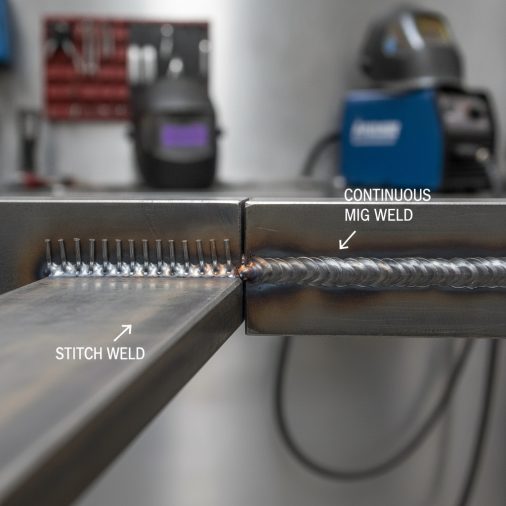
If you’re deciding between stitch welding and a continuous MIG bead, strength is probably your first concern — and rightfully so. The wrong choice can mean a joint that cracks under load, warps thin metal, or fails inspection. This article breaks down exactly how these two techniques compare in terms of strength, heat management, and real-world application. Whether you’re working on automotive sheet metal, structural fabrication, or a custom build, understanding when each method wins will help you make a smarter decision at the machine.
Quick Answer
Stitch welding is generally not as strong as a continuous MIG bead in raw tensile strength, but the difference is smaller than most people expect. For thin materials, stitch welding often produces a better practical result because it controls heat distortion, which can actually weaken a continuous bead joint on sheet metal. The right choice depends heavily on material thickness, joint type, and application load.
How Each Technique Actually Works

A continuous MIG bead is exactly what it sounds like — the trigger stays depressed and the weld runs uninterrupted from start to finish. The result is a solid, unbroken fusion line along the joint.
Stitch welding (also called skip welding or intermittent welding) lays a series of short weld segments with deliberate gaps between them. Each segment is typically 1–2 inches long, followed by a gap of equal or greater length. The welder alternates positions along the joint to distribute heat evenly.
Both methods use MIG (GMAW) equipment and wire, so the difference is entirely in technique and pattern — not the machine or consumables.
The Strength Comparison: What the Numbers Actually Tell You
In terms of weld metal strength, a continuous bead wins on paper. A full-penetration continuous MIG weld creates an unbroken fusion zone with maximum cross-sectional area bonded to the base metal. There are no gaps, no stress concentration points between segments, and no interruptions in the heat-affected zone.
Stitch welds, by contrast, have gaps. Those gaps are not fused metal — they’re bare base material. Under direct tensile load along the joint axis, a stitch-welded joint has less total bonded area and will theoretically fail at a lower load than a continuous bead of equivalent length.
However, the practical picture is more nuanced:
– On thin sheet metal (18–22 gauge), a continuous bead often causes warping, burn-through, or distortion that compromises the joint more than the gaps in a stitch pattern ever would.
– On thicker structural material (3/16″ and above), a continuous bead is generally preferred and the strength advantage becomes real and meaningful.
– Fatigue resistance in stitch welds can actually be competitive with continuous beads in certain loading scenarios, particularly where vibration is the primary stress rather than static tension.
The key insight: raw weld strength and practical joint strength are not always the same thing.
Where Stitch Welding Wins
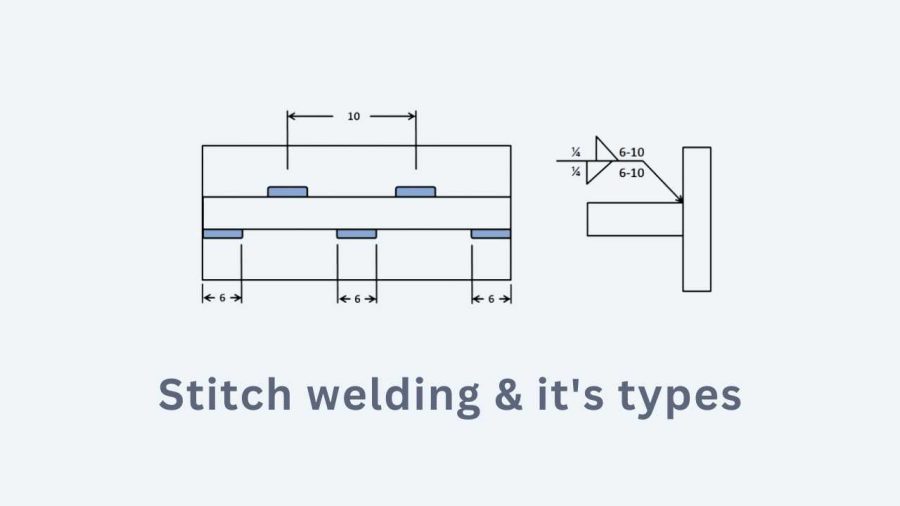
Stitch welding isn’t a compromise technique — it’s the correct technique in several common situations.
Thin sheet metal fabrication
Automotive body panels, floor pans, patch panels, and similar work are almost always better served by stitch welding. Continuous beads on thin gauge steel trap heat, cause oil-canning distortion, and frequently burn through. A properly executed stitch pattern keeps the metal flat and the joint solid.
Long seam welds on light structures
When welding long seams on thin-walled tubing or light structural sections, stitch welding prevents the cumulative heat buildup that causes bowing and warping along the length of the joint.
Tack-and-stitch assembly work
In production or fabrication environments, stitch welding is used to hold components in alignment during assembly before final welding, or as the final weld itself when full penetration isn’t required by the design spec.
Situations where weight matters
Less weld metal means less added weight. In motorsport fabrication or aerospace-adjacent work, stitch welding reduces mass without meaningfully compromising joint integrity when designed correctly.
Where Continuous Bead MIG Is the Right Call
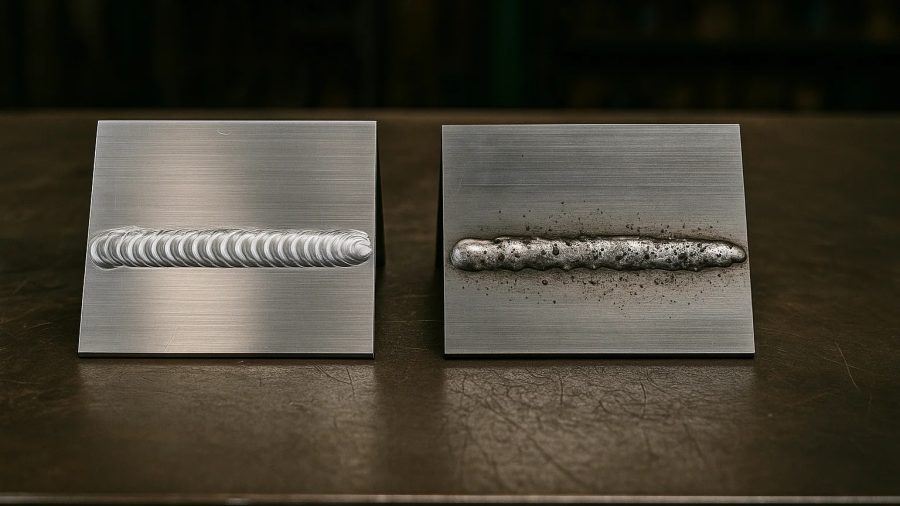
A continuous bead earns its place in structural and high-load applications.
Structural steel fabrication
Beams, brackets, frames, and load-bearing connections typically require full continuous welds per engineering specifications and welding codes (AWS D1.1, for example). Intermittent welds may not meet code requirements for structural applications.
Pressure-bearing joints
Any joint that must hold fluid or gas pressure — tanks, pipes, pressure vessels — requires a continuous, fully sealed weld. Stitch welds leave gaps that are leak paths by definition.
High static load joints
When a joint must resist maximum tensile, shear, or bending loads without fatigue cycling, a continuous bead provides the greatest bonded area and the most predictable failure load.
Thicker material (3/16″ and above)
On heavier stock, heat dissipation is less of a problem. The material absorbs and conducts heat well enough that distortion is manageable, and the strength advantage of a continuous bead becomes the dominant factor.
Side-by-Side Comparison
| Factor | Stitch Welding | Continuous MIG Bead |
|---|---|---|
| Raw tensile strength | Lower (gaps reduce bonded area) | Higher (full fusion along joint) |
| Heat distortion on thin metal | Minimal | Significant risk |
| Burn-through risk (thin gauge) | Low | Higher |
| Structural code compliance | Often not permitted | Standard requirement |
| Pressure/leak-tight joints | Not suitable | Required |
| Fatigue resistance (vibration) | Competitive | Good |
| Weld metal used | Less | More |
| Skill requirement | Moderate | Moderate to high (on thin metal) |
| Best material thickness | Under 3/16″ | 3/16″ and above |
Common Mistakes That Hurt Both Methods
Stitch welding mistakes:
– Gaps that are too long, reducing bonded area below what the joint needs
– Starting each stitch in the same direction, which causes uneven heat distribution
– Not allowing sufficient cooling between stitches, defeating the purpose of the technique
– Inconsistent stitch length, which creates unpredictable stress concentration
Continuous bead mistakes:
– Running too slow on thin material, causing heat buildup and distortion
– Incorrect travel speed creating a convex bead with poor fusion at the toes
– Not backstepping or using heat management techniques on longer seams
– Skipping interpass temperature checks on multi-pass welds
In practice, a poorly executed continuous bead on thin sheet metal is almost always weaker and worse-looking than a well-executed stitch pattern. Technique matters as much as method selection.
What Automotive and Motorsport Fabricators Actually Use
In automotive restoration and motorsport fabrication — two fields where this question comes up constantly — stitch welding is the dominant method for sheet metal work. Chassis builders welding cage tubing or frame sections will typically stitch first, then come back and fill in the gaps once the structure is confirmed to be square and undistorted.
Roll cage regulations in sanctioned motorsport (SCCA, NASA, FIA) typically specify weld requirements in terms of penetration and fusion quality rather than mandating continuous versus intermittent patterns for all joints. However, primary structural nodes on a cage are almost always fully welded.
Field experience in body shops shows that continuous MIG beads on 18-gauge patch panels almost always require planishing, grinding, and filler work to correct distortion. A stitch pattern done correctly often needs minimal finishing.
FAQ
Does stitch welding meet AWS structural welding code requirements?
AWS D1.1 (Structural Welding Code for Steel) does permit intermittent fillet welds in certain non-primary structural applications, but continuous welds are required for most load-bearing connections. If your project must meet AWS or similar code, check the specific joint classification and load requirements before choosing an intermittent pattern. Never assume stitch welding is code-compliant without verifying the applicable standard.
How long should each stitch be for sheet metal work?
A common starting point for automotive sheet metal is 1-inch stitches with 2-inch gaps, alternating positions along the joint. Thinner material may call for shorter stitches — as short as 3/4 inch — to further limit heat input. The goal is to keep the base metal cool enough to touch between passes, which typically means waiting 30–60 seconds between adjacent stitches.
Can you stitch weld and then fill in the gaps for a continuous bead?
Yes, and this is a standard technique in chassis and body fabrication. Stitch welding first locks the joint in position and prevents distortion. Once the structure is confirmed square and the metal has cooled, you fill in the gaps. This approach gives you the distortion control of stitch welding and the full fusion of a continuous bead.
Is stitch welding stronger than spot welding?
Generally yes. MIG stitch welds create a fusion bond along a short linear segment, which provides more bonded area and better tensile and shear strength than a single resistance spot weld. Spot welding is faster for production sheet metal assembly, but stitch MIG welding typically produces a stronger individual joint and is more accessible to small shops without resistance welding equipment.
Why does my stitch weld crack at the start and stop points?
Start and stop points are the most common failure locations in stitch welds because they experience rapid heating and cooling cycles. Cracking here usually indicates one of three things: the wire feed speed or voltage is set too low, the material is contaminated with oil or rust, or the stitch is too short relative to the material thickness. Slightly overlapping each new stitch onto the previous one’s end can help reduce stress at termination points.
What wire and gas settings work best for stitch welding thin sheet metal?
For 18–22 gauge mild steel, most fabricators use 0.023″ or 0.025″ ER70S-6 wire with 75/25 argon/CO₂ shielding gas. Voltage typically runs in the 15–18V range with wire feed speed adjusted to match. Lower heat input is the priority. Running the machine slightly cooler than you think necessary is almost always the right call on thin gauge — you can always add another pass, but you can’t un-burn a hole.
Does the gap in a stitch weld cause rust or corrosion problems?
It can, particularly in automotive applications where moisture gets into the gap between stitches. This is a real concern on floor pans, rocker panels, and any exterior joint exposed to road spray. Sealing the gaps with weld-through primer, seam sealer, or undercoating after welding is standard practice in body work. In structural applications where corrosion is a concern, continuous welds are preferred specifically because they eliminate this gap.
Final Thoughts
Stitch welding is not a weaker version of continuous MIG welding — it’s a different tool for a different job. On thin sheet metal, it’s often the stronger practical choice because it prevents the distortion and burn-through that undermine a continuous bead. On structural steel and pressure-bearing joints, a continuous bead is the correct and often code-required approach. Match the technique to the material thickness, load requirements, and application, and you’ll get better results than defaulting to one method for everything.
Meta Description:
Wondering if stitch welding matches continuous MIG bead strength? Learn when each method wins, where strength differences actually matter, and how to choose correctly.


