
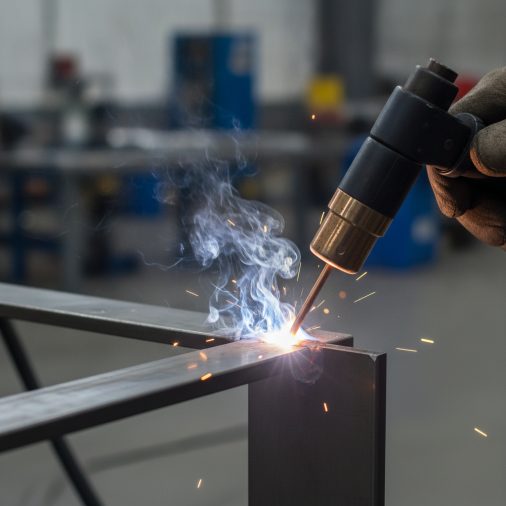
How MIG Welding Actually Works
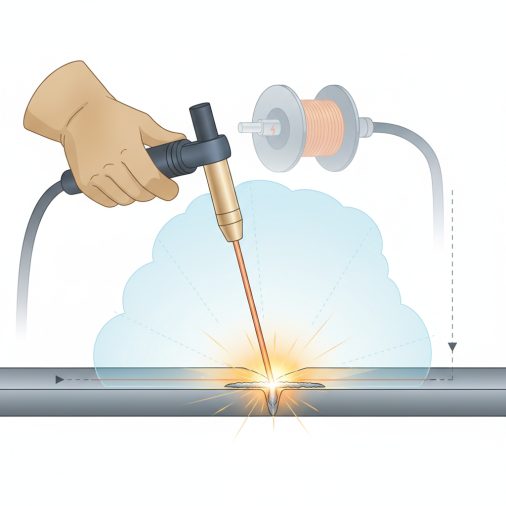
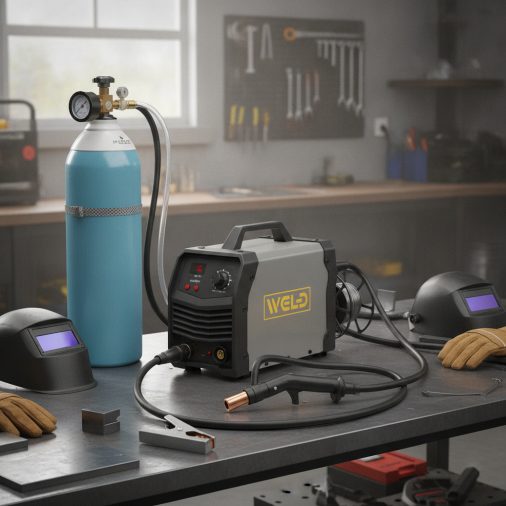
The Main Components of a MIG Weld Setup
What Materials Can Be MIG Welded?
MIG welding is versatile enough to handle a wide range of metals, which is a big reason for its popularity. – Mild steel — The most common application; welds cleanly with standard ER70S-6 wire and C25 gas – Stainless steel — Requires ER308L or ER316L wire and a tri-mix or 98/2 argon/CO₂ gas blend; if you’re curious about wire compatibility, using normal MIG wire on stainless steel has important limitations worth knowing – Aluminum — Needs a spool gun or push-pull system, ER4043 or ER5356 wire, and 100% argon gas – Chromoly steel — Weldable with MIG, though preheat and post-weld treatment may be needed depending on wall thickness; welding chromoly with a MIG welder involves some specific considerations – Galvanized steel — Can be welded but requires ventilation and surface prep due to zinc fume hazards Thinner materials like automotive sheet metal are particularly well-suited to MIG because of the fine control over heat input the process offers.What Does a MIG Weld Look Like?
A properly made MIG weld has a distinctive appearance that experienced welders recognize immediately. – Consistent width — The bead should be uniform from start to finish – Slight ripple pattern — Caused by the arc oscillating as the wire feeds; should be evenly spaced – Flat to slightly convex profile — Not excessively tall or undercut at the edges – No porosity — No visible holes or pitting in the bead surface – Good fusion — The weld should blend smoothly into the base metal on both sides A rough, irregular bead or visible spatter often signals problems with wire speed, voltage, travel speed, or shielding gas coverage. Knowing what a good MIG weld looks like helps you self-diagnose problems early.MIG Welding vs. Other Common Processes
| Process | Electrode Type | Shielding | Ease of Use | Best For |
|---|---|---|---|---|
| MIG (GMAW) | Continuous wire | External gas | Easiest | Production, general fabrication |
| Stick (SMAW) | Flux-coated rod | Flux-generated | Moderate | Outdoor, structural work |
| TIG (GTAW) | Non-consumable tungsten | External gas | Most difficult | Precision, thin metal, stainless |
| Flux-Core (FCAW) | Flux-filled wire | Gas or self-shielded | Easy | Heavy steel, outdoor use |
Common MIG Welding Problems and What Causes Them
Even experienced welders run into issues. Most problems trace back to settings, technique, or preparation. Porosity (holes in the weld bead) – Contaminated base metal or wire – Inadequate shielding gas coverage – Gas flow rate too low or too high – Drafts blowing gas away from the weld zone Excessive spatter – Voltage too low relative to wire speed – Wrong gas mixture – Contact tip worn or partially blocked Undercutting (groove along the weld edge) – Travel speed too fast – Voltage too high – Incorrect gun angle Cold lap / lack of fusion – Travel speed too fast – Amperage too low – Poor joint fit-up or excessive gap In practice, the most overlooked fix is simply slowing down travel speed. Many beginners move the gun too quickly, leaving a thin, poorly fused bead instead of a solid joint.Key Variables That Affect MIG Weld Quality
Four settings have the most direct impact on the quality of a MIG weld: 1. Wire feed speed — Controls amperage; faster feed increases heat input 2. Voltage — Controls arc length and bead profile; too low causes stubbing, too high causes spatter 3. Travel speed — Affects bead width and penetration depth; consistent speed is critical 4. Shielding gas flow rate — Typically 15–25 CFH for most applications; too low causes contamination, too high causes turbulence Most modern machines offer suggested settings charts on the inside panel. The Lincoln Electric Weld-Pak 140 HD, for example, includes a reference chart inside the door that covers wire size, voltage, and feed speed settings for common material thicknesses — a genuinely useful starting point for beginners dialing in their first welds. Getting the temperature range in MIG welding right matters more than most beginners realize, especially on thinner materials where burn-through is a real risk.Push vs. Pull Technique
The direction you move the welding gun influences bead shape and penetration. – Push (forehand) — Gun points in the direction of travel; produces a flatter, wider bead with less penetration; better visibility of the weld pool – Pull (backhand) — Gun points away from travel direction; produces a narrower, higher bead with deeper penetration For most MIG welding on steel, pushing is the standard recommendation. It gives a cleaner-looking bead and keeps the shielding gas ahead of the arc. Choosing between pushing and pulling a MIG welder depends on the joint type and what you’re optimizing for.FAQ
What does MIG stand for in welding? MIG stands for Metal Inert Gas. The term refers to the use of an inert or semi-inert shielding gas to protect the weld pool during welding. The process is formally classified as GMAW (Gas Metal Arc Welding) by the American Welding Society, but MIG remains the most widely used term in everyday welding practice. Is MIG welding strong enough for structural projects? Yes, MIG welds on properly prepared joints using the correct wire and settings produce welds with tensile strength meeting or exceeding the base metal. ER70S-6 wire, for instance, produces welds rated at approximately 70,000 psi tensile strength — adequate for most structural steel applications when procedures are followed correctly. Can a beginner learn MIG welding quickly? MIG is generally considered the most beginner-friendly arc welding process. Most people can produce acceptable flat welds within a few hours of practice. Consistent, quality welds across all positions — including vertical and overhead — take more time. Starting with flat butt joints and T-joints on mild steel is the most practical approach for new welders. What shielding gas is best for MIG welding steel? The most widely used shielding gas for MIG welding mild steel is a 75% argon / 25% CO₂ blend, often called C25. It produces a stable arc, minimal spatter, and good bead appearance. Pure CO₂ is cheaper and increases penetration but produces more spatter. Using 100% argon for MIG welding works for aluminum but is generally not ideal for steel. What thickness of metal can a MIG welder handle? Most hobbyist-grade MIG welders handle material from about 24-gauge sheet metal up to around 3/8 inch in a single pass, depending on machine amperage. Thicker material requires multiple passes or a higher-amperage industrial machine. Thin sheet metal below 18 gauge requires careful heat management to avoid burn-through, often using shorter stitch welds or a pulsed approach. What is the difference between MIG and flux-core welding? Both processes use a continuously fed wire electrode, but flux-core wire contains a flux compound inside the wire that generates its own shielding when burned. This makes flux-core better suited for outdoor welding or windy conditions where shielding gas would be disrupted. MIG with solid wire and gas generally produces cleaner welds with less post-weld cleanup. Can you MIG weld aluminum with a standard steel MIG setup? Not without modifications. Aluminum welding requires a spool gun or push-pull gun to handle the soft wire without birdnesting, a change to 100% argon shielding gas, and aluminum-specific wire such as ER4043 or ER5356. The standard steel drive rolls and liner will also need to be replaced or adjusted to avoid damaging the wire.MIG welding is one of those skills that rewards practice quickly. The fundamentals are straightforward — consistent travel speed, correct settings, clean metal, and proper gas coverage — and small improvements in technique translate directly into noticeably better welds. Start on flat mild steel, get the settings dialed in, and the process becomes intuitive faster than most beginners expect.


