
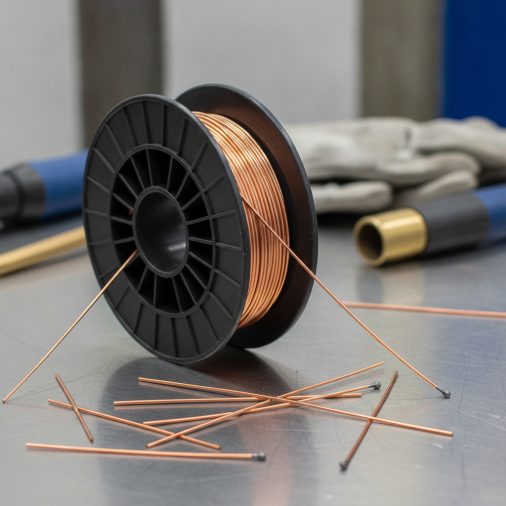
Why People Search for “MIG Weld Rod”

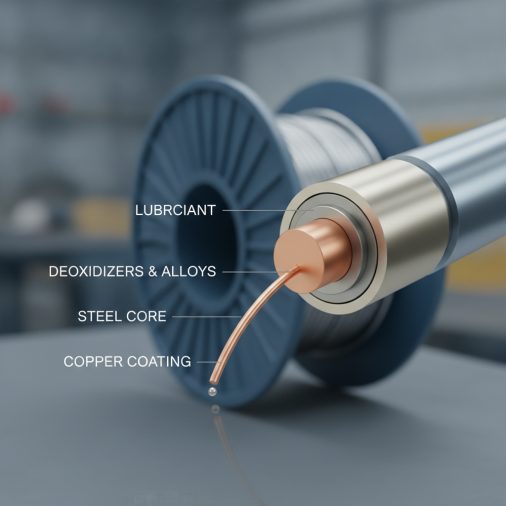
What MIG Wire Is Actually Made Of
| Wire Type | Base Metal | Common Designation |
|---|---|---|
| ER70S-6 | Mild steel | Most common general-purpose wire |
| ER308L | Stainless steel (304) | Low-carbon version for corrosion resistance |
| ER316L | Stainless steel (316) | Higher molybdenum content, better corrosion resistance |
| ER4043 | Aluminum | Smooth welds, good crack resistance |
| ER5356 | Aluminum | Higher strength, better for structural aluminum |
| ER70S-3 | Mild steel | Cleaner base metal required |
| ERNiCu-7 | Copper-nickel alloys | Specialty applications |
MIG Wire Diameter: Why It Matters More Than Most People Think
Wire diameter directly affects heat input, penetration, deposition rate, and how your machine performs. – 0.023″ — Best for thin sheet metal (18–24 gauge), low heat, minimal distortion – 0.030″ — Versatile all-around size, works well from thin to medium thickness – 0.035″ — Most common diameter for general shop use, handles material from 1/8″ to 1/2″ – 0.045″ — Higher deposition rate, better for thicker material, typically used in industrial settings Matching diameter to material thickness is one of the most overlooked adjustments beginners make. Running 0.035″ wire on 18-gauge sheet metal is a fast path to burn-through. Running 0.023″ wire on 1/2″ plate means inadequate penetration. If you’re working on thin auto body panels, the technique for MIG welding sheet metal matters as much as the wire choice — both influence heat management and weld quality.Solid Wire vs. Flux-Core Wire
This is where the “rod vs. wire” confusion deepens. There are two broad categories of MIG wire, and they work differently. Solid MIG Wire – Requires external shielding gas (usually 75% Argon / 25% CO2 for steel) – Cleaner welds with less spatter – Better for indoor work, thin material, and finish quality – Most common for production and general fabrication Flux-Core Wire (FCAW) – Has a flux compound inside the wire that creates its own shielding gas when burned – Can weld outdoors where wind disrupts gas coverage – More spatter, slightly rougher appearance – Available in self-shielded (no gas) and gas-shielded variants If you’re wondering whether you need gas for MIG welding, the short answer depends on which wire type you’re using. Self-shielded flux-core wire doesn’t require a gas cylinder, which makes it appealing for field work or budget setups. The Lincoln Electric Innershield NR-211-MP is a widely used self-shielded flux-core wire that works well for general fabrication and outdoor repairs without a gas cylinder.Choosing MIG Wire for Different Metals
The “correct” MIG wire isn’t universal. It changes based on what you’re welding. Mild Steel ER70S-6 with 75/25 Argon/CO2 is the standard combination. It’s forgiving on slightly dirty metal and produces smooth welds with good mechanical properties. Stainless Steel You need a stainless-specific wire like ER308L or ER316L. Using standard mild steel MIG wire on stainless steel compromises corrosion resistance and weld integrity. The shielding gas also changes — typically a tri-mix of Argon, CO2, and Helium. Aluminum Aluminum requires dedicated aluminum wire (ER4043 or ER5356), a spool gun or push-pull system, and 100% Argon shielding gas. The correct shielding gas for MIG welding aluminum matters significantly — CO2 mixtures cause contamination and rough welds on aluminum. Chromoly Steel ER70S-2 or ER80S-D2 wire are common choices for chromoly. MIG welding chromoly steel is possible with the right wire and technique, though many professionals prefer TIG for critical chromoly applications due to better heat control.Reading the AWS Wire Classification
Every spool of MIG wire carries an AWS (American Welding Society) classification code. Understanding it saves confusion when shopping. Using ER70S-6 as an example: – E — Electrode – R — Rod (can be used as filler rod in TIG welding too) – 70 — Minimum tensile strength of the weld deposit (70,000 psi) – S — Solid wire – 6 — Chemical composition and shielding gas requirements The number after the “S” indicates flux content and deoxidizers. S-6 has more silicon and manganese than S-2 or S-3, which is why it tolerates mill scale and light rust better.What Good MIG Wire Looks Like vs. What to Avoid
Wire quality directly affects arc stability and weld appearance. Low-quality or improperly stored wire causes more problems than most beginners realize. Signs of good-quality wire: – Smooth, uniform surface with consistent copper coating – Feeds without resistance through the liner – Stable arc with minimal spatter – Tightly wound spool without tangling Signs of problematic wire: – Rust or oxidation on the wire surface – Irregular surface texture or pitting – Birdnesting during feed (often caused by kinked wire or liner damage) – Excessive spatter even with correct settings Storing MIG wire in a sealed container with a desiccant pack prevents moisture absorption, which causes porosity in finished welds.Common Problems Caused by the Wrong Wire Choice
Choosing the wrong wire type or diameter leads to specific, recognizable problems. Porosity (small holes in the weld) Often caused by contamination, moisture in the wire, or wrong shielding gas for the wire type. ER70S-6 handles minor surface contamination better than S-3, reducing this risk on mild steel. Burn-through Wire diameter too large for the material thickness, or amperage set too high for the wire being used. Lack of fusion Wire diameter too small for thick material, or wire speed set too low. The arc doesn’t generate enough heat to properly fuse the base metal. Excessive spatter Can indicate incorrect wire type for the shielding gas being used, or that flux-core wire is being run with gas settings meant for solid wire. Understanding what a good MIG weld actually looks like helps identify whether your wire choice and settings are dialed in correctly.FAQ
Is MIG wire the same as a welding rod? Not exactly. A welding rod typically refers to a stick electrode used in SMAW (Stick) or a TIG filler rod. MIG wire is a continuously fed electrode wound on a spool. The term “MIG weld rod” is informal language often used by people transitioning from stick welding. They serve a similar functional purpose — adding filler metal to the weld — but the delivery mechanism is completely different. What MIG wire should a beginner start with? ER70S-6 in 0.030″ diameter is the most practical starting point for most beginners working on mild steel projects. It works with 75/25 Argon/CO2 shielding gas, tolerates less-than-perfect base metal, and is widely available. The Hobart Handler 140 is often set up with this combination from the factory, making it a natural pairing for entry-level work. Can I use the same MIG wire for all metals? No. Each base metal requires a compatible filler wire. Using ER70S-6 on stainless steel produces a weld that looks fine but fails the corrosion resistance the material was chosen for. Aluminum requires entirely different wire, a different liner in the gun, and different shielding gas. Always match the wire alloy to the base metal. What happens if I use the wrong wire diameter? Too small a diameter for thick metal means insufficient penetration and weak welds. Too large a diameter for thin material causes burn-through and warping. Always check your machine’s wire diameter compatibility and match it to the material thickness using the manufacturer’s chart, usually printed on the inside of the welder door. Does MIG wire expire or go bad? MIG wire doesn’t have a printed expiration date, but it can degrade. Surface oxidation from humidity is the main enemy — it disrupts the arc and causes weld porosity. Store opened spools in a sealed bag or airtight container with a desiccant. Wire stored properly in a dry environment typically stays usable for years. Visibly rusty or pitted wire should be replaced. What’s the difference between ER70S-3 and ER70S-6? ER70S-6 contains higher levels of silicon and manganese, acting as stronger deoxidizers. This makes it better suited for welding steel with mill scale or light surface rust. ER70S-3 requires cleaner base metal but can produce slightly cleaner welds on properly prepared steel. For most practical applications, ER70S-6 is the more forgiving and widely recommended choice. Can I TIG weld with MIG wire? Technically, some MIG wire designations (like ER70S-6) carry both “E” (electrode) and “R” (rod) in their classification, meaning the wire can be used as TIG filler rod. However, MIG wire typically comes in spools of thinner diameters and may not be the most practical choice. Dedicated TIG filler rods are sold in straight cut lengths and are generally preferred for TIG work.The terminology around MIG weld rods can be genuinely confusing when you’re coming from a stick welding background. The wire is the electrode, the spool is the delivery system, and matching wire type and diameter to your base metal is the foundation of getting good results. Get the AWS classification right, store your wire properly, and the rest of your settings will fall into place much more easily.


