If you’re setting up a MIG welder for the first time or troubleshooting a machine, you might be wondering whether MIG welding runs on AC or DC power. It’s a reasonable question, especially since other welding processes like stick or TIG can use either.
MIG welding exclusively uses DC (direct current), specifically DC electrode positive (DCEP), also called reverse polarity. AC power from the wall is converted inside the welder to DC before it reaches the arc. This setup delivers a stable, consistent arc, better penetration, and smoother wire feeding — all essential for quality MIG welds.
Why MIG Welding Requires DC, Not AC
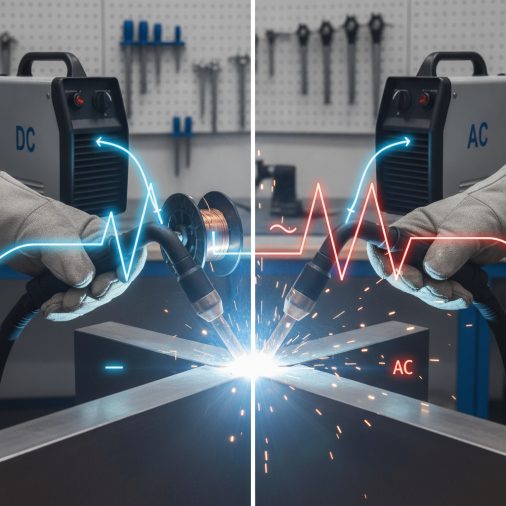
The fundamental reason MIG welding needs DC comes down to arc stability. Alternating current reverses polarity 120 times per second on a standard 60Hz supply. At that rate, the arc would extinguish and reignite constantly, making it nearly impossible to maintain a smooth, controllable weld puddle.
DC holds a constant polarity, which keeps the arc burning steadily. This is critical with MIG because the wire feeds continuously — if the arc keeps flickering, you get spatter, porosity, and inconsistent penetration.
All MIG welders, whether compact machines like the Lincoln Electric Easy MIG 180 or larger industrial units, include a rectifier that converts incoming AC wall power to DC output. The conversion happens internally, so you plug into a standard outlet and the machine handles the rest.
DC Electrode Positive vs. DC Electrode Negative
Within DC welding, there are two polarity configurations. MIG welding uses one of them almost exclusively.
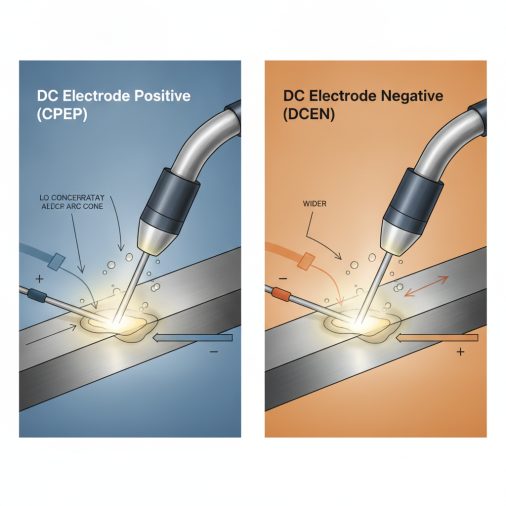
DCEP (DC Electrode Positive / Reverse Polarity)
– The welding wire (electrode) connects to the positive terminal
– The workpiece connects to the negative terminal
– Produces deeper penetration and a stable arc
– Standard setup for almost all MIG welding
DCEN (DC Electrode Negative / Straight Polarity)
– The wire connects to the negative terminal
– Generates more heat at the wire tip, less in the base metal
– Occasionally used with certain flux-core wires for faster wire burn rates
– Not commonly used for solid wire MIG welding
The distinction matters if you’re running flux-cored wire. Some self-shielded flux-core wires (the kind that don’t need external shielding gas) are designed for DCEN. Always check the wire manufacturer’s specifications before assuming polarity. If you’re unsure whether your setup even needs gas, it’s worth understanding when shielding gas is required for MIG welding and how it affects your polarity choice.
What Happens If You Try AC on a MIG Welder?
You can’t accidentally run a MIG welder on AC — the machine always outputs DC. But understanding what would happen explains why AC simply doesn’t work for this process.
With AC, the constantly reversing polarity would cause:
– Severe arc instability and frequent arc dropout
– Excessive spatter across the workpiece
– Poor fusion and weak weld joints
– Erratic wire feeding and burn-back into the contact tip
AC MIG would essentially be unusable. Some processes like AC TIG welding aluminum work because TIG uses different arc physics and the AC cleaning action is actually beneficial for breaking up the aluminum oxide layer. MIG doesn’t benefit from that same mechanism.
The One Exception: AC-Compatible Flux-Core Welding
There’s a nuanced exception worth knowing. Certain specialized flux-cored wires are formulated for AC output, typically found in very low-cost, transformer-based “no-gas” welders. These machines don’t use a rectifier and output raw AC.
These aren’t true MIG welders in the traditional sense. They’re flux-core only machines, often sold at entry-level price points. Weld quality is generally inferior compared to DC MIG — more spatter, rougher bead appearance, and less consistent penetration.
If you’re shopping for a machine and want genuine MIG capability, confirm it outputs DC. Any machine capable of true MIG welding with solid wire and shielding gas will be DC output.
How Polarity Affects Weld Quality in Practice
Getting polarity right has a direct, visible impact on your welds. Field experience consistently shows that incorrect polarity is one of the most common causes of poor welds in beginners and even intermediate welders who switch wire types.
Signs you may have incorrect polarity set:
– Excessive spatter that’s hard to explain by other settings
– Arc that feels “harsh” or unstable even with correct voltage and wire speed
– Poor penetration despite adequate heat settings
– Wire burning back to the contact tip repeatedly
If you’re running solid wire with shielding gas, you almost certainly want DCEP. If you’ve switched to self-shielded flux-core and the weld looks wrong despite correct settings, check whether that wire requires DCEN — many do.
Knowing what a good MIG weld looks like can help you quickly identify whether a polarity issue is affecting your bead quality.
Polarity Settings on Common MIG Machines
Most MIG welders handle polarity one of two ways:
Fixed polarity machines — Budget solid-wire MIG welders are typically wired for DCEP permanently. No adjustment needed or possible.
Switchable polarity machines — Multi-process welders and flux-core capable machines allow you to swap leads inside the machine or via an external switch. This lets you change between DCEP for solid wire and DCEN for certain flux-core wires.
On machines with switchable polarity, the leads are usually accessible inside a small panel door. You physically swap the torch lead and ground lead connections. Some higher-end machines use a dial or switch instead of manual lead swapping.
Always consult your machine’s manual when changing polarity. A common mistake is forgetting to swap back after running flux-core, then wondering why the solid wire welds look terrible.
Does Voltage or Wire Speed Change with Polarity?
Polarity change alone doesn’t require you to completely reset voltage and wire speed, but you’ll likely need to fine-tune. DCEN typically runs hotter at the wire end, meaning you may need slightly lower voltage or faster wire speed to maintain the same bead profile compared to DCEP.
When switching polarity, run a short test bead on scrap metal and adjust from there. The arc sound is a reliable guide — a consistent crackling sound indicates a dialed-in setting, while sputtering or popping suggests adjustments are needed.
FAQ
Does MIG welding use AC or DC power from the wall outlet?
Your wall outlet supplies AC power. The MIG welder converts that AC to DC internally using a rectifier circuit. What reaches the arc is always DC. You don’t need to do anything special — just plug in and the machine handles the conversion automatically.
Can you MIG weld aluminum with DC?
Yes, and most MIG welding of aluminum uses DCEP with 100% argon shielding gas. The DC positive setup provides enough arc stability and heat to melt aluminum effectively. Choosing the right shielding gas for aluminum MIG welding is just as important as polarity when working with this material.
Why does flux-core wire sometimes require DCEN instead of DCEP?
Self-shielded flux-core wires contain compounds in the flux that generate their own shielding gases when burned. These wires are engineered specifically for DCEN to achieve proper arc stability and slag behavior. Using them with DCEP produces poor results. Always verify polarity requirements on the wire packaging or manufacturer spec sheet.
What is DCEP in simple terms?
DCEP stands for DC Electrode Positive, also called reverse polarity. It means the welding wire (electrode) is connected to the positive terminal and the workpiece to the negative. This creates deeper penetration and a stable arc, which is why it’s the standard setup for solid wire MIG welding.
Can incorrect polarity damage the MIG welder?
Running incorrect polarity won’t typically damage the welder itself, but it will produce poor welds and can cause burn-back where the wire fuses to the contact tip. Repeated burn-back events can eventually wear the contact tip faster than normal. The bigger risk is defective welds going undetected, not machine damage.
Does polarity matter when welding different metals like stainless steel?
Standard DCEP applies for MIG welding stainless steel just as it does for mild steel. The key variables that change are the wire type and shielding gas, not the polarity. If you’re tackling stainless, understanding the wire and gas requirements for stainless MIG welding will have far more impact than polarity adjustments.
What’s the difference between a rectifier and an inverter in MIG welders?
Both convert AC to DC, but inverter-based machines do it at high frequency, making them lighter, more energy efficient, and better at maintaining precise arc characteristics. Traditional transformer-rectifier machines are heavier but often more durable in harsh environments. Both output DC and work fine for MIG welding.
The Practical Takeaway
MIG welding runs on DC — always. Your wall outlet provides AC, and the welder converts it before the current ever reaches the arc. For solid wire MIG with shielding gas, DCEP is your standard setup and you’ll rarely need to change it.
The polarity question only gets more involved when you introduce flux-core wires, some of which require DCEN. Whenever you switch wire types, verify the polarity requirement. A two-second check of the wire spec sheet can save you from an hour of troubleshooting a mysteriously bad weld.