
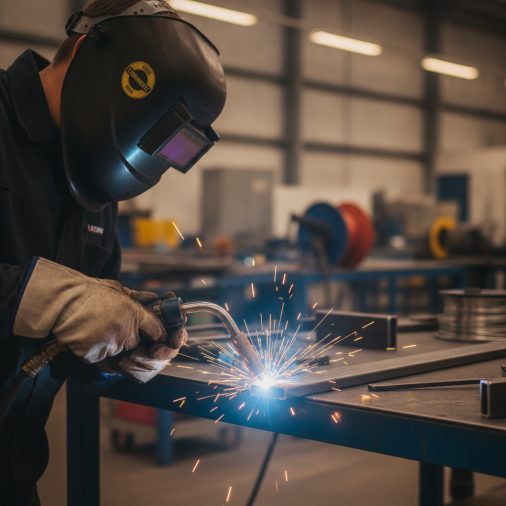
If you’re thinking about picking up MIG welding, the first question most people ask is a simple one: how long is this actually going to take? Whether you’re looking to handle repairs around the shop, start a fabrication hobby, or build toward a welding career, the timeline matters. This article breaks down realistic learning timelines, the factors that speed up or slow down progress, and what “learning MIG welding” actually means at each stage — so you can set honest expectations before you strike your first arc.
Most beginners can lay a basic, functional MIG weld within a few hours of their first session. Reaching a competent, consistent level typically takes 2–4 weeks of regular practice. Developing professional-grade skill across different positions, materials, and joint types generally requires 3–6 months of dedicated, hands-on work.
What “Learning MIG Welding” Actually Means

The phrase covers a wide range of ability. There’s a big difference between being able to run a flat bead on mild steel and being able to weld overhead joints on stainless or pass a certification test.
It helps to think of MIG welding proficiency in three distinct stages:
– Functional basics — You can set up the machine, strike an arc, and run a passable bead on flat material. Most people reach this within a few hours to a couple of days.
– Consistent competency — Your welds are clean, penetration is reliable, and you can handle common joint types (butt, lap, T-joint) in flat and horizontal positions. This typically takes 2–6 weeks of regular practice.
– Skilled proficiency — You can weld multiple positions (vertical, overhead), adjust confidently for different metals and thicknesses, troubleshoot problems on the fly, and produce welds that meet structural or aesthetic standards. Expect 3–6 months of serious practice to reach this level.
Understanding which stage you’re aiming for will shape how you approach training and how you measure progress.
Factors That Affect How Fast You Progress
No two people learn at the same pace, and MIG welding is no exception. Several variables have a real impact on how quickly skills develop.
Practice frequency
Welding three or four times per week produces dramatically faster results than welding once every couple of weeks. Muscle memory fades quickly when there are long gaps between sessions. Consistent, short sessions beat occasional marathon practice.
Access to equipment
Having your own machine — or reliable access to one — removes a major bottleneck. Learners who have to book time at a community college or makerspace often progress more slowly simply because practice time is limited.
Quality of instruction
Learning from an experienced welder, even informally, compresses the learning curve significantly. A mentor can identify bad habits early — travel speed, torch angle, distance from the workpiece — before they become ingrained. Self-teaching from videos alone is possible but slower, and bad habits are harder to self-diagnose.
Prior experience with related skills
People who have experience with metalworking, automotive repair, or even steady-hand crafts like woodworking or soldering often pick up the physical coordination faster. The hand steadiness and spatial awareness transfer.
Material and joint variety
Sticking to flat mild steel at first is smart. Introducing stainless steel, aluminum, or out-of-position welding too early adds complexity before the fundamentals are solid. Progress feels slower when too many variables are introduced at once.
A Realistic MIG Welding Learning Timeline
| Stage | Timeframe | What You Can Do |
|---|---|---|
| Complete beginner | First 1–3 sessions | Strike an arc, run basic flat beads, understand machine settings |
| Functional welder | 1–4 weeks | Weld butt joints, lap joints, T-joints in flat position |
| Competent hobbyist | 1–3 months | Weld horizontal and vertical positions, handle common repairs |
| Skilled practitioner | 3–6 months | Multi-position welding, material variety, consistent quality |
| Certification-ready | 6–12+ months | Meet AWS D1.1 or similar structural welding standards |
These timelines assume regular practice — roughly 3–5 hours per week at minimum. More practice per week compresses the timeline. Less practice stretches it.
The Skills You’re Actually Building (And Why Some Take Longer)
MIG welding looks deceptively simple from the outside. Point the gun, pull the trigger, move. In practice, you’re managing several variables simultaneously.
Travel speed is one of the first things beginners struggle with. Move too fast and the weld is thin and cold. Move too slow and you pile up excess material or burn through the base metal. Finding the right rhythm takes repetition.
Gun angle affects penetration and bead shape. Most MIG welding uses a push or slight drag technique, typically at a 10–15 degree angle. Small deviations produce noticeably different results, and correcting this becomes instinctive only after significant practice.
Stick-out (contact tip to work distance) is the gap between the contact tip and the weld pool. Too much stick-out reduces penetration and increases spatter. Too little risks burning back into the tip. Maintaining consistent stick-out while moving along a joint is a coordination skill that takes time.
Machine settings — wire feed speed and voltage — need to be dialed in for each material thickness and wire diameter. Learning to read a weld bead and adjust settings accordingly is a skill that develops gradually. A good weld sounds like bacon frying: a steady, even crackle. A bad setting sounds erratic or sputtery.
Positional welding — vertical up, vertical down, overhead — introduces gravity as an active problem. The molten pool wants to fall. Controlling it requires technique adjustments that feel almost like learning a new skill from scratch.
Common Mistakes That Slow Progress
Most beginners hit the same walls. Recognizing them early saves weeks of frustration.
Skipping machine setup. Running the wrong wire feed speed or voltage for the material thickness produces poor welds regardless of technique. Always match settings to the material before blaming your hand movement.
Rushing bead practice. Many beginners want to jump to joints and projects before their basic bead is consistent. Running straight, even beads on flat plate is unglamorous but essential. It builds the travel speed and gun angle control that everything else depends on.
Ignoring cleanliness. MIG welding is sensitive to contamination. Mill scale, rust, paint, oil, and moisture all cause porosity and poor fusion. Grinding or cleaning the base metal before welding is not optional — it’s part of the process.
Inconsistent practice gaps. Taking two weeks off after a good session and expecting to pick up where you left off rarely works. The physical coordination involved in welding degrades faster than most people expect.
Not watching the puddle. New welders often focus on the wire tip or the gun rather than the weld pool itself. The pool tells you everything — its size, shape, and behavior indicate whether settings and technique are correct.
Self-Taught vs. Formal Training: What’s the Real Difference?
Both paths work. The difference is speed and depth.
A structured welding course — community college, vocational school, or trade program — provides immediate feedback, access to proper equipment, and a curriculum that builds skills in the right order. A 6-week introductory course can get a beginner to competent hobbyist level faster than 6 months of unguided self-teaching.
Self-teaching through online resources, welding forums, and YouTube channels is genuinely viable for hobby-level goals. The main risk is developing poor technique that becomes difficult to unlearn. If you’re self-teaching, record yourself welding occasionally and compare your technique to experienced welders. It’s one of the most effective self-correction tools available.
For anyone pursuing welding professionally or aiming for AWS certification, formal training is the more reliable route. Certifications require documented training and testing under controlled conditions, and most employers in structural or pipe welding expect them.
FAQ
Can I learn MIG welding on my own without taking a class?
Yes, many hobbyists and DIYers learn MIG welding without formal instruction. Online tutorials, welding forums, and practice time can get you to a functional level. The main risk is developing bad habits that go unnoticed. If possible, have an experienced welder review your work periodically, even informally. For professional or structural welding goals, formal training is a better investment.
How many hours of practice does it take to get good at MIG welding?
Most people reach a competent hobbyist level after 20–40 hours of hands-on practice. Reaching skilled proficiency — consistent multi-position welding with good quality control — typically requires 100–200 hours. Professional-level skill and certification readiness generally demands 300+ hours, depending on the welding standard being pursued.
Is MIG welding easier to learn than TIG or stick welding?
MIG welding is generally considered the most beginner-friendly process. The wire feeds automatically, machine setup is more forgiving, and the learning curve is shorter than TIG, which requires separate filler rod control and foot pedal coordination. Stick welding has a steeper arc-starting learning curve. MIG is the standard starting point for most new welders.
What materials can a beginner MIG weld, and which should they avoid at first?
Start with mild steel in the 1/8″ to 3/16″ thickness range. It’s forgiving, widely available, and inexpensive for practice. Avoid aluminum until you’re comfortable with steel — it requires a spool gun or push-pull setup, different technique, and much more precise heat control. Stainless steel is manageable once fundamentals are solid but requires cleaner prep and tighter settings.
What equipment do I need to start practicing MIG welding at home?
At minimum: a MIG welder (a 140–180 amp machine handles most hobby work), an auto-darkening welding helmet, welding gloves, a leather or flame-resistant jacket, and mild steel plate for practice. A wire brush and angle grinder for prep work are also essential. A gas cylinder with 75/25 argon-CO2 mix is standard for mild steel. Flux-core wire is an option if you want to avoid gas setup initially; flux core welding tips beginners helps explain why this detail matters.
How long does it take to pass an AWS welding certification?
AWS D1.1 structural welding certification requires demonstrating consistent, defect-free welds in specific positions and joint configurations. Most welders with 6–12 months of solid practice are in a position to attempt certification testing. The test itself is a single-day practical exam, but the preparation time varies significantly based on prior experience and the specific qualification being pursued.
Does the type of MIG welder affect how fast you learn?
Yes, to a degree. A quality machine with stable arc characteristics and reliable wire feed makes it easier to identify whether problems come from technique or equipment. Cheap welders with inconsistent arc behavior can mask genuine skill development. You don’t need an industrial machine to learn, but a reliable mid-range unit from a reputable brand makes the process less frustrating.
Final Thoughts
MIG welding has one of the shorter learning curves among welding processes, but “short” is relative. A few hours gets you started. A few months of consistent practice gets you genuinely capable. The biggest factor isn’t natural talent — it’s how often you actually pick up the gun and practice. Start with flat beads on clean mild steel, focus on reading the weld pool, and build complexity gradually. The skills compound faster than most beginners expect once the fundamentals click.


