
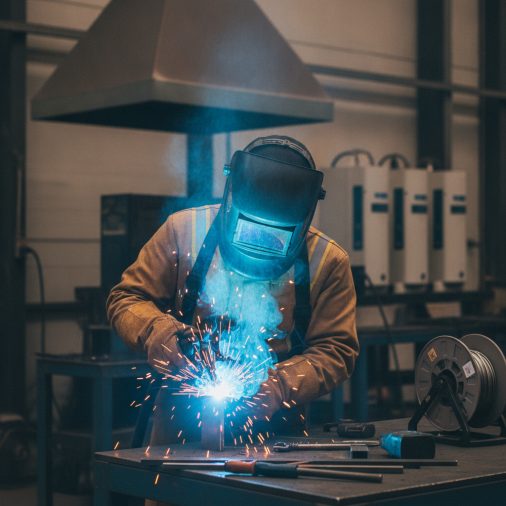
Yes, MIG welding poses genuine health risks if proper precautions aren’t taken. The primary dangers come from welding fumes, UV radiation, and electrical hazards. Fume exposure — especially from galvanized steel, stainless steel, or flux-core wire — can cause serious respiratory conditions over time. With the right ventilation, PPE, and safe practices, most risks are manageable.
MIG welding is one of the most widely used welding processes in the world, but the health risks it carries are frequently underestimated — especially by hobbyists and newer welders who focus on technique and forget about what’s happening in the air around them. This article breaks down the real health hazards associated with MIG welding, explains which risks are most serious, and gives you practical guidance on protecting yourself without overcomplicating your setup.
The Core Health Hazards of MIG Welding
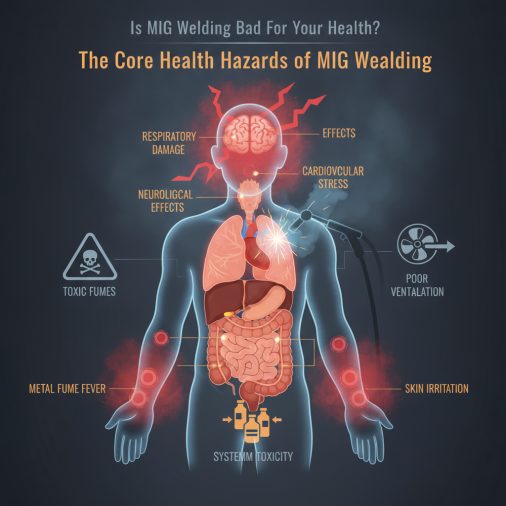
MIG welding generates several categories of health hazards simultaneously. Understanding each one separately helps you prioritize your protection.
Welding Fumes: The Biggest Long-Term Risk
The most significant health concern in MIG welding is fume inhalation. When the arc melts the base metal and filler wire, it vaporizes metals and coatings that then cool into fine particles — particles small enough to penetrate deep into the lungs.
Common harmful components in MIG welding fumes include:
– Manganese — found in most MIG wire; linked to neurological damage with chronic exposure
– Hexavalent chromium (Cr VI) — produced when welding stainless steel; classified as a Group 1 carcinogen by the IARC
– Zinc oxide — released when welding galvanized steel; causes metal fume fever
– Iron oxide — present in most carbon steel welding; less acutely toxic but still a respiratory irritant
– Nickel compounds — another carcinogen associated with stainless steel welding fumes
– Ozone and nitrogen oxides — gases produced by the arc itself, particularly with MIG on aluminum
The particle size matters. Fume particles are typically 0.01–1 micron in diameter — far smaller than dust. They bypass the nose and throat entirely and deposit in the alveoli, where the body struggles to clear them.
Metal Fume Fever: The Short-Term Warning Sign
Metal fume fever is a well-documented acute reaction to zinc oxide fumes, most commonly triggered by welding galvanized or zinc-coated steel. Symptoms typically appear 4–12 hours after exposure and include:
– Chills and fever
– Muscle aches
– Headache
– Nausea
– Fatigue that resembles the flu
The condition usually resolves within 24–48 hours, which leads many welders to dismiss it. That’s a mistake. Repeated exposure to zinc fumes carries cumulative risk, and the fact that your body reacted strongly is a clear signal that your ventilation setup failed.
Chronic Respiratory Disease From Long-Term Exposure
Field experience and occupational health research consistently show that welders with years of unprotected or under-protected exposure face elevated risks of:
– Siderosis — iron oxide accumulation in the lungs (generally benign but indicates poor protection)
– Pulmonary fibrosis — scarring of lung tissue that reduces breathing capacity
– Chronic obstructive pulmonary disease (COPD)
– Lung cancer — particularly associated with stainless steel welding fumes
– Manganism — a neurological disorder resembling Parkinson’s disease, caused by chronic manganese exposure
These conditions develop over years, not days. That’s precisely why many welders don’t connect their health problems to their work until significant damage has already occurred.
UV Radiation and Arc Flash
The MIG arc emits intense ultraviolet and infrared radiation. Without proper eye protection, even brief unprotected exposure can cause arc eye (photokeratitis) — a painful condition that feels like sand in your eyes and typically peaks 6–12 hours after exposure.
Skin exposure to the arc’s UV radiation can cause sunburn-like burns even through light clothing. Welders who work with their arms or neck exposed regularly face cumulative skin damage over time.
Electrical and Heat Hazards
MIG welding operates at relatively low voltages compared to some other processes, but electrocution risk is real — particularly in damp environments or when working with damaged equipment. Burns from spatter and contact with hot metal are among the most common acute injuries in welding shops.
How Dangerous Is MIG Welding Compared to Other Welding Processes?
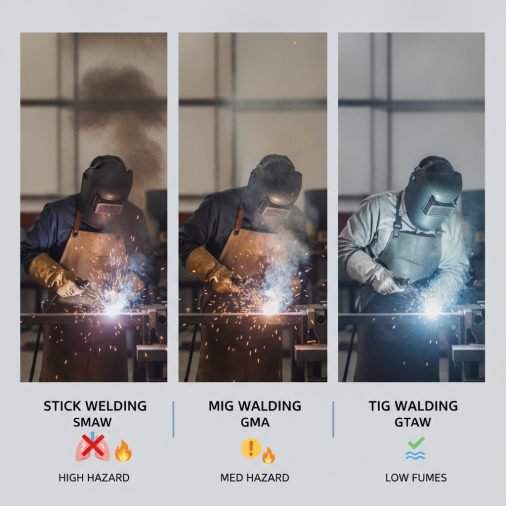
| Welding Process | Fume Generation | UV Radiation | Spatter Risk | Overall Health Risk |
|---|---|---|---|---|
| MIG (GMAW) — Mild Steel | Moderate | High | Moderate | Moderate |
| MIG (GMAW) — Stainless Steel | High (Cr VI) | High | Moderate | High |
| Flux-Core (FCAW) | High | High | High | High |
| TIG (GTAW) | Low | Very High | Very Low | Low–Moderate |
| Stick (SMAW) | High | High | High | High |
| Oxy-Acetylene | Low–Moderate | Moderate | Low | Low–Moderate |
Standard MIG welding on mild steel sits in the moderate risk category. The risk jumps significantly when welding stainless steel, coated metals, or switching to flux-core wire — all common in real-world shop and fabrication work.
The Materials That Make MIG Welding More Dangerous
The base metal and wire type you’re working with dramatically affect fume toxicity. Most welders understand that welding is hazardous in a general sense, but fewer appreciate how much the specific material changes the risk profile.
Galvanized steel is one of the most hazardous common materials. The zinc coating vaporizes readily and produces dense zinc oxide fumes. Many hobbyists weld galvanized steel without realizing what it is — the shiny, slightly crystalline surface is the giveaway.
Stainless steel generates hexavalent chromium and nickel compounds, both confirmed carcinogens. Welding stainless without local exhaust ventilation (LEV) is genuinely high-risk work, and OSHA’s permissible exposure limit (PEL) for Cr VI is just 5 micrograms per cubic meter of air as an 8-hour time-weighted average.
Painted or coated metals can release lead, cadmium, or other toxic compounds depending on the coating type. Grinding or burning through old paint before welding is strongly recommended.
Aluminum produces ozone at higher concentrations than steel welding, which irritates the respiratory tract and can cause pulmonary edema at high exposures.
Practical Protection: What Actually Works
The hierarchy of controls used in occupational health — elimination, substitution, engineering controls, administrative controls, PPE — applies directly to welding safety.
Ventilation: Your First Line of Defense
General shop ventilation is not enough for welding. You need one of the following:
– Local exhaust ventilation (LEV) — a fume extraction arm or hood positioned within 12 inches of the arc. This is the most effective engineering control and should be the standard for any regular welding work.
– On-torch fume extraction — integrated into the MIG gun itself; effective but can slightly affect shielding gas coverage if not set up correctly.
– General dilution ventilation — large fans moving air through the space. Acceptable as a supplement but not as a primary control for stainless or coated metals.
Working outdoors helps significantly, but wind direction matters. Position yourself so the fume plume moves away from your breathing zone, not toward it.
Respiratory Protection
When ventilation alone isn’t sufficient — which includes most enclosed spaces and all stainless/galvanized work — respiratory protection is essential.
– P100 half-face respirator — effective for particulate fumes from mild steel welding
– OV/P100 combination cartridge respirator — needed when welding coated metals or materials that produce gas-phase hazards
– Powered air-purifying respirator (PAPR) — preferred for extended stainless steel welding or high-production environments
A standard dust mask (N95) is not adequate for welding fumes. The particle size is too small and the concentration too high.
Eye and Skin Protection
– Use an auto-darkening helmet with a minimum shade 10 lens for MIG welding; shade 11–12 for higher amperage work.
– Wear leather welding gloves and a welding jacket or sleeves — not just for burn protection, but to limit UV skin exposure.
– Keep bystanders at least 10 feet away or behind welding screens.
Signs Your Current Setup Isn’t Protecting You
Most welders don’t realize their protection is inadequate until symptoms appear. Watch for:
– Persistent cough or throat irritation after welding sessions
– Headaches that develop during or after welding
– Flu-like symptoms 6–12 hours after welding galvanized material
– Eye irritation or redness after sessions
– Unusual fatigue that doesn’t resolve with rest
Any of these symptoms warrants a review of your ventilation and PPE setup before your next session — not after.
FAQ
Can MIG welding cause cancer?
Yes, certain MIG welding scenarios carry a documented cancer risk. Welding stainless steel produces hexavalent chromium and nickel compounds, both classified as human carcinogens. The International Agency for Research on Cancer (IARC) classifies welding fumes overall as a Group 1 carcinogen. Risk is highest with chronic, unprotected exposure — particularly in enclosed spaces without adequate local exhaust ventilation.
Is occasional hobby MIG welding dangerous?
Occasional welding on mild steel with reasonable ventilation carries relatively low risk. The concern with hobby welding is that many people work in garages or small sheds with poor airflow and no fume extraction. Even infrequent exposure to galvanized steel or stainless without protection can cause acute symptoms. Establishing good habits early — ventilation, respirator, proper PPE — matters regardless of how often you weld.
How long does it take for welding fumes to affect your health?
Acute effects like metal fume fever or arc eye can occur within hours of a single exposure. Chronic conditions like pulmonary fibrosis, COPD, or manganism typically develop after years of repeated exposure. The insidious nature of long-term fume exposure is that lung function can decline significantly before symptoms become obvious, which is why baseline and periodic lung function testing is recommended for regular welders.
Does welding outside eliminate the health risk?
Welding outdoors significantly reduces fume concentration compared to enclosed spaces, but it doesn’t eliminate risk. Wind direction is critical — if the fume plume drifts toward your face, outdoor welding can still result in meaningful exposure. Positioning yourself upwind of the arc and using a respirator when working with hazardous materials remains good practice even outdoors.
What is the safest metal to MIG weld from a health perspective?
Plain low-carbon (mild) steel is the least hazardous common MIG welding material. It produces primarily iron oxide fumes, which are less acutely toxic than chromium or zinc compounds. That said, “least hazardous” doesn’t mean risk-free — adequate ventilation and respiratory protection still apply, particularly for extended work sessions.
Is flux-core MIG welding more dangerous than standard MIG?
Generally, yes. Flux-core arc welding (FCAW) produces significantly more fume than solid wire GMAW because the flux itself burns and generates additional compounds. Spatter is also higher, increasing burn risk. If you’re working in a well-ventilated space and need the penetration or outdoor capability that flux-core offers, the process is manageable — but it warrants more careful attention to fume control than solid wire MIG.
Can a standard N95 mask protect you while MIG welding?
No. An N95 respirator filters particles down to 0.3 microns at 95% efficiency, but welding fumes contain particles significantly smaller than that, and the fit of a standard N95 is not designed for the heat and physical demands of welding. A P100 half-face respirator with a proper face seal provides substantially better protection for welding fume particulates.
Final Thoughts
MIG welding is a manageable health risk — not an unavoidable one. The welders who develop serious long-term health problems are typically those who spent years working without adequate ventilation, dismissed early warning signs, or didn’t realize that the material they were welding (stainless, galvanized, coated) required a higher level of protection than mild steel. Invest in a fume extraction arm, use the right respirator for the material, and treat any acute symptoms as a signal to improve your setup. Your lungs don’t regenerate — protecting them from the start is far easier than managing the consequences later.


