Undercut is one of the most frustrating defects you’ll encounter in MIG welding. It shows up as a groove or notch along the toe of the weld bead — and what makes it problematic is that it looks almost like a finished weld at first glance.
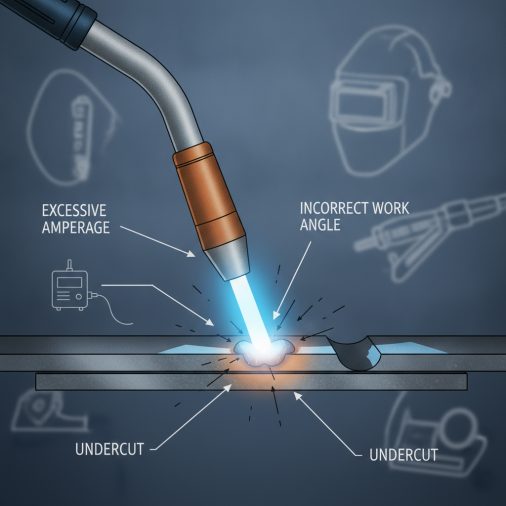
MIG weld undercut is a groove melted into the base metal along the weld toe that doesn’t get filled by the weld metal. It reduces the effective cross-section of the parent material, creating a stress concentration point that can lead to cracking or joint failure under load. The most common causes are excessive voltage, too-fast travel speed, incorrect gun angle, and poor weaving technique.
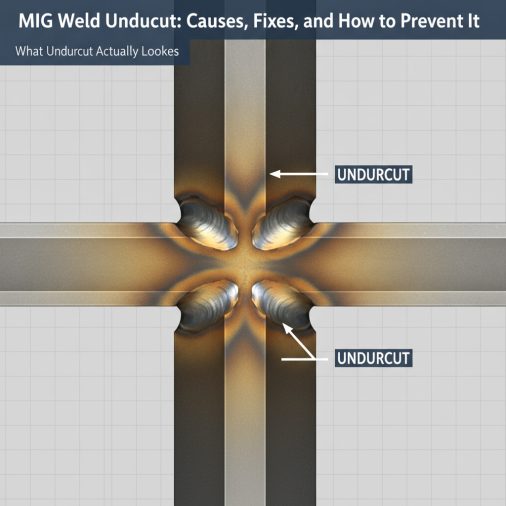
What Undercut Actually Looks Like
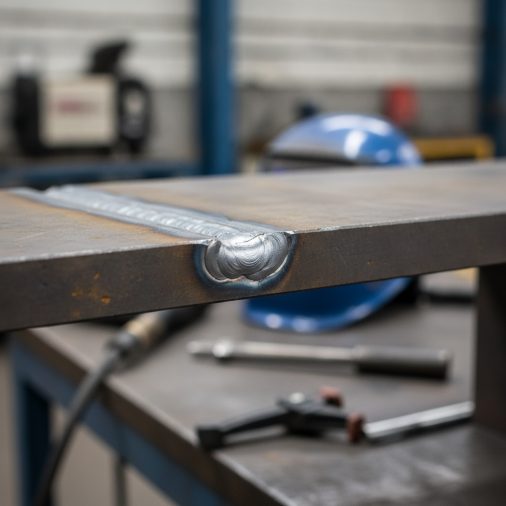
Undercut appears as a narrow channel or depression running parallel to the weld bead, right at the point where the weld meets the base metal. It can be shallow and barely visible, or deep enough to catch your fingernail when you run it across the joint.
Severity matters. A shallow undercut of less than 0.5 mm on a non-critical weld is sometimes acceptable per AWS D1.1 structural welding code, but anything deeper — especially on structural or pressure-bearing components — is a reject condition.
In practice, undercut is often more common on vertical welds or overhead passes where gravity pulls the molten puddle away from the fusion zone. If you’re learning how to weld vertical MIG, undercut is one of the first problems you’ll need to manage.
Why Undercut Happens: The Real Causes
Undercut doesn’t appear randomly. It has specific mechanical causes, and understanding them makes it much easier to fix.
Voltage too high
Excessive arc voltage creates a wide, flat puddle with too much heat at the edges. The arc erodes the base metal faster than the weld pool can fill it back in. This is the single most common cause of undercut in MIG welding.
Travel speed too fast
When you move the gun too quickly, the weld bead is narrow and doesn’t deposit enough filler to fill the edges of the melted zone. You get fusion, but not fill.
Incorrect gun angle
If the gun is angled too steeply toward the workpiece or too far to one side, the arc force pushes molten metal away from the toe rather than fusing it properly. Even a few degrees off can make a visible difference.
Excessive weaving width
Wide weave patterns can over-heat the edges of the joint without enough dwell time to let the puddle fill the groove. This is especially common when welders try to fill a wide gap by weaving aggressively.
Electrode stickout too long
A longer stickout increases resistance in the circuit, which changes how the arc behaves. It can lead to erratic arc characteristics and uneven heat distribution — both contributing to edge erosion.
Voltage, Wire Feed, and Travel Speed: Getting the Balance Right
These three variables work together. Changing one affects the others, and undercut often results from an imbalance between them.
Parameter
Too High
Too Low
Voltage
Wide bead, undercut at toes
Narrow bead, poor fusion
Wire Feed Speed
Spatter, burn-through risk
Weak bead, underfill
Travel Speed
Undercut, narrow bead
Wide bead, burn-through
The sweet spot for most mild steel MIG work sits around 17–22V depending on material thickness, with wire feed speed adjusted to match. If you’re seeing undercut, the first adjustment is usually reducing voltage by 0.5–1V increments while also slowing your travel speed slightly.
Understanding how much heat a MIG weld generates helps explain why voltage has such a dramatic effect on bead shape and edge erosion.
Gun Angle and Its Effect on Undercut
Most welders focus on voltage and speed when troubleshooting undercut, but gun angle is just as influential.
For a flat or horizontal fillet weld, a 10–15 degree travel angle (push or drag) and a 45-degree work angle for T-joints is the standard starting point. Tilting the gun too far toward one plate focuses the arc on that plate’s edge, melting more base metal than the puddle can refill.
There’s also a difference between push and pull technique. Pushing versus pulling the MIG gun changes where heat concentrates and how the bead profile forms — pulling (dragging) generally produces a slightly flatter, wider bead that can help reduce toe undercut in some positions.
How to Fix Undercut After It’s Already There
If undercut is minor and within acceptable tolerances for the application, it may not require repair. For anything structural or critical, you’ll need to address it properly.
Option 1: Run a repair pass
For shallow undercut, a light stringer bead along the toe — with lower voltage and slower travel — can fill the groove without significantly changing the weld profile. Use slightly reduced amperage and focus the arc directly into the undercut channel.
Option 2: Grind and re-weld
For deeper undercut or cases where weld quality is critical, grind back the affected area and reweld from scratch. This is the cleanest approach for structural work.
Option 3: Blend grinding
On cosmetic welds where structural integrity isn’t the concern, a flap disc can blend shallow undercut into the surrounding base metal. This removes the stress riser but removes base material, so it’s only suitable for non-structural applications.
Knowing what a good MIG weld should look like gives you a reliable reference point when evaluating whether a repair is necessary.
Positions and Materials That Increase Undercut Risk
Undercut risk isn’t uniform across all welding situations. Certain combinations of position, material, and joint type create conditions where it’s more likely.
– Vertical and overhead positions — Gravity pulls the puddle, making it harder to maintain consistent fusion at the toes
– Thin sheet metal — Higher sensitivity to voltage; even a small increase causes edge melt-back
– Wide V-groove joints — Requires careful weaving technique to avoid burning the groove walls
– Aluminum — Higher thermal conductivity and lower melting point make undercut more likely at the start of a pass
For thin material specifically, MIG welding sheet metal requires tight control over heat input, and undercut is one of the more common complaints from welders working below 3 mm.
Practical Prevention Checklist
Most undercut problems are preventable with consistent technique and correct machine setup. Before you start a weld:
– Set voltage at the lower end of the recommended range for your material thickness
– Match wire feed speed to voltage — don’t run high voltage with low wire speed
– Check stickout length: 6–10 mm is standard for short-circuit MIG on mild steel
– Confirm gun angle is correct for the joint type and position
– Keep travel speed consistent — uneven speed is a major cause of intermittent undercut
– If weaving, dwell slightly at each toe before moving back across
A welder like the Lincoln Electric Weld-Pak 140 has clear voltage settings that make incremental adjustments straightforward — useful when you’re dialing in a new material thickness and undercut keeps appearing at a specific setting.
Undercut vs. Overlap: Knowing the Difference
These two defects are sometimes confused because they both occur at the weld toe, but they’re opposite problems.
Defect
Appearance
Root Cause
Undercut
Groove or depression at the weld toe
Too much heat, fast travel, wrong angle
Overlap
Weld metal rolls over base metal without fusing
Too slow travel, low voltage, excess filler
Undercut removes material. Overlap adds material without proper fusion. Both create stress concentration points, but they require different corrective actions.
Overlap is more common when travel speed is too slow or heat input too low — the opposite conditions from undercut. Common MIG welding mistakes like these often appear together when machine settings are significantly off from the correct parameters.
FAQ
What is the acceptable level of undercut in MIG welding?
AWS D1.1 allows undercut up to 1/32 inch (approximately 0.8 mm) for most structural applications, provided it doesn’t exceed 10% of the base metal thickness. For pressure vessels, pipe work, or code-critical welds, undercut is typically a zero-tolerance defect. Always check the applicable welding code for your specific application before accepting any undercut.
Can undercut cause a weld to fail?
Yes. Undercut acts as a stress riser — a geometric discontinuity where stress concentrates under load. In dynamic or cyclic loading conditions, undercut is a crack initiation site. In static loading, deep undercut reduces the effective throat of the weld and lowers its load-bearing capacity. On structural components, even moderate undercut significantly increases fatigue failure risk.
Why does undercut happen more on the top side of a horizontal fillet weld?
In a horizontal fillet weld, the arc naturally melts more of the upper vertical plate due to gravity pulling the molten pool toward the lower plate. If gun angle doesn’t compensate by directing slightly more heat toward the bottom plate, the upper toe consistently sees more arc erosion than can be refilled. Adjusting the work angle 5–10 degrees toward the upper plate usually resolves this.
Does shielding gas affect undercut?
Shielding gas composition influences arc characteristics and bead profile. C25 (75% argon / 25% CO₂) produces a stable arc and good bead wetting, which helps minimize toe undercut compared to 100% CO₂, which creates a more aggressive, spatter-prone arc. Higher argon mixes generally produce cleaner bead profiles with less tendency for edge erosion on mild steel applications.
How do I fix undercut on stainless steel MIG welds?
Repairing undercut on stainless steel follows the same principle as mild steel — a light fill pass or grinding and rewelding — but you need to be more careful about heat input to avoid sensitization (chromium carbide precipitation at grain boundaries). Keep interpass temperatures below 150°C and use the correct filler wire for your grade. Stainless steel MIG welding requires tighter heat control throughout the entire process.
Why does undercut appear only at the start of a weld pass?
At the start of a pass, the base metal is still cold and the arc initially runs hotter relative to the available heat sink. This brief thermal mismatch can cause slight edge erosion before the weld zone reaches thermal equilibrium. Starting on a run-on tab, or using a lower wire feed speed at the initiation point, typically eliminates this.
Is undercut more common with flux-core wire than solid wire MIG?
Flux-core wire generally runs at higher voltages and produces more heat than short-circuit MIG with solid wire. This higher heat input increases the tendency for undercut, especially at higher amperage settings. Technique adjustments — particularly travel speed and gun angle — become more critical with flux-core. The Hobart Handler 140 is a good example of a machine that allows you to run both wire types, making it easier to compare how each affects bead geometry on the same material.
Undercut is a mechanical problem with mechanical solutions. Get the voltage under control, maintain consistent travel speed, and pay attention to gun angle — those three adjustments resolve the vast majority of undercut issues. On critical welds, always inspect the toes closely before calling a pass acceptable, since shallow undercut is easy to miss visually until you run your finger along the bead.