
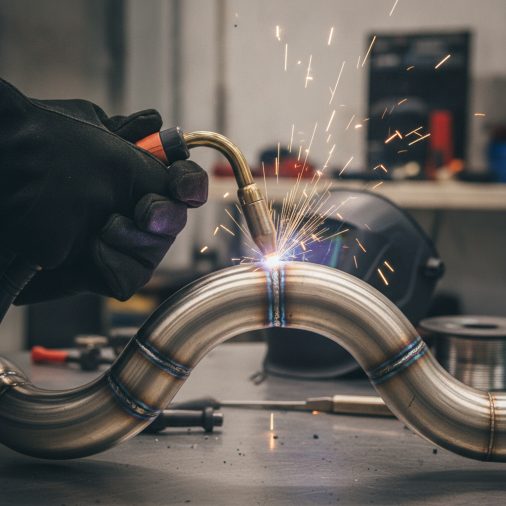
Why MIG Welding Is a Realistic Option for Exhaust Work
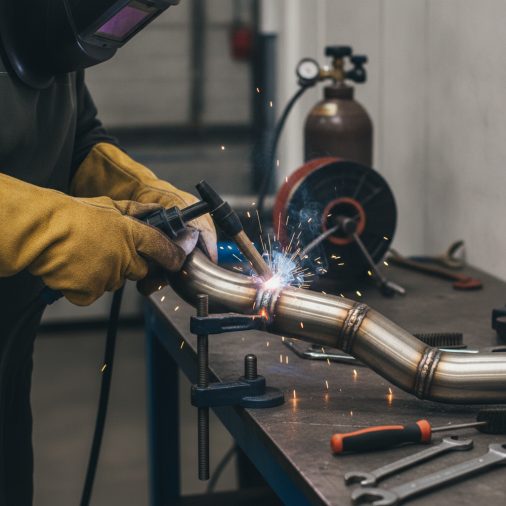
What Exhaust Pipe Is Actually Made Of
| Material | Common Location | MIG Weldable? | Notes |
|---|---|---|---|
| Mild steel | Budget OEM systems, manifolds | Yes | Easiest to MIG weld |
| Aluminized steel | Most factory exhausts | Yes | Remove coating before welding |
| 409 stainless | Mid-grade OEM systems | Yes, with correct wire | Needs ER309L wire |
| 304 stainless | Performance systems | Yes, with correct setup | Best done with tri-mix gas |
| Galvanized steel | Occasionally found on older vehicles | Avoid or grind first | Toxic zinc fumes when welded |
Wire and Gas Selection for Exhaust MIG Welding
Getting this combination right separates a lasting weld from one that cracks after a few heat cycles. For mild steel and aluminized steel: – Wire: ER70S-6 (0.023″ or 0.025″ diameter for thin pipe) – Gas: 75% Argon / 25% CO₂ (C25) — the standard mix for clean welds on thin material – ER70S-6 produces a fluid puddle and handles minor surface contamination better than ER70S-3 For 409 or 304 stainless exhaust: – Wire: ER309L for dissimilar or mixed-material joints; ER308L for same-material 304 stainless – Gas: Tri-mix (90% Helium / 7.5% Argon / 2.5% CO₂) or 98% Argon / 2% CO₂ – Using regular ER70S-6 wire on stainless will result in a structurally weak, corrosion-prone weld If you’re unsure whether your system is mild steel or stainless, hold a magnet to it. Mild steel and 409 stainless are magnetic. 304 stainless is not, or only weakly so. That simple test narrows it down quickly. You can also read more about welding stainless with a MIG welder if your system uses stainless tubing.Setting Up Your Welder for Thin Exhaust Tubing
Exhaust pipe wall thickness is unforgiving. Too much heat burns through; too little leaves a cold, porous weld. For most passenger car exhaust tubing in the 16–18 gauge range: – Voltage: Start low — typically 13–16V depending on your machine – Wire speed: Adjust until the arc sounds like a steady fry (not a pop or a stutter) – Travel speed: Move consistently; pausing even briefly on thin pipe causes burn-through – Technique: Use short stitch welds or tack-and-skip sequences rather than one continuous bead Dialing in the right MIG settings for exhaust pipe takes a few test passes on scrap tubing of the same gauge. Never go straight to the actual repair without testing first. The Lincoln Electric Weld-Pak 140 HD and the Hobart Handler 140 are two machines that are commonly used for this kind of work. Both handle the lower voltage ranges needed for thin exhaust tubing without struggling, and they give you enough wire speed control to dial things in precisely.Preparing the Pipe Before Welding
Preparation matters more on exhaust work than almost any other welding job. The pipes live under the vehicle where they collect oil, road salt, and rust for years. Steps before striking an arc: 1. Clean the weld area with a wire brush or angle grinder to remove rust, scale, and surface contamination 2. Degrease thoroughly with acetone or brake cleaner — oil and grease cause porosity 3. If the pipe is aluminized, grind away the aluminum coating in the weld zone; welding over it creates a contaminated bead 4. If sections overlap (slip joint), make sure the fit is tight with minimal gap 5. Check that the pipe is dry — moisture causes porosity and poor fusion Skipping prep is the single most common reason DIY exhaust welds fail quickly. Even a good weld on a dirty pipe traps contaminants and develops porosity that you won’t see until the bead cracks under thermal stress.Common Problems and How to Avoid Them
Burn-through on thin pipe This is the most frequent issue. The fix is lower voltage, faster travel speed, and using the smallest wire diameter suitable for your machine — 0.023″ wire gives you more control on thin gauge than 0.030″. Porosity (holes in the weld bead) Almost always caused by contamination or inadequate shielding gas coverage. Check for gas leaks in your hose, increase flow rate slightly (15–20 CFH is typical), and ensure you’ve cleaned the base metal properly. Cracking after heat cycles This usually points to the wrong filler wire for the base metal — particularly if you’ve used mild steel wire on a stainless system — or a weld that was completed too quickly without allowing stress relief. On stainless exhausts, use the correct ER309L wire and avoid quenching the weld with water. Weld doesn’t hold at the joint Often caused by poor fit-up. Exhaust pipe gaps wider than the wire diameter are difficult to bridge cleanly on thin material. Use a slip coupler or band clamp to close the gap before welding.When MIG Welding Isn’t the Right Choice
MIG welding is not ideal for every exhaust situation. – Performance headers made from thin stainless — Wall thickness can drop to 18 or even 20 gauge. TIG welding gives you better heat control at these extremes. – Cast iron manifolds — Cast iron requires preheating, specific filler, and controlled cooling. welding cast iron with a MIG welder is possible but carries real cracking risk without careful technique. – Severely rusted pipe — If the surrounding metal is pitted and paper-thin from corrosion, no welding process will save it. Section replacement is the correct repair. – Catalytic converter housings — These contain ceramic internals and are typically not weld-repaired; replacement is standard practice. Knowing when to weld and when to replace saves you from chasing a repair that won’t last.Exhaust Welding Safety Considerations
Working under a vehicle with a welder introduces a few hazards worth taking seriously. – Fumes: Exhaust residue burns off during welding and produces harmful fumes. Work outdoors or with strong ventilation. – Fire risk: Make sure the exhaust system has cooled completely before welding. Hot exhaust components near fuel lines or undercoating are a genuine fire risk. – Galvanized material: If you suspect the pipe is galvanized, grind the coating away completely before welding. Zinc oxide fumes from galvanized steel are toxic. MIG welding galvanized steel requires strict ventilation protocols. – Lift safety: Never work under a vehicle supported only by a floor jack. Use proper jack stands rated for the vehicle weight.FAQ
Can you MIG weld exhaust pipe without gas? Technically, you can use flux-core wire without shielding gas, and it will produce a weld. However, flux-core generates more spatter and a rougher bead, which is harder to seal cleanly on thin exhaust tubing. For exhaust work, solid wire with shielding gas produces a cleaner, more reliable result. Flux-core is better reserved for thicker structural steel where a little spatter doesn’t matter. What wire size should I use for exhaust pipe? For most passenger car exhaust pipe in the 16–18 gauge range, 0.023″ ER70S-6 wire is the best choice. It gives you more precise heat control on thin material compared to 0.030″ wire. If your machine doesn’t support 0.023″, 0.025″ is a reasonable alternative. Avoid 0.035″ wire on anything thinner than 14 gauge exhaust tubing. Can you MIG weld exhaust pipe while it’s still on the car? Yes, it’s done regularly. Make sure the system has cooled completely, disconnect the vehicle’s battery to protect electronics, keep the welder’s ground clamp as close to the weld area as possible, and protect nearby fuel lines, wiring, and rubber components from spatter and heat. Working on the car adds awkward positioning, so having a second person spot for fire hazards is smart. Is a MIG weld on exhaust pipe strong enough to last? A properly prepared and correctly executed MIG weld on exhaust pipe is durable. Exhaust welds don’t carry structural load — they mainly need to seal and survive thermal cycling. With correct prep, appropriate filler wire, and good fusion, a MIG weld on mild steel or aluminized exhaust tubing can last as long as the surrounding pipe material. The weld rarely fails before the surrounding rusty pipe does. Do you need to back-purge stainless exhaust pipe when MIG welding? Back-purging (flooding the inside of the pipe with argon during welding) is standard practice in TIG welding stainless. With MIG welding, it’s less commonly done on exhaust repairs, but it does produce a cleaner inside bead with less oxidation. For performance or show applications where inside bead quality matters, back-purging is worth the effort. For a functional daily-driver repair, most fabricators skip it and accept the interior oxidation. Can you use a flux-core welder for exhaust pipe? A flux-core welder can weld exhaust pipe, but it’s more difficult to control on thin-wall tubing. The higher heat input and spatter make clean, tight welds harder to achieve. If gas-shielded MIG is available, it’s the better tool for this application. Flux-core is more practical when you’re working outdoors in wind where shielding gas gets blown away. What’s the best way to weld a cracked exhaust manifold? Cast iron exhaust manifolds are a different challenge entirely. MIG welding a cast iron manifold without proper preheating (typically 500°F or higher) and controlled post-weld cooling risks further cracking. Nickel-based filler is preferred over standard steel wire. Most technicians either braze the crack, use a cast iron-specific stick electrode, or replace the manifold. MIG is generally not the first choice for cast iron manifold repair.MIG welding exhaust pipe is well within reach for a prepared DIYer. The keys are knowing your material, choosing the right wire and gas, getting the heat settings dialed in on scrap first, and putting real effort into prep work. A clean surface and a controlled arc beat an expensive welder on a dirty pipe every time. If you want a complete walkthrough of the process from start to finish, the practical guide to MIG welding exhaust pipe covers each step in detail.


