If you’re a hobbyist or light fabricator looking for a capable step-up MIG welder, the R-Tech MIG 180 comes up regularly in UK welding communities. But does it actually deliver clean welds, reliable performance, and long-term value?
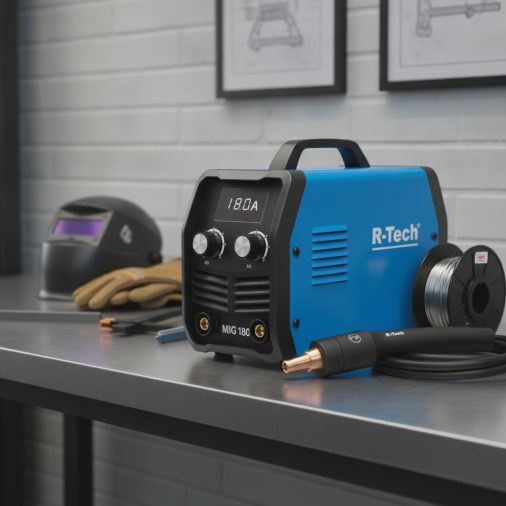
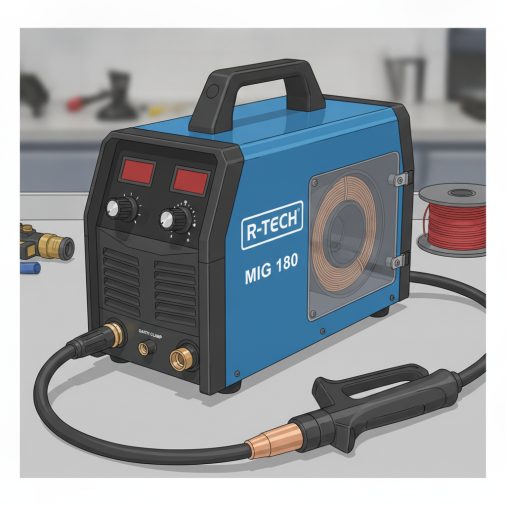
The R-Tech MIG 180 is a well-regarded 180-amp single-phase MIG welder made by UK manufacturer R-Tech Welding. It runs on a standard 230V supply, handles mild steel up to around 6mm, and uses inverter technology for a stable arc. It’s not a budget machine — but for serious hobbyists, farmers, and small workshops wanting a reliable everyday welder, it earns its price tag through build quality and genuinely useful UK-based support.
What Is the R-Tech MIG 180?
R-Tech Welding is a UK-based manufacturer that builds and sells inverter welding machines directly to customers. Unlike many welders in this price range that are rebranded imports, R-Tech designs and supports their machines in-house, which matters a lot when something goes wrong.
The MIG 180 sits in their mid-range lineup, positioned between their entry-level MIG 150 and the more powerful MIG 200. It targets the serious hobbyist, small fabrication shop, or farm workshop that needs more than a basic machine without moving into industrial territory.
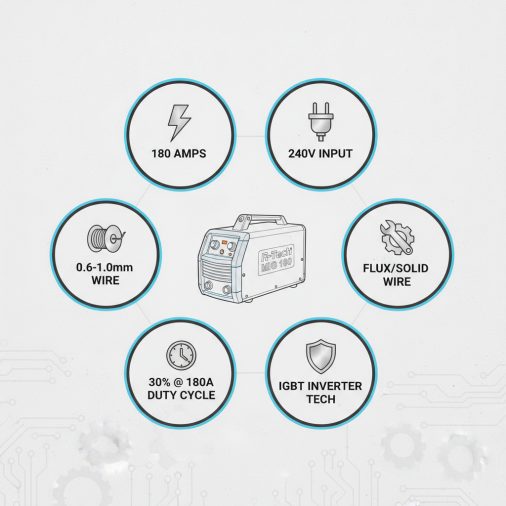
Key Specifications at a Glance
Specification
Detail
Input Voltage
230V single-phase
Amperage Range
30A – 180A
Duty Cycle
60% @ 130A / 35% @ 180A
Wire Diameter
0.6mm – 0.9mm
Max Mild Steel Thickness
~6mm (single pass)
Spool Size
5kg (standard)
Shielding Gas
CO₂ / Argon mix
Processes
MIG, Flux-Core (gasless)
Weight
Approximately 9.5kg
Warranty
3 years (UK)
The duty cycle at 180A is 35%, which means at full power you get about 3.5 minutes of arc time in every 10-minute window. For most hobby and light fabrication work, this is rarely a limiting factor.
Arc Quality and Weld Performance
This is where the MIG 180 stands apart from similarly priced competitors. The inverter-based power supply delivers a noticeably smooth, stable arc — even at lower amperages where cheaper machines tend to sputter.
On thin 1.5mm sheet steel, the machine behaves predictably with fine voltage control. On thicker 4–5mm plate, it drives penetration well without excessive spatter. The wire feed mechanism is consistent, with minimal birdnesting when using quality wire.
In practice, users with experience on older transformer-based machines often describe the arc feel as a significant improvement — quieter, tighter, and more forgiving of minor torch angle variations.
Voltage and Wire Speed Controls
The MIG 180 uses stepless (continuously variable) voltage and wire speed controls rather than stepped settings. This gives you much finer tuning compared to machines with 4–6 preset voltage taps.
That flexibility is genuinely useful when you’re moving between material thicknesses or different wire diameters. Dialing in the sweet spot feels intuitive, and the response is immediate. If you’re still getting comfortable with MIG welder settings for different materials, the stepless controls make small corrections easier without jumping between fixed steps.
The front panel is straightforward — two main dials, a clear display, and torch connection on the Euro fitting. Nothing overcomplicated.
Gasless / Flux-Core Capability
The MIG 180 runs flux-core wire with simple polarity reversal (DCEN instead of DCEP), which is standard for gasless operation. This is useful for outdoor work where wind would disrupt shielding gas coverage.
Weld quality in gasless mode is acceptable for structural work but not as clean as gas-shielded runs. Slag removal is straightforward, and the arc behaviour remains stable with 0.9mm flux-core wire. If you’re regularly welding outside or in breezy conditions, this dual capability adds real flexibility.
Build Quality and Construction
At roughly 9.5kg, the MIG 180 is compact and portable without feeling cheap. The casing is solid, the torch connector is a standard Euro torch fitting, and the internal components are accessible if you ever need servicing.
The torch supplied with the unit is decent quality — not the flimsy generic type often bundled with budget machines. The earth clamp is robust and maintains solid contact without the spring weakening quickly.
One thing worth noting: R-Tech manufactures and tests machines in the UK, which means quality control is tighter than you’d typically expect at this price point from a direct-import brand.
R-Tech MIG 180 vs. Comparable Machines
For buyers comparing options in this category, here’s how the MIG 180 stacks up against two well-known alternatives:
Feature
R-Tech MIG 180
SIP Migmate 180
Lincoln Electric Weld-Pak 180HD
Technology
Inverter
Transformer
Transformer
Voltage Control
Stepless
Stepped
Stepped
Duty Cycle @ Max
35% @ 180A
~30% @ 180A
~30% @ 180A
Warranty
3 years
1–2 years
1 year
UK Support
Direct manufacturer
Distributor network
Distributor network
Weight
~9.5kg
~22kg
~35kg
The R-Tech’s inverter technology and direct manufacturer support give it real advantages, particularly in portability and longevity of support. The Lincoln Electric Weld-Pak 180HD is a proven workhorse, but the older transformer design makes it considerably heavier and less energy-efficient.
Who Should Buy the R-Tech MIG 180?
The machine suits a specific buyer profile well:
– Serious hobbyists who weld regularly and want a reliable, long-lasting machine
– Farmers and rural workshops handling general steel repairs up to 6mm
– Small fabrication shops doing light structural work or automotive repairs
– Buyers who value after-sales support from a UK-based team
It’s probably more machine than a complete beginner needs, and less than a professional production welder would want. That sweet spot is exactly where it excels.
If you’re thinking about the broader range of materials this type of welder can handle, it’s worth understanding what you can realistically weld with a MIG welder before committing to a machine at this power level.
Common User Complaints and Honest Limitations
No machine is perfect. A few recurring points come up from long-term users:
– Fan noise — The cooling fan runs during welding and is audible, which some users in quiet workshop settings find noticeable.
– Duty cycle at max output — The 35% duty cycle at 180A is standard for this class, but anyone expecting to run long continuous passes at full power will hit the thermal cutout.
– Price — At the upper end of the hobbyist price range, it’s not a casual purchase. Cheaper alternatives exist, but they typically sacrifice build quality or support.
– No spool gun support — The MIG 180 doesn’t natively support a spool gun for aluminum. For aluminum MIG welding, you’d need a different setup entirely.
The thermal cutout protection is reliable and does its job without causing machine damage, but it does interrupt workflow if you’re consistently pushing near the top of the duty cycle.
Practical Tips for Getting the Best Results
A few things help dial in performance from day one:
1. Set gas flow between 10–15 L/min for standard Argon/CO₂ mix on mild steel.
2. Use 0.8mm wire for most general fabrication work — it’s the most versatile diameter for this machine’s range.
3. Clean base metal thoroughly — the inverter arc is stable, but contaminated metal still causes porosity.
4. Start slightly lower on voltage than you think you need and work up — the stepless control makes this quick.
5. Adjust drive roll tension carefully — too much pressure on the wire can cause deformation and feeding problems.
For reference on technique, understanding whether to push or pull your MIG torch has a direct effect on bead appearance and penetration with this machine.
FAQ
Is the R-Tech MIG 180 suitable for automotive bodywork?
Yes, with care. The stepless voltage control and stable low-amperage arc make it suitable for thin sheet metal repairs, but you’ll want 0.6mm wire and careful heat management to avoid warping. It handles light automotive fabrication well, though a dedicated auto-body specialist welder with more granular control may be preferred for very thin panels.
Can the R-Tech MIG 180 weld stainless steel?
Yes. With ER308L stainless wire and a tri-mix shielding gas (typically helium/argon/CO₂), the MIG 180 handles stainless reasonably well for light fabrication. Results on thicker stainless are adequate, though weld quality is more sensitive to gas selection and preparation. Welding stainless with a MIG welder requires attention to wire type and gas mix to avoid oxidation.
What is R-Tech’s warranty and support like in practice?
R-Tech offers a 3-year warranty and handles support directly rather than through a distributor chain. Users generally report responsive phone and email support, which is a significant real-world advantage over brands where warranty claims go through a third-party retailer.
How does the duty cycle affect everyday use?
For most hobby and repair work, the 60% duty cycle at 130A is what matters most in practice. At this setting, you get 6 minutes of arc time per 10-minute cycle — more than enough for typical weld runs. The 35% at 180A only becomes relevant on extended heavy runs, which most hobbyist and farm work rarely involves continuously.
Does the R-Tech MIG 180 need a dedicated circuit?
On a standard 230V UK supply, the MIG 180 draws around 20–25A at full output. Many domestic workshops run it from a 13A or 16A socket at moderate settings, but for consistent full-power use, a 32A circuit is more appropriate. Running it on an undersized circuit can cause nuisance tripping. Separately, check the guidance on using extension cords with MIG welders before running long cable runs.
How does the MIG 180 compare to the R-Tech MIG 200?
The MIG 200 adds roughly 20A of extra headroom, a higher duty cycle, and handles thicker material more comfortably in a single pass. For light to medium fabrication up to 6mm, the MIG 180 is sufficient. If you regularly work on 8mm+ steel or need sustained high-amperage output, the MIG 200 becomes the more practical choice.
Is the R-Tech MIG 180 a good first welder for someone moving up from a basic machine?
It’s an excellent step-up machine. Users transitioning from basic flux-core-only or import-brand MIG welders consistently report a noticeable improvement in arc stability, control, and build confidence. The stepless controls help develop proper technique without fighting the machine.
Final Thoughts
The R-Tech MIG 180 is a genuinely well-built inverter MIG welder that delivers consistent, predictable performance across a wide range of everyday steel fabrication tasks. The stepless controls, stable arc, and direct UK manufacturer support set it apart from machines at a similar price point. It won’t suit everyone’s budget or application, but for the buyer who welds regularly and wants a machine that will still be working reliably five years from now, it’s a strong choice worth the investment.