
How Each Process Actually Works
Speed and Productivity Differences
Weld Quality and Appearance
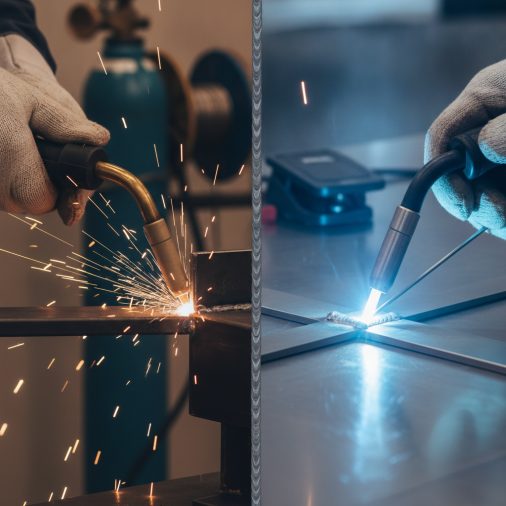
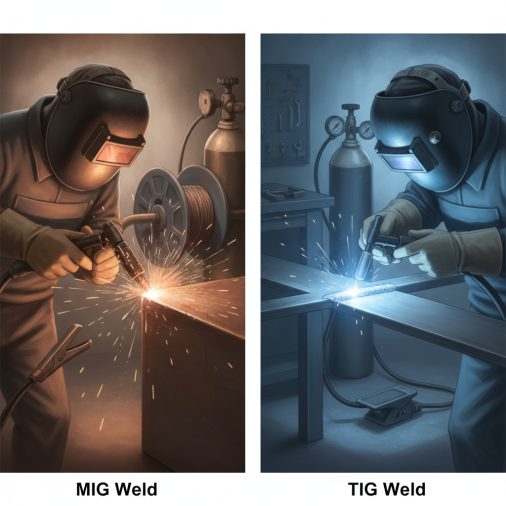
TIG consistently produces cleaner, narrower, and better-looking welds. Because the welder controls every variable manually — arc length, filler amount, heat input — the result is precise and repeatable when done well. TIG welds on stainless steel or aluminum often have that recognizable “stacked dimes” appearance that requires no grinding or cleanup. MIG welds are strong and functional, but typically rougher in appearance. Spatter is common, especially on lower-quality machines or with improper settings. For cosmetic work or welds that will remain visible, MIG often needs grinding or blending afterward. If you’ve ever looked at a polished stainless exhaust manifold or a custom motorcycle frame and wondered how those welds look so refined, that’s TIG work. Exhaust welding is a good example of where TIG and MIG each earn their place, depending on the material and finish requirements.Material Compatibility
Both processes handle mild steel and stainless steel well, but their strengths diverge on thinner or more reactive metals. MIG welding works well on: – Mild steel (typically 16 gauge and thicker) – Stainless steel with appropriate wire and gas – Aluminum with a spool gun or push-pull setup – Structural and heavy-gauge materials TIG welding handles: – Thin sheet metal and tubing without burn-through risk – Stainless steel with minimal heat distortion – Aluminum with AC current – Titanium, chromoly, copper, and other exotic alloys – Any material where contamination control matters Titanium is a useful example. It requires inert gas coverage not just at the arc but over the cooling weld metal — a level of control that TIG makes achievable where welding titanium with a MIG welder presents serious shielding challenges. For chromoly steel — common in roll cages and performance builds — both processes are usable, but many fabricators prefer TIG for the heat control it provides on thin-wall tubing. MIG welding chromoly is entirely viable when technique and wire selection are dialed in.Side-by-Side Comparison
| Factor | MIG Welding | TIG Welding |
|---|---|---|
| Learning curve | Moderate — beginner-friendly | Steep — requires coordination and practice |
| Speed | Fast | Slow |
| Weld appearance | Functional, often needs cleanup | Clean, precise, minimal cleanup |
| Material thickness | Best on 16 gauge and thicker | Excellent on thin gauge; handles thick too |
| Exotic metals | Limited | Titanium, chromoly, copper, nickel alloys |
| Equipment cost | Lower | Higher |
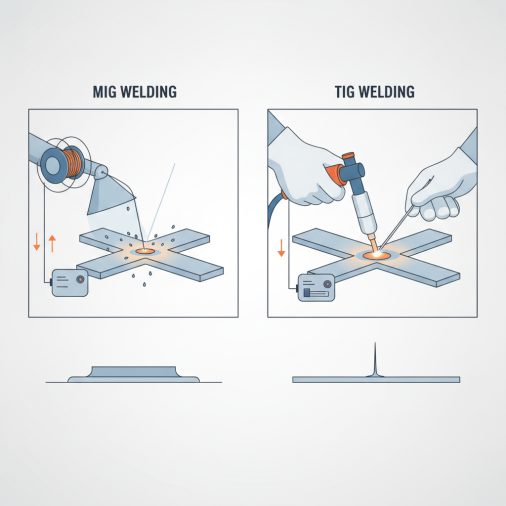
| Filler control | Automatic (wire feed) | Manual (separate rod) |
| Shielding gas | Required for standard MIG | Always required |
| Best applications | Structural, fabrication, repair | Aerospace, automotive finish, precision work |
Skill Level and Learning Curve
MIG welding is genuinely more accessible. Most beginners can produce functional welds within a few hours of practice. The machine handles wire speed and feeding; the welder focuses on travel speed, angle, and distance. Machines like the Lincoln Electric Weld-Pak 140 are designed specifically to make entry-level MIG welding forgiving and approachable. TIG welding requires independent coordination of both hands and a foot simultaneously. Arc length must stay consistent — typically around 1/8 inch — while filler rod additions need to be rhythmic and controlled. Most welders spend weeks or months before producing consistently clean TIG beads. That doesn’t mean beginners should avoid TIG. It means expectations need to be realistic about the practice time involved.Equipment and Operating Costs
MIG setups are generally less expensive to buy and run. Entry-level machines capable of real work are widely available. Consumables — wire, tips, nozzles — are inexpensive and easy to find. TIG machines cost more upfront, particularly machines with AC capability for aluminum. Tungsten electrodes last a long time but require sharpening and occasional replacement. Filler rods are purchased by the pound and are material-specific. Gas costs are comparable between processes. Both use argon-based shielding — typically pure argon for TIG, and a 75/25 argon-CO₂ mix for mild steel MIG work. Whether you need shielding gas for MIG welding depends on the wire type, but standard MIG on bare wire always requires it.Which One Should You Choose?
The answer depends on what you’re actually building or repairing. Choose MIG if you: – Work primarily with mild steel or standard structural materials – Need speed and efficiency – Are newer to welding and want faster results – Do repairs, fabrication, or general metalwork – Work on thicker stock where precise heat control is less critical Choose TIG if you: – Work with thin-wall tubing, exotic alloys, or cosmetic-grade stainless – Need precise heat input with minimal distortion – Want cleaner welds that require little or no post-weld grinding – Are willing to invest time developing technique – Work in aerospace, motorsports, or custom fabrication where appearance matters Some shops run both. MIG handles the structural passes and rough work; TIG finishes the visible joints or handles specialty materials. That’s not inefficiency — that’s using each process where it actually excels.FAQ
Is TIG welding stronger than MIG welding? Not inherently. Both processes produce welds that can match or exceed the base metal strength when done correctly. TIG’s advantage isn’t strength — it’s precision and cleanliness. A properly executed MIG weld on structural steel is every bit as strong as a TIG weld on the same joint. Can a beginner learn TIG welding before MIG? Technically yes, but it’s rarely recommended. TIG demands hand-eye-foot coordination that takes time to develop. Most instructors teach MIG first because it builds arc awareness and torch control without the added complexity of feeding a separate filler rod and managing a foot pedal simultaneously. What shielding gas is used for TIG welding? TIG welding almost always uses pure argon (100% Ar). For some stainless steel applications, small additions of helium or hydrogen may be used to increase heat input or improve weld appearance. Unlike MIG on mild steel, CO₂ is never used in TIG because it would contaminate the tungsten electrode. Can you MIG weld the same metals as TIG? For common metals like mild steel and stainless, yes. But TIG has a broader material range. Titanium, for example, is welded almost exclusively with TIG due to its contamination sensitivity. MIG welding titanium is technically possible in industrial settings but extremely difficult to execute correctly. Which process produces less spatter? TIG produces virtually no spatter because there’s no wire transfer across the arc — the filler rod is dipped directly into the weld pool. MIG spatter varies depending on transfer mode, gas mix, and machine settings, but it’s always present to some degree with short-circuit or globular transfer modes. Pulse MIG significantly reduces spatter but requires more capable equipment. Is MIG or TIG better for sheet metal? TIG generally handles thin sheet metal more forgiving because amperage can be reduced in real time with a foot pedal, preventing burn-through. Experienced MIG welders manage thin material well using tack sequences and short bursts, but the margin for error is smaller. For sheet metal under 18 gauge, TIG provides more control. MIG welding sheet metal successfully is possible with proper technique, just less forgiving. Which process is better for welding aluminum? Both can weld aluminum, but they use different setups. TIG on aluminum requires AC current to break the oxide layer. MIG on aluminum uses a spool gun or push-pull system with 100% argon gas and ER4043 or ER5356 wire. TIG gives better control on thin aluminum; MIG is faster on thicker sections. MIG welding aluminum works well when the right setup is used.MIG and TIG aren’t competitors — they’re complementary tools. MIG wins on speed, accessibility, and everyday structural work. TIG wins on precision, cleanliness, and material versatility. Knowing which situation calls for which process is the real skill, and that judgment comes from understanding what each one actually does well rather than treating one as universally superior.


